Bristol Medical School, University of Bristol, Bristol, UK.
Bristol Medical School, Bristol Trials Centre, University of Bristol, Bristol, UK.
BJU Int. 2022 Sep;130(3):370-380. doi: 10.1111/bju.15739. Epub 2022 May 3.
To investigate the functional and quality of life (QoL) outcomes of treatments for localised prostate cancer and inform treatment decision-making.
Men aged 50-69 years diagnosed with localised prostate cancer by prostate-specific antigen testing and biopsies at nine UK centres in the Prostate Testing for Cancer and Treatment (ProtecT) trial were randomised to, or chose one of, three treatments. Of 2565 participants, 1135 men received active monitoring (AM), 750 a radical prostatectomy (RP), 603 external-beam radiotherapy (EBRT) with concurrent androgen-deprivation therapy (ADT) and 77 low-dose-rate brachytherapy (BT, not a randomised treatment). Patient-reported outcome measures (PROMs) completed annually for 6 years were analysed by initial treatment and censored for subsequent treatments. Mixed effects models were adjusted for baseline characteristics using propensity scores.
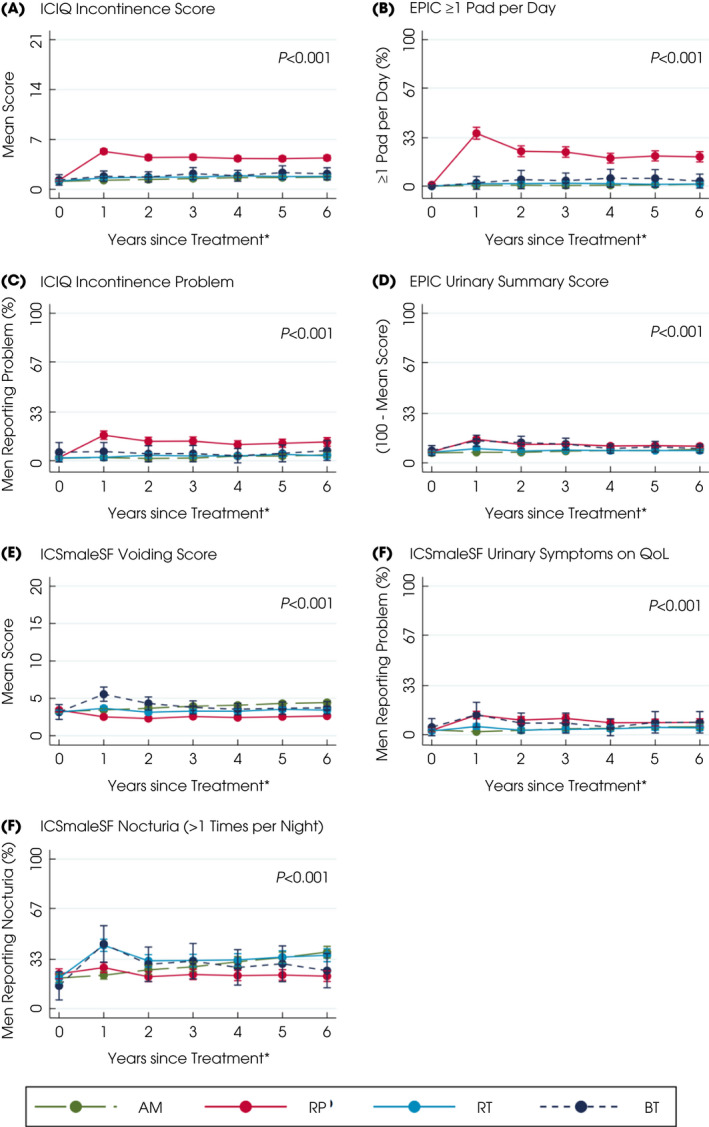
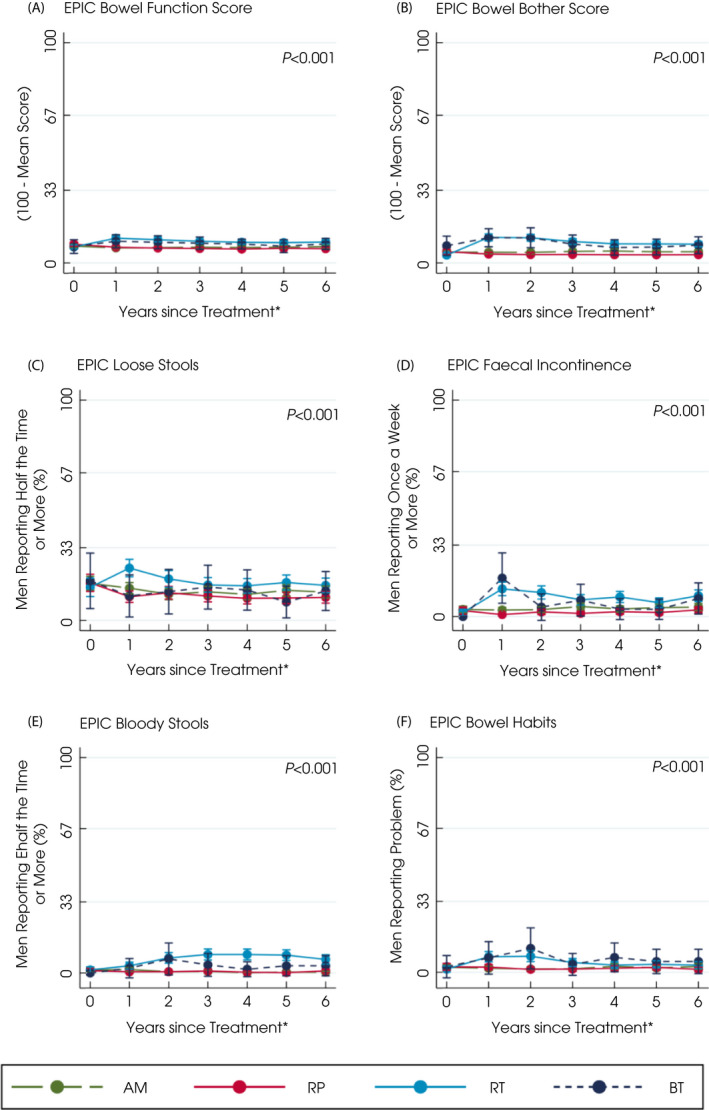
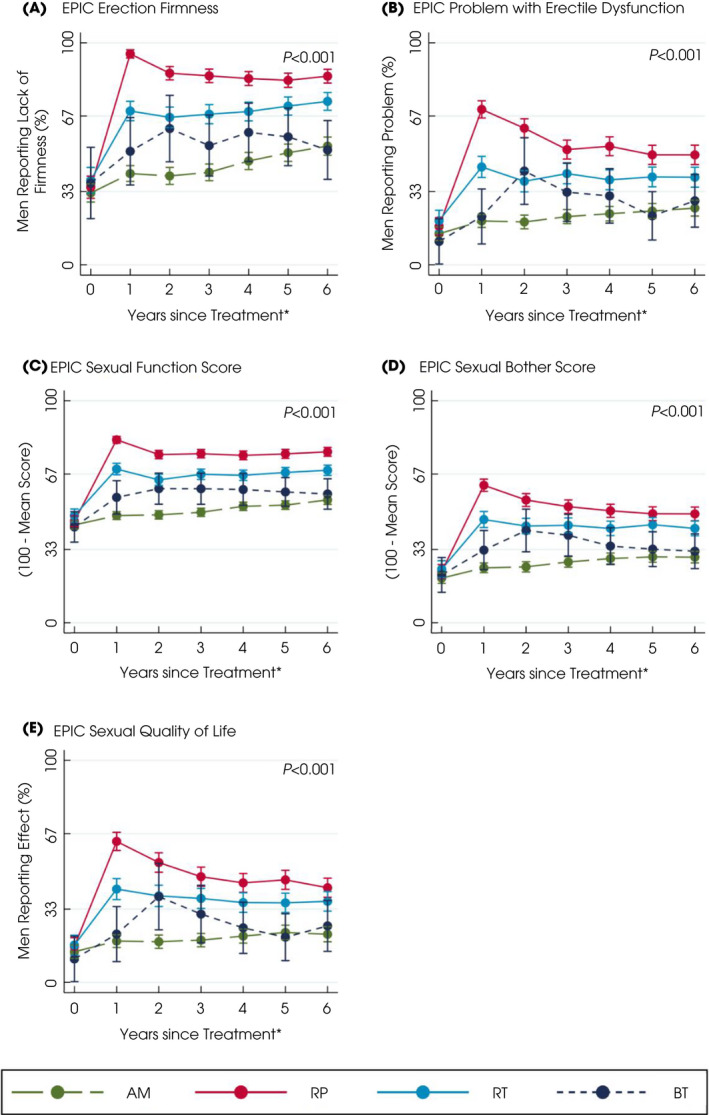
Treatment-received analyses revealed different impacts of treatments over 6 years. Men remaining on AM experienced gradual declines in sexual and urinary function with age (e.g., increases in erectile dysfunction from 35% of men at baseline to 53% at 6 years and nocturia similarly from 20% to 38%). Radical treatment impacts were immediate and continued over 6 years. After RP, 95% of men reported erectile dysfunction persisting for 85% at 6 years, and after EBRT this was reported by 69% and 74%, respectively (P < 0.001 compared with AM). After RP, 36% of men reported urinary leakage requiring at least 1 pad/day, persisting for 20% at 6 years, compared with no change in men receiving EBRT or AM (P < 0.001). Worse bowel function and bother (e.g., bloody stools 6% at 6 years and faecal incontinence 10%) was experienced by men after EBRT than after RP or AM (P < 0.001) with lesser effects after BT. No treatment affected mental or physical QoL.
Treatment decision-making for localised prostate cancer can be informed by these 6-year functional and QoL outcomes.
探讨局部前列腺癌治疗的功能和生活质量(QoL)结果,并为治疗决策提供信息。
在 Prostate Testing for Cancer and Treatment(ProtecT)试验中,9 个英国中心通过前列腺特异性抗原检测和活检诊断为局部前列腺癌的 50-69 岁男性患者被随机分配或选择三种治疗方法之一。在 2565 名参与者中,1135 名男性接受主动监测(AM),750 名接受根治性前列腺切除术(RP),603 名接受外照射放射治疗(EBRT)联合雄激素剥夺治疗(ADT),77 名接受低剂量率近距离放射治疗(BT,非随机治疗)。对 6 年内每年完成的患者报告结局测量(PROMs)进行分析,并根据后续治疗进行 censored。混合效应模型使用倾向评分调整了基线特征。
治疗接受分析显示,不同的治疗方法在 6 年内有不同的影响。接受 AM 的男性随着年龄的增长,性功能和尿功能逐渐下降(例如,勃起功能障碍从基线时 35%的男性增加到 6 年时的 53%,夜尿症也从 20%增加到 38%)。根治性治疗的影响是即时的,并持续了 6 年。RP 后,95%的男性报告说勃起功能障碍持续存在,6 年后为 85%,EBRT 后分别为 69%和 74%(与 AM 相比,P<0.001)。RP 后,36%的男性报告说需要至少 1 个尿垫/天的尿漏,6 年后持续 20%,而 EBRT 或 AM 治疗的男性没有变化(P<0.001)。EBRT 后男性的肠道功能和不适(例如,6 年后有 6%的血性粪便和 10%的粪便失禁)比 RP 或 AM 后更严重(P<0.001),BT 后的影响较小。没有治疗方法影响精神或身体 QoL。
这些 6 年的功能和 QoL 结果可以为局部前列腺癌的治疗决策提供信息。