Kim Min-Jae, Jung Bong-Kwang, Cho Jaeeun, Kim Deok-Gyu, Song Hyemi, Lee Keon-Hoon, Cho Seon, Htoon Thi Thi, Tin Htay Htay, Chai Jong-Yil
Department of Parasitology and Tropical Medicine, Seoul National University College of Medicine, Seoul 03080, Korea.
Korea Association of Health Promotion, Seoul 03722, Korea.
Korean J Parasitol. 2016 Jun;54(3):345-8. doi: 10.3347/kjp.2016.54.3.345. Epub 2016 Jun 30.
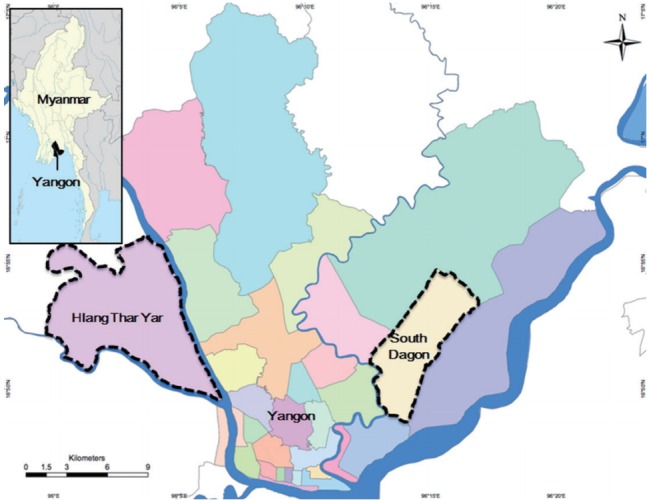
Although intestinal protozoans are common etiologies of diarrhea, few studies have been conducted in Myanmar. This study planned to investigate the prevalence of Giardia lamblia, Entamoeba coli, Entamoeba histolytica, and Endolimax nana among schoolchildren and their guardians in suburban areas near Yangon, Myanmar. We performed a cross-sectional survey among schoolchildren and their guardians from 7 primary schools in South Dagon and Hlaing Thar Yar districts, Yangon, Myanmar. Stool samples were observed with a microscope after concentration technique and iodine staining. Total 821 stool samples, including 556 from schoolchildren and 265 from guardians, were examined. The median age was 6 years old for schoolchildren and 36 years old for guardians. A 53.1% of the school children and 14.6 % of the guardians were males. The overall prevalence of each intestinal protozoan species was as follows: 3.4% (28/821) for G. lamblia; 3.5% (29/821) for E. coli; 1.2% (10/821) for E. histoytica, and 3.0% for E. nana. This study showed that intestinal protozoans are common in primary schoolchildren and their guardians in suburban areas near Yangon, Myanmar. Health interventions, such as hand washing education, improvement of sanitation, and establishment of water purification systems are urgently needed in this area.
尽管肠道原生动物是腹泻的常见病因,但在缅甸开展的相关研究较少。本研究计划调查缅甸仰光附近郊区学童及其监护人中兰氏贾第鞭毛虫、结肠内阿米巴、溶组织内阿米巴和微小内蜒阿米巴的感染率。我们对缅甸仰光南达贡和莱达雅尔区7所小学的学童及其监护人进行了横断面调查。粪便样本经浓缩技术和碘染色后用显微镜观察。共检查了821份粪便样本,其中包括556份学童样本和265份监护人样本。学童的中位年龄为6岁,监护人为36岁。学童中53.1%为男性,监护人中14.6%为男性。各肠道原生动物物种的总体感染率如下:兰氏贾第鞭毛虫为3.4%(28/821);结肠内阿米巴为3.5%(29/821);溶组织内阿米巴为1.2%(10/821);微小内蜒阿米巴为3.0%。本研究表明,肠道原生动物在缅甸仰光附近郊区的小学生及其监护人中很常见。该地区迫切需要开展洗手教育、改善环境卫生和建立水净化系统等健康干预措施。