Jin Ying-Ying, Chen Qing-Juan, Wei Yang, Wang Ya-Li, Wang Zhong-Wei, Xu Kun, He Yun, Ma Hong-Bing
Department of Oncology, The Second Affiliated Hospital of Xi'an Jiaotong University, No. 157, Xiwu Lu, Xi'an 710004, Shaanxi Province, China.
Department of Oncology, Xianyang Center Hospital, Xianyang City, 610041, Shaanxi Province, China.
J Radiat Res. 2016 Sep;57(5):468-476. doi: 10.1093/jrr/rrw068. Epub 2016 Jul 15.
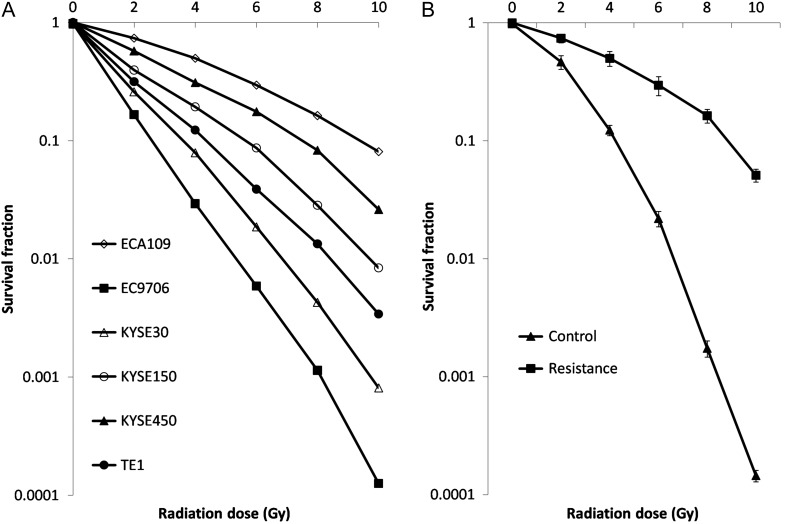
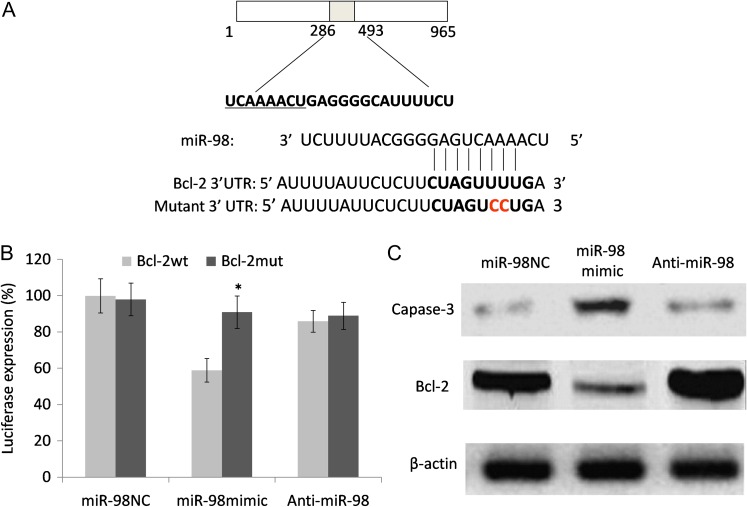
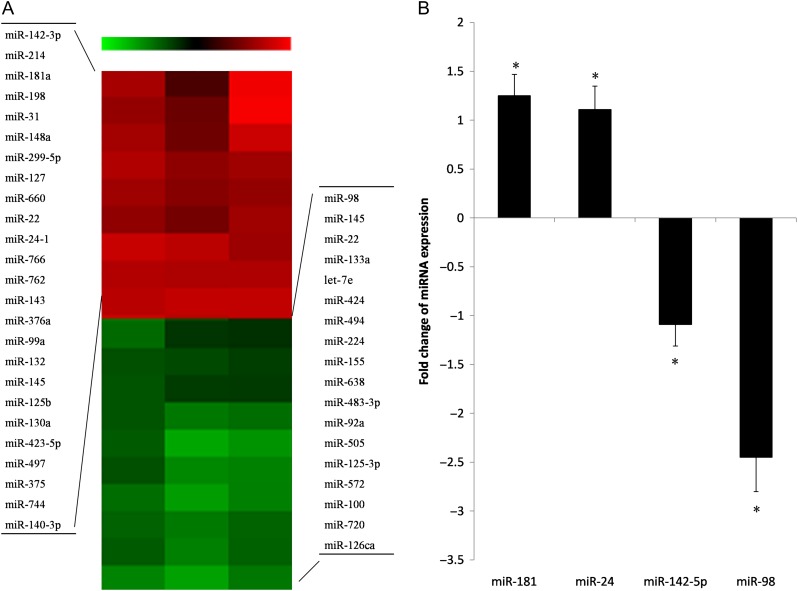
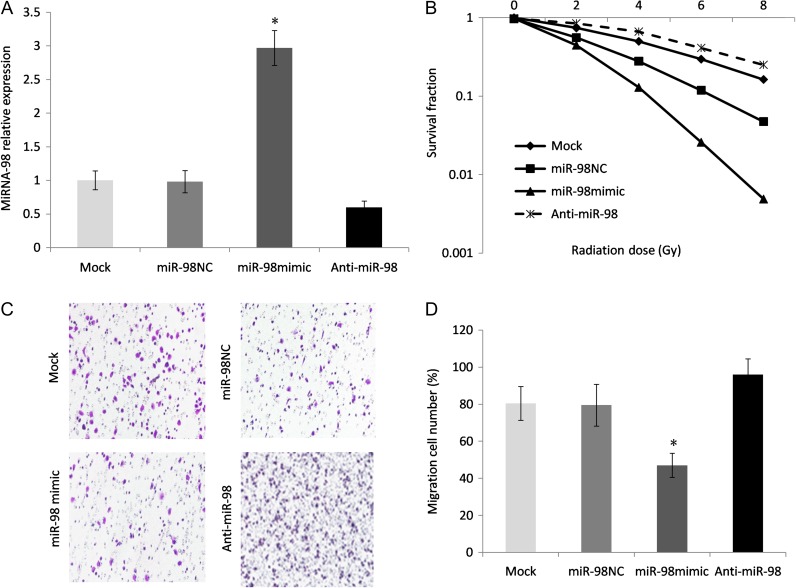
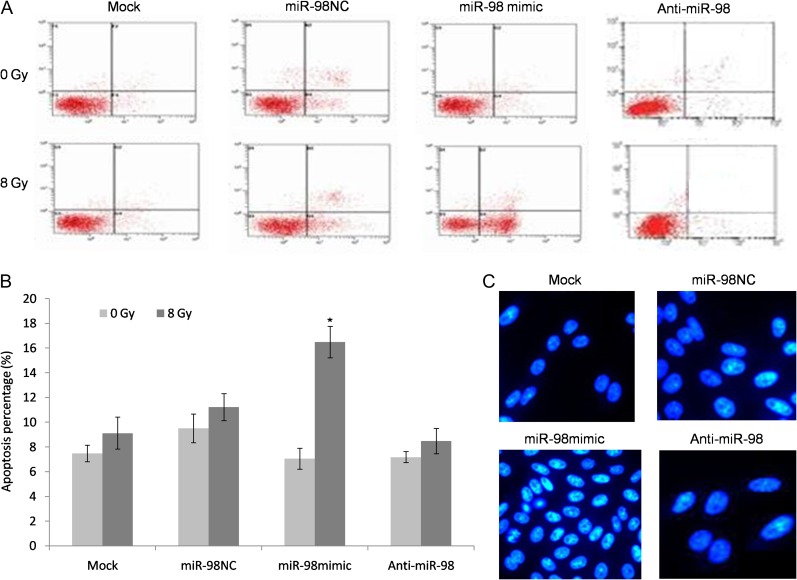
Although radiation resistance is a common challenge in the clinical treatment of esophageal squamous cell carcinoma (ESCC), an effective treatment strategy has yet to be developed. Aberrant expression of microRNAs (miRNAs) is responsible for cancer sensitivity to radiation. In this study, we aimed to identify the miRNAs that are associated with radioresistance in ESCC. We used a miRNA microarray to perform a comparison of miRNA expression in both ESCC parental and acquired radioresistance cell lines. qRT-PCR was used to confirm the alterations. Cell radiosensitivity was determined with a survival fraction assay. Functional analyses of the identified miRNA in ESCC cells with regard to metastasis and apoptosis were performed by transwell assays and flow cytometry. The miRNA targets were identified with pathway analysis and confirmed with a luciferase assay. miR-98 was recognized as the most downregulated miRNA in established radioresistant cell line. AmiR-98 mimic enforced the expression of miRNA-98 and made ESCC cells sensitive to radiotherapy, while anti-miR-98 reversed this process. Optimal results were achieved by decreasing cellular proliferation, decreasing cell migration and inducing apoptosis. The luciferase target gene analysis results showed that the overexpression of miRNA-98 inhibited tumor growth and resistance tolerance by directly binding to the BCL-2 gene. Our study indicated that increasing miRNA-98 expression can be used as a potential radiosensitive therapeutic strategy for treating esophageal cancer cells.
尽管放射抗性是食管鳞状细胞癌(ESCC)临床治疗中的一个常见挑战,但尚未开发出有效的治疗策略。微小RNA(miRNA)的异常表达与癌症对辐射的敏感性有关。在本研究中,我们旨在鉴定与ESCC放射抗性相关的miRNA。我们使用miRNA微阵列对ESCC亲本细胞系和获得性放射抗性细胞系中的miRNA表达进行比较。采用qRT-PCR确认这些改变。通过存活分数测定法确定细胞放射敏感性。通过Transwell实验和流式细胞术对鉴定出的miRNA在ESCC细胞中的转移和凋亡功能进行分析。通过通路分析鉴定miRNA靶标,并通过荧光素酶测定法进行确认。miR-98被认为是在已建立的放射抗性细胞系中表达下调最明显的miRNA。amiR-98模拟物增强了miRNA-98的表达,使ESCC细胞对放疗敏感,而抗miR-98则逆转了这一过程。通过降低细胞增殖、减少细胞迁移和诱导凋亡获得了最佳结果。荧光素酶靶基因分析结果表明,miRNA-98的过表达通过直接结合BCL-2基因抑制肿瘤生长和耐药性。我们的研究表明,增加miRNA-98的表达可作为治疗食管癌细胞的一种潜在的放射增敏治疗策略。