Liao Ming-Feng, Chang Hong-Shiu, Chang Kuo-Hsuan, Ro Long-Sun, Chu Chun-Che, Kuo Hung-Chou, Lyu Rong-Kuo
Section of Neuromuscular Disease, Department of Neurology, Chang Gung Memorial Hospital-Linkou Medical Center, Chang Gung University College of Medicine, Taoyuan, Taiwan.
Medicine (Baltimore). 2016 Jul;95(28):e4210. doi: 10.1097/MD.0000000000004210.
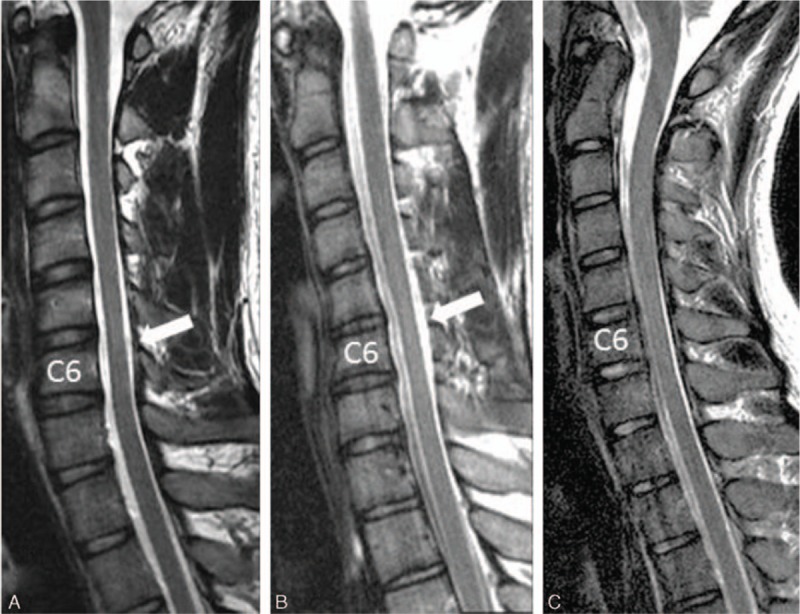
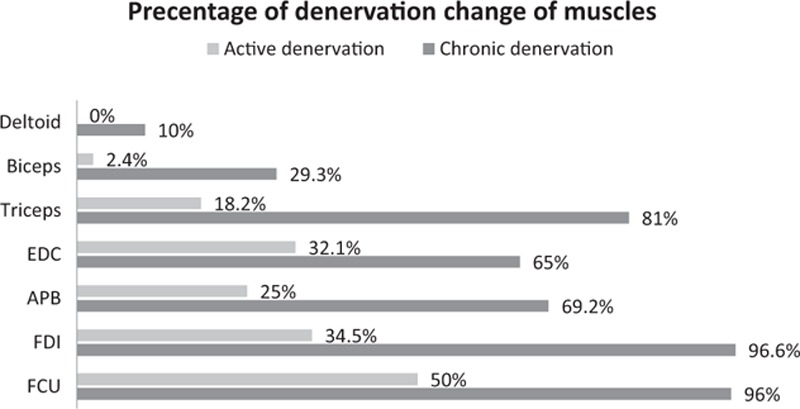
Hirayama disease (HD) is characterized by development of asymmetric forearm muscle atrophy during adolescence with or without focal cervical spinal cord atrophy. The purpose of this study is to assess the correlation of clinical symptoms, disease progression, and electrophysiological findings with cervical spine magnetic resonance imaging (MRI) findings.The medical records, cervical spine MRIs, and electrophysiological findings of 44 HD patients were retrospectively reviewed and analyzed.Denervation changes in any single C5 to C7 root-innervated muscle (deltoid, biceps, triceps, or extensor digitorum communis) occurred more frequently in the 25 patients with cord atrophy than the 19 patients without cord atrophy (88% vs 53%, P = 0.02). Onset age, duration of disease progression, neurological examinations, nerve conduction study, and electromyographic findings from individual muscles were similar between patient groups.Compared with HD patients without cord atrophy, HD patients with cord atrophy experience a more severe denervation change in C5 to C7 root-innervated muscles.
平山病(HD)的特征是在青少年期出现不对称性前臂肌肉萎缩,可伴有或不伴有局灶性颈脊髓萎缩。本研究的目的是评估临床症状、疾病进展、电生理检查结果与颈椎磁共振成像(MRI)结果之间的相关性。我们对44例HD患者的病历、颈椎MRI和电生理检查结果进行了回顾性分析。25例伴有脊髓萎缩的患者中,任何单一由C5至C7神经根支配的肌肉(三角肌、肱二头肌、肱三头肌或指总伸肌)出现失神经改变的频率高于19例无脊髓萎缩的患者(88%对53%,P = 0.02)。两组患者的发病年龄、疾病进展持续时间、神经学检查、神经传导研究以及各肌肉的肌电图检查结果相似。与无脊髓萎缩的HD患者相比,伴有脊髓萎缩的HD患者在C5至C7神经根支配的肌肉中出现更严重的失神经改变。