Sun Xiaojie, Liu Xiucai, Liu B O, Li Shuyan, Zhang Dongmei, Guo Hongyan
Department of Biochemistry, Qiqihar Medical University, Qiqihar, Heilongjiang 161006, P.R. China.
Department of Respiratory Medicine, Third Affiliated Hospital of Qiqihar Medical University, Qiqihar, Heilongjiang 161000, P.R. China.
Oncol Lett. 2016 Jul;12(1):437-444. doi: 10.3892/ol.2016.4638. Epub 2016 May 26.
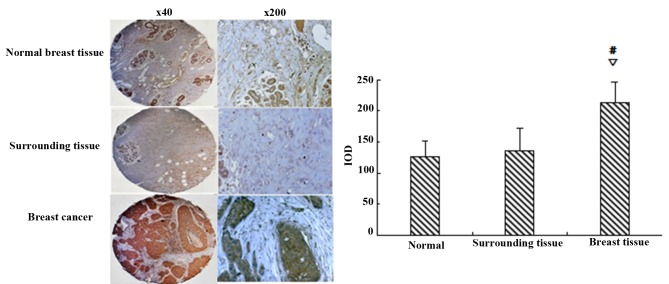
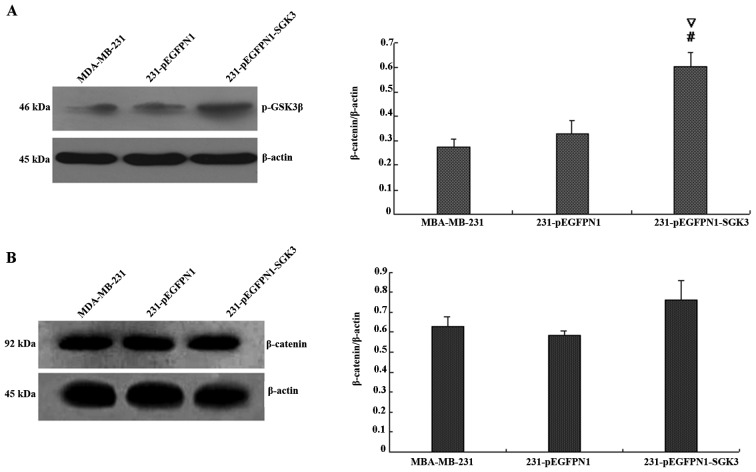
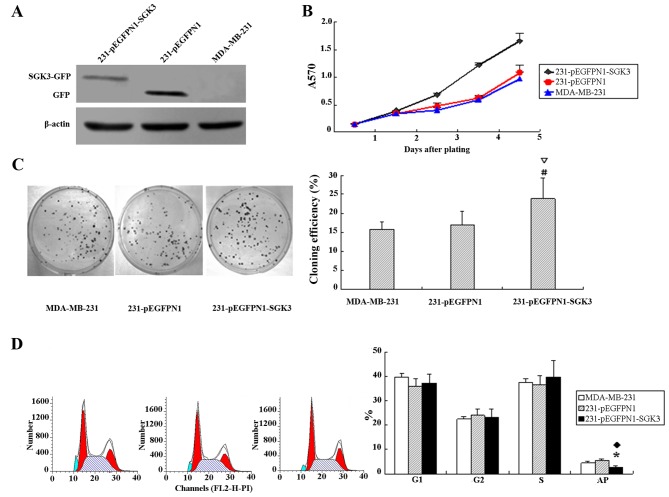
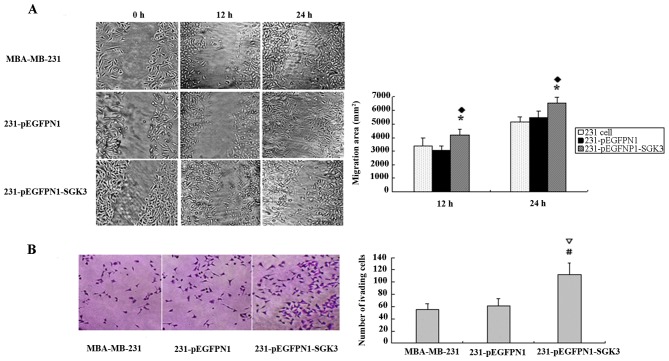
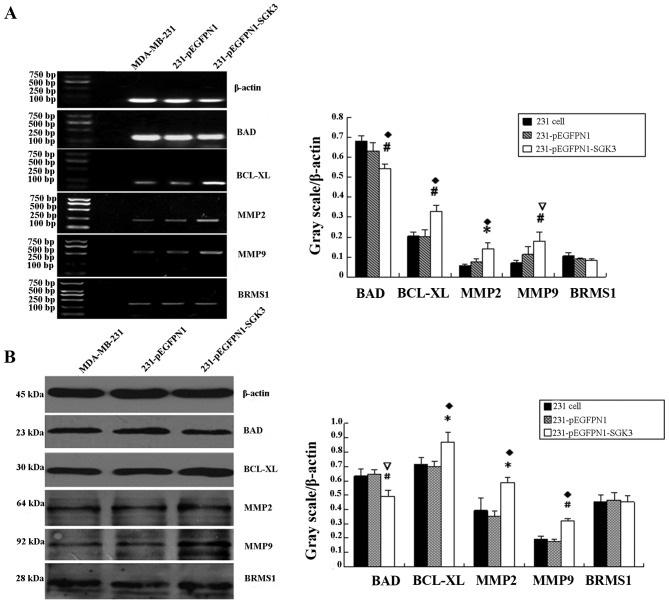
Serum- and glucocorticoid-regulated protein kinase 3 (SGK3) is critical for tumor survival, proliferation and invasion. In the present study we evaluated SGK3 expression in breast tissues and investigated alterations in SGK3 levels in tumor multiplication, progression and apoptosis. Tissue microarray analyses were performed to examine SGK3 expression in breast cancer samples, as well as in adjacent noncancerous and normal tissues. The pEGFP-N1-SGK3 plasmid was transfected into MDA-MB-231 cells to generate SGK3-overexpressing cells. Cell growth assays, colony formation assays, cell cycle analyses, horizontal and vertical migration tests, reverse transcription-polymerase chain reaction and western blot assays were employed to investigate the biological behavior of SGK3-overexpressing cells. SGK3 levels were significantly higher in breast cancer samples compared with adjacent noncancerous and normal tissues. Cell growth curves revealed increased proliferation and decreased apoptosis in SGK3-overexpressing cells. SGK3-overexpressing cells also demonstrated enhanced invasion and migration abilities. SGK3-overexpressing cells had high levels of an apoptosis-related gene () and invasion-related genes ( and ), and decreased levels of an anti-apoptosis gene (). Phosphorylation of GSK-3β, which is downstream in the phosphoinositide 3-kinase signaling pathway, was activated by SGK3 overexpression. β-catenin phosphorylation did not differ between the SGK3-overexpressing and non-SGK3-overexpressing cells. SGK3 overexpression induces GSK-3β phosphorylation, enhancing apoptosis- and invasion-related genes and proteins and thereby leading to tumor development and aggression in breast cancer cells.
血清和糖皮质激素调节蛋白激酶3(SGK3)对肿瘤的存活、增殖和侵袭至关重要。在本研究中,我们评估了SGK3在乳腺组织中的表达,并研究了SGK3水平在肿瘤增殖、进展和凋亡过程中的变化。进行组织芯片分析以检测SGK3在乳腺癌样本以及相邻非癌组织和正常组织中的表达。将pEGFP-N1-SGK3质粒转染到MDA-MB-231细胞中以产生SGK3过表达细胞。采用细胞生长试验、集落形成试验、细胞周期分析、水平和垂直迁移试验、逆转录-聚合酶链反应和蛋白质印迹试验来研究SGK3过表达细胞的生物学行为。与相邻非癌组织和正常组织相比,乳腺癌样本中的SGK3水平显著更高。细胞生长曲线显示SGK3过表达细胞的增殖增加而凋亡减少。SGK3过表达细胞还表现出侵袭和迁移能力增强。SGK3过表达细胞中凋亡相关基因()和侵袭相关基因(和)水平较高,而抗凋亡基因()水平降低。SGK3过表达激活了磷脂酰肌醇3激酶信号通路下游的GSK-3β磷酸化。SGK3过表达细胞和非SGK3过表达细胞之间β-连环蛋白磷酸化没有差异。SGK3过表达诱导GSK-3β磷酸化,增强凋亡和侵袭相关基因及蛋白质的表达,从而导致乳腺癌细胞的肿瘤发展和侵袭性增强。