Huber Bettina, Herzog Bastian, Drewes Jörg E, Koch Konrad, Müller Elisabeth
Chair of Urban Water Systems Engineering, Technical University of Munich, Am Coulombwall 3, 85748, Garching, Germany.
BMC Microbiol. 2016 Jul 18;16(1):153. doi: 10.1186/s12866-016-0767-7.
Biogenic sulfuric acid (BSA) corrosion damages sewerage and wastewater treatment facilities but is not well investigated in sludge digesters. Sulfur/sulfide oxidizing bacteria (SOB) oxidize sulfur compounds to sulfuric acid, inducing BSA corrosion. To obtain more information on BSA corrosion in sludge digesters, microbial communities from six different, BSA-damaged, digesters were analyzed using culture dependent methods and subsequent polymerase chain reaction denaturing gradient gel electrophoresis (PCR-DGGE). BSA production was determined in laboratory scale systems with mixed and pure cultures, and in-situ with concrete specimens from the digester headspace and sludge zones.
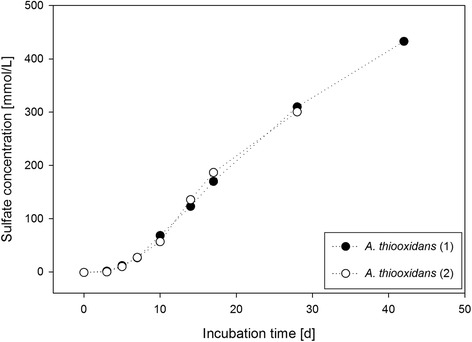
The SOB Acidithiobacillus thiooxidans, Thiomonas intermedia, and Thiomonas perometabolis were cultivated and compared to PCR-DGGE results, revealing the presence of additional acidophilic and neutrophilic SOB. Sulfate concentrations of 10-87 mmol/L after 6-21 days of incubation (final pH 1.0-2.0) in mixed cultures, and up to 433 mmol/L after 42 days (final pH <1.0) in pure A. thiooxidans cultures showed huge sulfuric acid production potentials. Additionally, elevated sulfate concentrations in the corroded concrete of the digester headspace in contrast to the concrete of the sludge zone indicated biological sulfur/sulfide oxidation.
The presence of SOB and confirmation of their sulfuric acid production under laboratory conditions reveal that these organisms might contribute to BSA corrosion within sludge digesters. Elevated sulfate concentrations on the corroded concrete wall in the digester headspace (compared to the sludge zone) further indicate biological sulfur/sulfide oxidation in-situ. For the first time, SOB presence and activity is directly relatable to BSA corrosion in sludge digesters.
生物源硫酸(BSA)腐蚀会损坏污水和废水处理设施,但在污泥消化池中尚未得到充分研究。硫/硫化物氧化细菌(SOB)将硫化合物氧化为硫酸,引发BSA腐蚀。为了获取更多关于污泥消化池中BSA腐蚀的信息,采用依赖培养的方法以及随后的聚合酶链反应变性梯度凝胶电泳(PCR-DGGE)对来自六个不同的、遭受BSA损坏的消化池中的微生物群落进行了分析。在实验室规模的系统中,使用混合培养物和纯培养物测定了BSA的产生情况,并在现场对消化池顶部空间和污泥区域的混凝土样本进行了测定。
培养出了SOB嗜酸氧化硫硫杆菌、中间型硫单胞菌和代谢过硫硫单胞菌,并将其与PCR-DGGE结果进行了比较,发现还存在其他嗜酸和嗜中性SOB。混合培养物在孵育6 - 21天后(最终pH值为1.0 - 2.0)的硫酸盐浓度为10 - 87 mmol/L,而在纯嗜酸氧化硫硫杆菌培养物中孵育42天后(最终pH值<1.0)的硫酸盐浓度高达433 mmol/L,这表明其具有巨大的硫酸生产潜力。此外,与污泥区域的混凝土相比,消化池顶部空间腐蚀混凝土中的硫酸盐浓度升高,表明存在生物硫/硫化物氧化现象。
SOB的存在以及在实验室条件下对其硫酸生产的证实表明,这些微生物可能是污泥消化池中BSA腐蚀的原因。消化池顶部空间腐蚀混凝土壁上的硫酸盐浓度升高(与污泥区域相比)进一步表明现场存在生物硫/硫化物氧化现象。首次将SOB的存在和活性与污泥消化池中的BSA腐蚀直接联系起来。