Brant Hayley L, Ewers Robert M, Vythilingam Indra, Drakeley Chris, Benedick Suzan, Mumford John D
Faculty of Natural Sciences, Centre for Environmental Policy, Imperial College London, Silwood Park Campus, Buckhurst Road, Ascot, SL5 7PY, UK.
Department of Life Sciences, Faculty of Natural Sciences, Imperial College London, Silwood Park Campus, Buckhurst Road, Ascot, Berkshire, SL5 7PY, UK.
Malar J. 2016 Jul 19;15(1):370. doi: 10.1186/s12936-016-1416-1.
Malaria cases caused by Plasmodium knowlesi, a simian parasite naturally found in long-tailed and pig-tailed macaques, are increasing rapidly in Sabah, Malaysia. One hypothesis is that this increase is associated with changes in land use. A study was carried out to identify the anopheline vectors present in different forest types and to observe the human landing behaviour of mosquitoes.
Mosquito collections were carried out using human landing catches at ground and canopy levels in the Tawau Division of Sabah. Collections were conducted along an anthropogenic disturbance gradient (primary forest, lightly logged virgin jungle reserve and salvage logged forest) between 18:00 and 22:00 h.
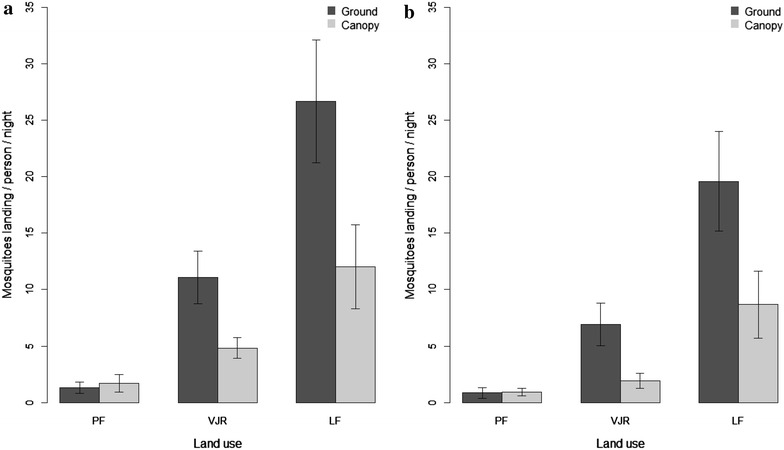
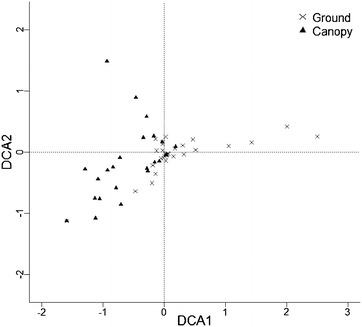
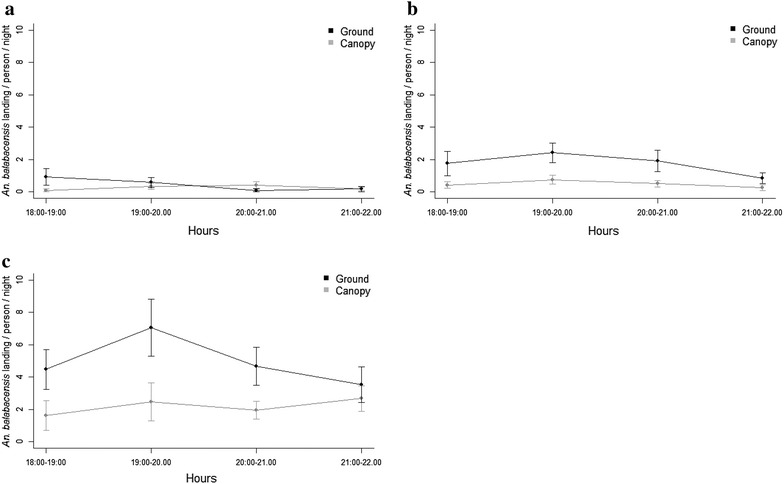
Anopheles balabacensis, a vector of P. knowlesi, was the predominant species in all collection areas, accounting for 70 % of the total catch, with a peak landing time of 18:30-20:00 h. Anopheles balabacensis had a preference for landing on humans at ground level compared to the canopy (p < 0.0001). A greater abundance of mosquitoes were landing in the logged forest compared to the primary forest (p < 0.0001). There was no difference between mosquito abundance in the logged forest and lightly logged forest (p = 0.554). A higher evening temperature (p < 0.0001) and rainfall (p < 0.0001) significantly decreased mosquito abundance during collection nights.
This study demonstrates the potential ability of An. balabacensis to transmit P. knowlesi between canopy-dwelling simian hosts and ground-dwelling humans, and that forest disturbance increases the abundance of this disease vector. These results, in combination with regional patterns of land use change, may partly explain the rapid rise in P. knowlesi cases in Sabah. This study provides essential data on anthropophily for the principal vector of P. knowlesi which is important for the planning of vector control strategies.
诺氏疟原虫是一种自然存在于长尾猕猴和猪尾猕猴体内的猿类寄生虫,由其引起的疟疾病例在马来西亚沙巴州迅速增加。一种假设认为,这种增加与土地利用变化有关。开展了一项研究,以确定不同森林类型中存在的按蚊媒介,并观察蚊子的人饵诱捕行为。
在沙巴州斗湖地区,于地面和树冠层利用人饵诱捕法进行蚊子采集。在18:00至22:00之间,沿着人为干扰梯度(原始森林、轻度砍伐的原始丛林保护区和皆伐森林)进行采集。
诺氏疟原虫媒介巴拉巴按蚊是所有采集区域的主要种类,占总捕获量的70%,高峰着陆时间为18:30至20:00。与树冠层相比,巴拉巴按蚊更倾向于在地面落在人身上(p < 0.0001)。与原始森林相比,皆伐森林中有更多的蚊子着陆(p < 0.0001)。皆伐森林和轻度砍伐森林中的蚊子数量没有差异(p = 0.554)。较高的夜间温度(p < 0.0