Li Rong, Chen Bo-Lin, Zhou Yan-Wu, Guo Ren-Wei, Shuai Meng-Ting, Zeng Jun-Xian, Leng Ai-Min
Department of Gastroenterology, Xiangya Hospital, Changsha, Hunan 410008, P.R. China.
Thoracic Medicine Department II, Hunan Cancer Hospital, The Affiliated Cancer Hospital of Xiangya School of Medicine, Central South Univerisity, Changsha, Hunan 410013, P.R. China.
Mol Med Rep. 2016 Sep;14(3):1933-40. doi: 10.3892/mmr.2016.5473. Epub 2016 Jul 6.
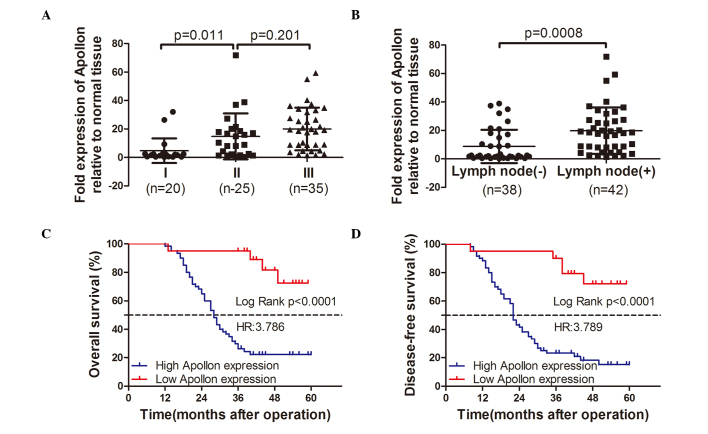
Apollon, an unusually large member of the inhibitors of apoptosis protein family, may be important for oncogenesis development. The aim of the present study was to assess the association between esophageal squamous cell carcinoma (ESCC) and Apollon expression levels, and to highlight the association between Apollon and the occurrence, development and prognosis of ESCC. Apollon expression was detected by immunohistochemical staining and reverse transcription-quantitative polymerase chain reaction in ESCC tissues, adjacent non‑cancerous tissues and paired normal tissues respectively, in order to analyze the association between Apollon expression and the clinicopathological features of ESCC. Survival analysis was used to assess the prognostic significance of Apollon expression. It was determined that the mRNA and protein expression levels of Apollon were significantly higher in the carcinoma tissues compared with the adjacent non‑cancerous tissues and normal control tissues (P<0.001). There was a significant difference in lymph node involvement and the tumor, nodes, and metastases stage in patients categorized according to different Apollon expression levels. The prognostic significance of Apollon was also determined using the log‑rank method. The overexpression of Apollon was associated with shorter overall survival and disease-free survival rates. The present study indicates that Apollon expression is associated with the biological characteristics of ESCC, and may be a valuable prognostic factor and a novel chemotherapeutic target for ESCC treatment.
Apollon是凋亡抑制蛋白家族中一个异常大的成员,可能对肿瘤发生发展具有重要意义。本研究旨在评估食管鳞状细胞癌(ESCC)与Apollon表达水平之间的关联,并突出Apollon与ESCC发生、发展及预后之间的关联。分别通过免疫组织化学染色和逆转录-定量聚合酶链反应检测ESCC组织、癌旁非癌组织及配对正常组织中的Apollon表达,以分析Apollon表达与ESCC临床病理特征之间的关联。采用生存分析评估Apollon表达的预后意义。结果显示,与癌旁非癌组织和正常对照组织相比,癌组织中Apollon的mRNA和蛋白表达水平显著更高(P<0.001)。根据不同Apollon表达水平分类的患者在淋巴结受累情况及肿瘤、淋巴结、转移分期方面存在显著差异。还采用对数秩检验确定了Apollon的预后意义。Apollon的过表达与总生存率和无病生存率较低相关。本研究表明,Apollon表达与ESCC的生物学特性相关,可能是ESCC治疗中有价值的预后因素和新型化疗靶点。