Bopanna Sawan, Roy Maitreyee, Das Prasenjit, Dattagupta S, Sreenivas V, Mouli V Pratap, Kedia Saurabh, Dhingra Rajan, Pradhan Rajesh, Kumar N Suraj, Yadav Dawesh P, Makharia Govind, Ahuja Vineet
Department of Gastroenterology, All India Institute of Medical Sciences, New Delhi, India.
Department of Pathology, All India Institute of Medical Sciences, New Delhi, India.
Intest Res. 2016 Jul;14(3):264-9. doi: 10.5217/ir.2016.14.3.264. Epub 2016 Jun 27.
BACKGROUND/AIMS: Recent data suggest that the incidence of ulcerative colitis (UC) related colorectal cancer (CRC) in India is similar to that of West. The optimum method for surveillance is still a debate. Surveillance with random biopsies has been the standard of care, but is a tedious process. We therefore undertook this study to assess the yield of random biopsy in dysplasia surveillance.
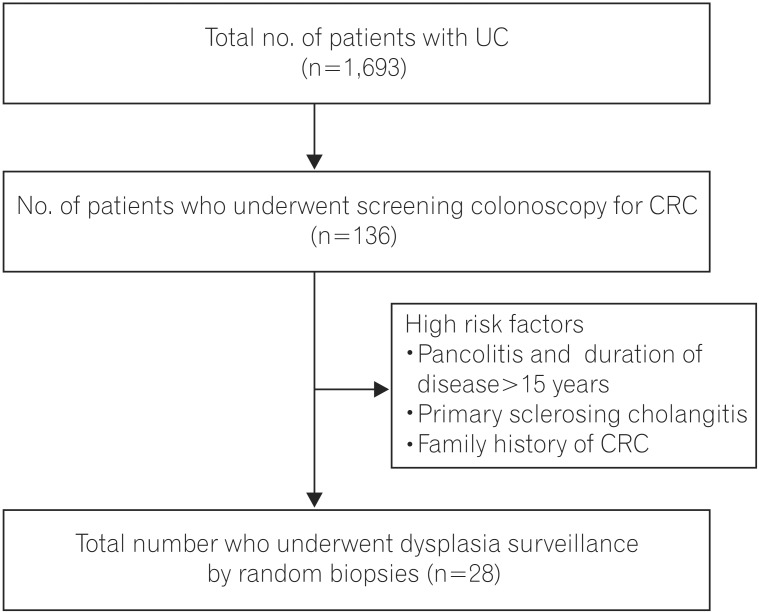
Between March 2014 and July 2015, patients of UC attending the Inflammatory Bowel Disease clinic at the All India Institute of Medical Sciences with high risk factors for CRC like duration of disease >15 years and pancolitis, family history of CRC, primary sclerosing cholangitis underwent surveillance colonoscopy for dysplasia. Four quadrant random biopsies at 10 cm intervals were taken (33 biopsies). Two pathologists examined specimens for dysplasia, and the yield of dysplasia was calculated.
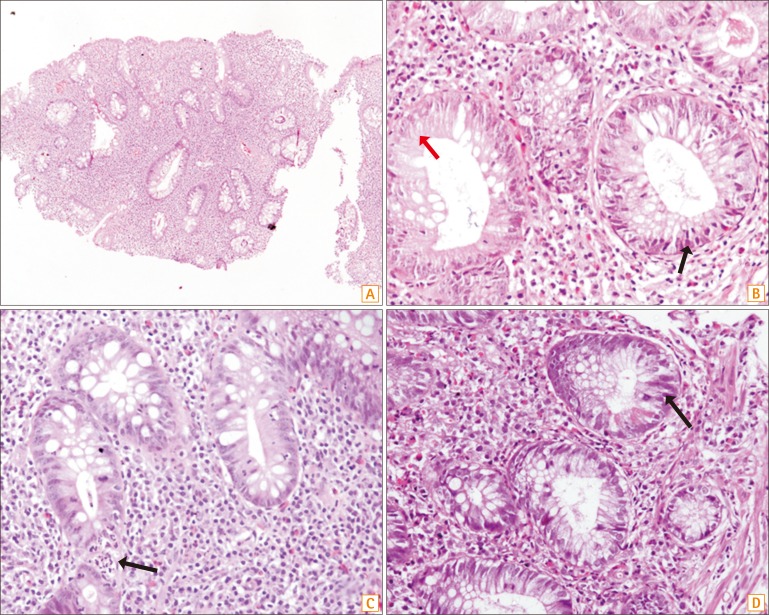
Twenty-eight patients were included. Twenty-six of these had pancolitis with a duration of disease greater than 15 years, and two patients had associated primary sclerosing cholangis. No patient had a family history of CRC. The mean age at onset of disease was 28.89±8.73 years and the duration of disease was 19.00±8.78 years. Eighteen patients (64.28%) were males. A total of 924 biopsies were taken. None of the biopsies revealed any evidence of dysplasia, and 7/924 (0.7%) were indefinite for dysplasia.
Random biopsy for surveillance in longstanding extensive colitis has a low yield for dysplasia and does not suffice for screening. Newer techniques such as chromoendoscopy-guided biopsies need greater adoption.
背景/目的:最近的数据表明,印度溃疡性结肠炎(UC)相关结直肠癌(CRC)的发病率与西方相似。监测的最佳方法仍存在争议。随机活检监测一直是标准治疗方法,但过程繁琐。因此,我们开展了这项研究,以评估随机活检在发育异常监测中的检出率。
2014年3月至2015年7月期间,全印度医学科学研究所炎症性肠病门诊中患有CRC高风险因素(如病程>15年、全结肠炎、CRC家族史、原发性硬化性胆管炎)的UC患者接受了发育异常监测结肠镜检查。每隔10 cm进行四个象限的随机活检(共33次活检)。两名病理学家检查标本中的发育异常情况,并计算发育异常的检出率。
纳入28例患者。其中26例患有全结肠炎,病程超过15年,2例患者伴有原发性硬化性胆管炎。没有患者有CRC家族史。疾病发病的平均年龄为28.89±8.73岁,病程为19.00±8.78年。18例患者(64.28%)为男性。共进行了924次活检。所有活检均未发现发育异常的证据,924次活检中有7次(0.7%)发育异常情况不明确。
长期广泛性结肠炎监测的随机活检发育异常检出率低,不足以用于筛查。诸如染色内镜引导活检等新技术需要更广泛地应用。