Morozova Irina, Flegontov Pavel, Mikheyev Alexander S, Bruskin Sergey, Asgharian Hosseinali, Ponomarenko Petr, Klyuchnikov Vladimir, ArunKumar GaneshPrasad, Prokhortchouk Egor, Gankin Yuriy, Rogaev Evgeny, Nikolsky Yuri, Baranova Ancha, Elhaik Eran, Tatarinova Tatiana V
Institute of Evolutionary Medicine, University of Zurich, Zurich, Switzerland
Department of Biology and Ecology, Faculty of Science, University of Ostrava, Ostrava, Czech Republic Bioinformatics Center, A.A. Kharkevich Institute for Information Transmission Problems, Russian Academy of Sciences, Moscow, Russian Federation.
DNA Res. 2016 Aug;23(4):295-310. doi: 10.1093/dnares/dsw029. Epub 2016 Jul 19.
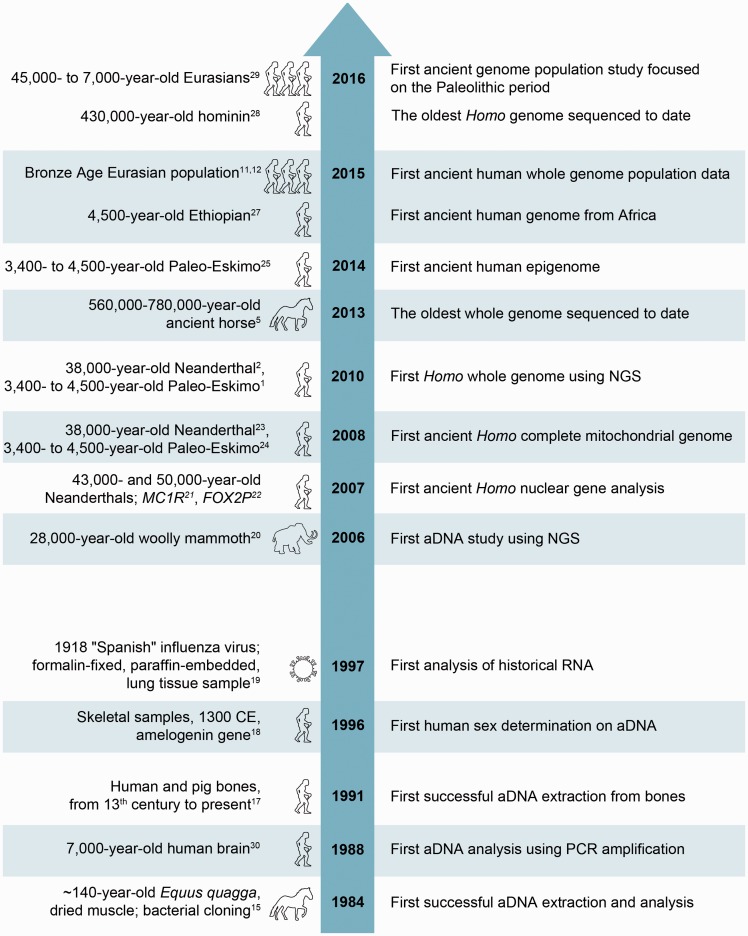
The term 'ancient DNA' (aDNA) is coming of age, with over 1,200 hits in the PubMed database, beginning in the early 1980s with the studies of 'molecular paleontology'. Rooted in cloning and limited sequencing of DNA from ancient remains during the pre-PCR era, the field has made incredible progress since the introduction of PCR and next-generation sequencing. Over the last decade, aDNA analysis ushered in a new era in genomics and became the method of choice for reconstructing the history of organisms, their biogeography, and migration routes, with applications in evolutionary biology, population genetics, archaeogenetics, paleo-epidemiology, and many other areas. This change was brought by development of new strategies for coping with the challenges in studying aDNA due to damage and fragmentation, scarce samples, significant historical gaps, and limited applicability of population genetics methods. In this review, we describe the state-of-the-art achievements in aDNA studies, with particular focus on human evolution and demographic history. We present the current experimental and theoretical procedures for handling and analysing highly degraded aDNA. We also review the challenges in the rapidly growing field of ancient epigenomics. Advancement of aDNA tools and methods signifies a new era in population genetics and evolutionary medicine research.
“古代DNA”(aDNA)这一术语正走向成熟,自20世纪80年代初“分子古生物学”研究开始,在PubMed数据库中有超过1200条相关记录。该领域起源于前PCR时代对古代遗骸DNA的克隆和有限测序,自PCR和下一代测序技术引入以来取得了令人难以置信的进展。在过去十年中,aDNA分析开创了基因组学的新纪元,并成为重建生物历史、生物地理学和迁徙路线的首选方法,应用于进化生物学、群体遗传学、考古遗传学、古流行病学以及许多其他领域。这种变化是由于应对aDNA研究中因损伤和碎片化、样本稀缺、重大历史空白以及群体遗传学方法适用性有限等挑战而开发新策略所带来的。在本综述中,我们描述了aDNA研究的最新成果,特别关注人类进化和人口历史。我们介绍了处理和分析高度降解aDNA的当前实验和理论程序。我们还回顾了快速发展的古代表观基因组学领域所面临的挑战。aDNA工具和方法的进步标志着群体遗传学和进化医学研究的新时代。