• 文献检索
  • 文档翻译
  • 深度研究
  • 学术资讯
  • Suppr Zotero 插件Zotero 插件
  • 邀请有礼
  • 套餐&价格
  • 历史记录
应用&插件
Suppr Zotero 插件Zotero 插件浏览器插件Mac 客户端Windows 客户端微信小程序
定价
高级版会员购买积分包购买API积分包
服务
文献检索文档翻译深度研究API 文档MCP 服务
关于我们
关于 Suppr公司介绍联系我们用户协议隐私条款
关注我们

Suppr 超能文献

核心技术专利:CN118964589B侵权必究
粤ICP备2023148730 号-1Suppr @ 2026

文献检索

告别复杂PubMed语法,用中文像聊天一样搜索,搜遍4000万医学文献。AI智能推荐,让科研检索更轻松。

立即免费搜索

文件翻译

保留排版,准确专业,支持PDF/Word/PPT等文件格式,支持 12+语言互译。

免费翻译文档

深度研究

AI帮你快速写综述,25分钟生成高质量综述,智能提取关键信息,辅助科研写作。

立即免费体验

克特人的基因组研究:一个与古爱斯基摩人相关的族群,拥有显著的古代北欧亚血统。

Genomic study of the Ket: a Paleo-Eskimo-related ethnic group with significant ancient North Eurasian ancestry.

作者信息

Flegontov Pavel, Changmai Piya, Zidkova Anastassiya, Logacheva Maria D, Altınışık N Ezgi, Flegontova Olga, Gelfand Mikhail S, Gerasimov Evgeny S, Khrameeva Ekaterina E, Konovalova Olga P, Neretina Tatiana, Nikolsky Yuri V, Starostin George, Stepanova Vita V, Travinsky Igor V, Tříska Martin, Tříska Petr, Tatarinova Tatiana V

机构信息

Department of Biology and Ecology, Faculty of Science, University of Ostrava, Ostrava, Czech Republic.

A.A. Kharkevich Institute for Information Transmission Problems, Russian Academy of Sciences, Moscow, Russia.

出版信息

Sci Rep. 2016 Feb 11;6:20768. doi: 10.1038/srep20768.

DOI:10.1038/srep20768
PMID:26865217
原文链接:https://pmc.ncbi.nlm.nih.gov/articles/PMC4750364/
Abstract

The Kets, an ethnic group in the Yenisei River basin, Russia, are considered the last nomadic hunter-gatherers of Siberia, and Ket language has no transparent affiliation with any language family. We investigated connections between the Kets and Siberian and North American populations, with emphasis on the Mal'ta and Paleo-Eskimo ancient genomes, using original data from 46 unrelated samples of Kets and 42 samples of their neighboring ethnic groups (Uralic-speaking Nganasans, Enets, and Selkups). We genotyped over 130,000 autosomal SNPs, identified mitochondrial and Y-chromosomal haplogroups, and performed high-coverage genome sequencing of two Ket individuals. We established that Nganasans, Kets, Selkups, and Yukaghirs form a cluster of populations most closely related to Paleo-Eskimos in Siberia (not considering indigenous populations of Chukotka and Kamchatka). Kets are closely related to modern Selkups and to some Bronze and Iron Age populations of the Altai region, with all these groups sharing a high degree of Mal'ta ancestry. Implications of these findings for the linguistic hypothesis uniting Ket and Na-Dene languages into a language macrofamily are discussed.

摘要

凯特人是俄罗斯叶尼塞河流域的一个民族,被认为是西伯利亚最后的游牧狩猎采集部落,凯特语与任何语系都没有明显的关联。我们利用来自46个不相关的凯特人样本以及42个其相邻民族(讲乌拉尔语的恩加纳桑人、埃涅茨人以及塞尔库普人)的原始数据,研究了凯特人与西伯利亚及北美人群之间的联系,重点关注了马尔塔人和古爱斯基摩人的古代基因组。我们对超过13万个常染色体单核苷酸多态性进行了基因分型,确定了线粒体和Y染色体单倍群,并对两名凯特人个体进行了高覆盖度的基因组测序。我们确定,恩加纳桑人、凯特人、塞尔库普人和尤卡吉尔人形成了一个与西伯利亚古爱斯基摩人关系最为密切的人群集群(不考虑楚科奇和堪察加的原住民)。凯特人与现代塞尔库普人以及阿尔泰地区的一些青铜和铁器时代人群关系密切,所有这些群体都有高度的马尔塔血统。本文讨论了这些发现对将凯特语和纳-德内语归为一个语言大系的语言学假设的影响。
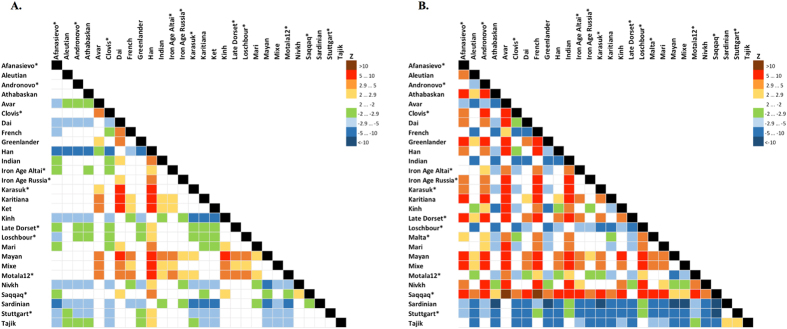
https://cdn.ncbi.nlm.nih.gov/pmc/blobs/4d7e/4750364/5e65d3523b65/srep20768-f5.jpg
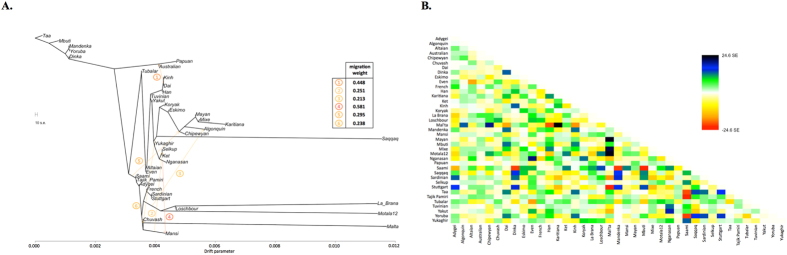
https://cdn.ncbi.nlm.nih.gov/pmc/blobs/4d7e/4750364/c78de324a5f9/srep20768-f1.jpg
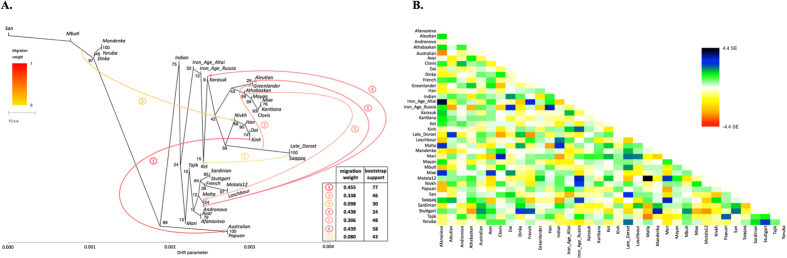
https://cdn.ncbi.nlm.nih.gov/pmc/blobs/4d7e/4750364/4b6fc546cbc2/srep20768-f2.jpg
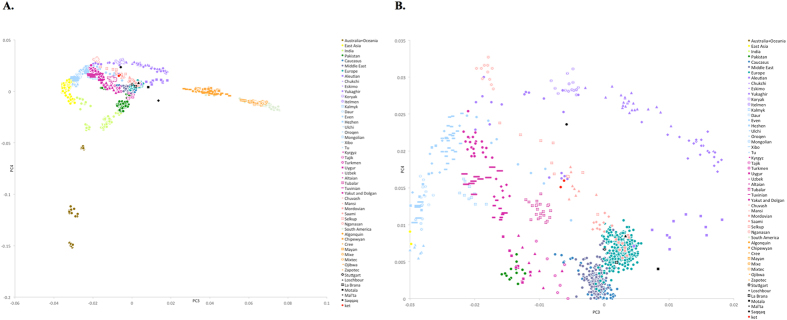
https://cdn.ncbi.nlm.nih.gov/pmc/blobs/4d7e/4750364/31afffba4f94/srep20768-f3.jpg
https://cdn.ncbi.nlm.nih.gov/pmc/blobs/4d7e/4750364/6b26f2635c4b/srep20768-f4.jpg
https://cdn.ncbi.nlm.nih.gov/pmc/blobs/4d7e/4750364/5e65d3523b65/srep20768-f5.jpg
https://cdn.ncbi.nlm.nih.gov/pmc/blobs/4d7e/4750364/c78de324a5f9/srep20768-f1.jpg
https://cdn.ncbi.nlm.nih.gov/pmc/blobs/4d7e/4750364/4b6fc546cbc2/srep20768-f2.jpg
https://cdn.ncbi.nlm.nih.gov/pmc/blobs/4d7e/4750364/31afffba4f94/srep20768-f3.jpg
https://cdn.ncbi.nlm.nih.gov/pmc/blobs/4d7e/4750364/6b26f2635c4b/srep20768-f4.jpg
https://cdn.ncbi.nlm.nih.gov/pmc/blobs/4d7e/4750364/5e65d3523b65/srep20768-f5.jpg

相似文献

1
Genomic study of the Ket: a Paleo-Eskimo-related ethnic group with significant ancient North Eurasian ancestry.克特人的基因组研究:一个与古爱斯基摩人相关的族群,拥有显著的古代北欧亚血统。
Sci Rep. 2016 Feb 11;6:20768. doi: 10.1038/srep20768.
2
Palaeo-Eskimo genetic ancestry and the peopling of Chukotka and North America.古爱斯基摩人遗传渊源与楚科奇半岛和北美洲的人类迁徙
Nature. 2019 Jun;570(7760):236-240. doi: 10.1038/s41586-019-1251-y. Epub 2019 Jun 5.
3
Mitochondrial genome diversity at the Bering Strait area highlights prehistoric human migrations from Siberia to northern North America.白令海峡地区的线粒体基因组多样性凸显了史前人类从西伯利亚到北美北部的迁徙。
Eur J Hum Genet. 2015 Oct;23(10):1399-404. doi: 10.1038/ejhg.2014.286. Epub 2015 Jan 7.
4
Reconstructing genetic history of Siberian and Northeastern European populations.重建西伯利亚和东北欧人群的遗传史。
Genome Res. 2017 Jan;27(1):1-14. doi: 10.1101/gr.202945.115. Epub 2016 Dec 13.
5
Mitochondrial diversity of Iñupiat people from the Alaskan North Slope provides evidence for the origins of the Paleo- and Neo-Eskimo peoples.来自阿拉斯加北坡的伊努皮亚特人的线粒体多样性为古爱斯基摩人和新爱斯基摩人的起源提供了证据。
Am J Phys Anthropol. 2015 Aug;157(4):603-14. doi: 10.1002/ajpa.22750. Epub 2015 Apr 17.
6
Siberian genetic diversity reveals complex origins of the Samoyedic-speaking populations.西伯利亚遗传多样性揭示了萨摩耶语族群的复杂起源。
Am J Hum Biol. 2018 Nov;30(6):e23194. doi: 10.1002/ajhb.23194. Epub 2018 Nov 8.
7
Upper Palaeolithic Siberian genome reveals dual ancestry of Native Americans.上新世西伯利亚人基因组揭示了美洲原住民的双重祖先。
Nature. 2014 Jan 2;505(7481):87-91. doi: 10.1038/nature12736. Epub 2013 Nov 20.
8
Middle Holocene Siberian genomes reveal highly connected gene pools throughout North Asia.中全新世西伯利亚基因组揭示了整个北亚地区高度连通的基因库。
Curr Biol. 2023 Feb 6;33(3):423-433.e5. doi: 10.1016/j.cub.2022.11.062. Epub 2023 Jan 12.
9
Mitochondrial DNA diversity in indigenous populations of the southern extent of Siberia, and the origins of Native American haplogroups.西伯利亚南部土著人群的线粒体DNA多样性及美洲原住民单倍群的起源
Ann Hum Genet. 2005 Jan;69(Pt 1):67-89. doi: 10.1046/j.1529-8817.2003.00127.x.
10
mtDNA variation among Greenland Eskimos: the edge of the Beringian expansion.格陵兰爱斯基摩人的线粒体DNA变异:白令海扩张的边缘地带
Am J Hum Genet. 2000 Sep;67(3):718-26. doi: 10.1086/303038. Epub 2000 Aug 2.

引用本文的文献

1
Patterns of genetic admixture reveal similar rates of borrowing across diverse scenarios of language contact.基因混合模式揭示了在不同语言接触场景下相似的借用率。
Sci Adv. 2025 Aug 29;11(35):eadv7521. doi: 10.1126/sciadv.adv7521.
2
Ancient DNA reveals the prehistory of the Uralic and Yeniseian peoples.古代DNA揭示了乌拉尔语族和叶尼塞语族民族的史前史。
Nature. 2025 Jul 2. doi: 10.1038/s41586-025-09189-3.
3
Gradient in grammatical structure of indigenous languages reflects pathway of human expansion in the Americas.本土语言语法结构的梯度反映了人类在美洲扩张的路径。

本文引用的文献

1
Genome-wide patterns of selection in 230 ancient Eurasians.230名古代欧亚人的全基因组选择模式
Nature. 2015 Dec 24;528(7583):499-503. doi: 10.1038/nature16152. Epub 2015 Nov 23.
2
POPULATION GENETICS. Genomic evidence for the Pleistocene and recent population history of Native Americans.群体遗传学。美洲原住民更新世及近代群体历史的基因组证据。
Science. 2015 Aug 21;349(6250):aab3884. doi: 10.1126/science.aab3884. Epub 2015 Jul 21.
3
Differential Evolution approach to detect recent admixture.用于检测近期混合的差分进化方法。
Sci Rep. 2025 Apr 24;15(1):14365. doi: 10.1038/s41598-025-86265-8.
4
Insight into the evolutionary and domesticated history of the most widely cultivated mushroom Agaricus bisporus via mitogenome sequences of 361 global strains.通过对 361 株全球菌株的线粒体基因组序列分析,深入了解最广泛种植的蘑菇双孢蘑菇的进化和驯化历史。
BMC Genomics. 2023 Apr 5;24(1):182. doi: 10.1186/s12864-023-09257-w.
5
Indian genetic heritage in Southeast Asian populations.东南亚人群中的印度遗传遗产。
PLoS Genet. 2022 Feb 17;18(2):e1010036. doi: 10.1371/journal.pgen.1010036. eCollection 2022 Feb.
6
Variation of Genomic Sites Associated with Severe Covid-19 Across Populations: Global and National Patterns.不同人群中与重症新冠肺炎相关的基因组位点变异:全球及各国模式
Pharmgenomics Pers Med. 2021 Nov 4;14:1391-1402. doi: 10.2147/PGPM.S320609. eCollection 2021.
7
Peopling of the Americas as inferred from ancient genomics.从古代基因组学推断的美洲人群起源。
Nature. 2021 Jun;594(7863):356-364. doi: 10.1038/s41586-021-03499-y. Epub 2021 Jun 16.
8
Population genetic considerations for using biobanks as international resources in the pandemic era and beyond.大流行时代及以后利用生物库作为国际资源的群体遗传学考虑因素。
BMC Genomics. 2021 May 17;22(1):351. doi: 10.1186/s12864-021-07618-x.
9
The story of the lost twins: decoding the genetic identities of the Kumhar and Kurcha populations from the Indian subcontinent.失落双胞胎的故事:解码来自印度次大陆的库马尔和库尔查人群的遗传身份。
BMC Genet. 2020 Oct 22;21(Suppl 1):117. doi: 10.1186/s12863-020-00919-2.
10
Untangling the Evolution of American Wild Grapes: Admixed Species and How to Find Them.解析美国野生葡萄的进化历程:杂交物种及其发现方法
Front Plant Sci. 2020 Feb 7;10:1814. doi: 10.3389/fpls.2019.01814. eCollection 2019.
BMC Genomics. 2015;16 Suppl 8(Suppl 8):S9. doi: 10.1186/1471-2164-16-S8-S9. Epub 2015 Jun 18.
4
Population genomics of Bronze Age Eurasia.青铜时代欧亚大陆的人口基因组学。
Nature. 2015 Jun 11;522(7555):167-72. doi: 10.1038/nature14507.
5
The genetic legacy of the expansion of Turkic-speaking nomads across Eurasia.说突厥语的游牧民族在欧亚大陆扩张的基因遗产。
PLoS Genet. 2015 Apr 21;11(4):e1005068. doi: 10.1371/journal.pgen.1005068. eCollection 2015 Apr.
6
Massive migration from the steppe was a source for Indo-European languages in Europe.来自草原的大规模迁徙是欧洲印欧语系的一个源头。
Nature. 2015 Jun 11;522(7555):207-11. doi: 10.1038/nature14317. Epub 2015 Mar 2.
7
ANGSD: Analysis of Next Generation Sequencing Data.ANGSD:下一代测序数据分析
BMC Bioinformatics. 2014 Nov 25;15(1):356. doi: 10.1186/s12859-014-0356-4.
8
Paleogenomics. Genomic structure in Europeans dating back at least 36,200 years.古基因组学。追溯到至少 36200 年前的欧洲人基因组结构。
Science. 2014 Nov 28;346(6213):1113-8. doi: 10.1126/science.aaa0114. Epub 2014 Nov 6.
9
Ancient human genomes suggest three ancestral populations for present-day Europeans.古代人类基因组表明当今欧洲人有三个祖先群体。
Nature. 2014 Sep 18;513(7518):409-13. doi: 10.1038/nature13673.
10
The genetic prehistory of the New World Arctic.新世界北极的遗传史前史。
Science. 2014 Aug 29;345(6200):1255832. doi: 10.1126/science.1255832.