Kim Min-Ji, Yoon Joo-Heon, Ryu Ji-Hwan
Research Center for Natural Human Defense System, Brain Korea 21 PLUS Project for Medical Science, and Severance Biomedical Science Institute, Yonsei University College of Medicine, Seoul 03722, Korea.
Research Center for Natural Human Defense System, Brain Korea 21 PLUS Project for Medical Science, Department of Otorhinolaryngology, and The Airway Mucus Institute, Yonsei University College of Medicine, Seoul 03722, Korea.
BMB Rep. 2016 Oct;49(10):529-535. doi: 10.5483/bmbrep.2016.49.10.115.
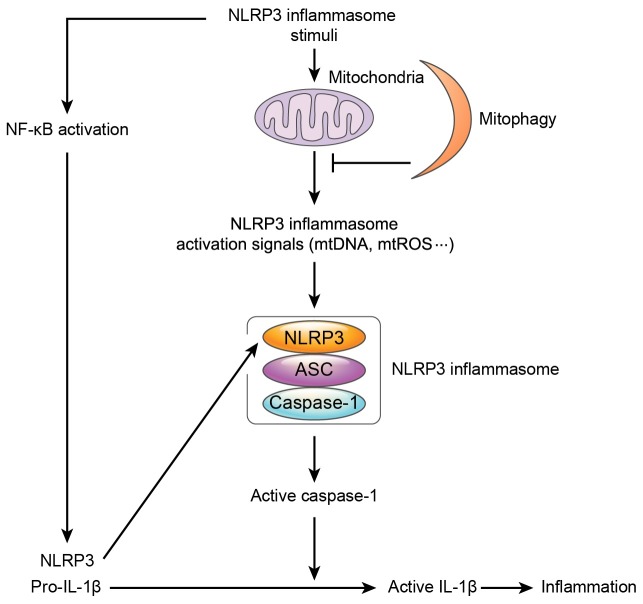
The NLRP3 inflammasome is activated by a variety of external or host-derived stimuli and its activation initiates an inflammatory response through caspase-1 activation, resulting in inflammatory cytokine IL-1β maturation and secretion. The NLRP3 inflammasome activation is a kind of innate immune response, most likely mediated by myeloid cells acting as a host defense mechanism. However, if this activation is not properly regulated, excessive inflammation induced by overactivated NLRP3 inflammasome can be detrimental to the host, causing tissue damage and organ dysfunction, eventually causing several diseases. Previous studies have suggested that mitochondrial damage may be a cause of NLRP3 inflammasome activation and autophagy, which is a conserved self-degradation process that negatively regulates NLRP3 inflammasome activation. Recently, mitochondria-selective autophagy, termed mitophagy, has emerged as a central player for maintaining mitochondrial homeostasis through the elimination of damaged mitochondria, leading to the prevention of hyperinflammation triggered by NLRP3 inflammasome activation. In this review, we will first focus on the molecular mechanisms of NLRP3 inflammasome activation and NLRP3 inflammasome-related diseases. We will then discuss autophagy, especially mitophagy, as a negative regulator of NLPP3 inflammasome activation by examining recent advances in research. [BMB Reports 2016; 49(10): 529-535].
NLRP3炎性小体可被多种外部或宿主来源的刺激激活,其激活通过半胱天冬酶-1的激活引发炎症反应,导致炎性细胞因子IL-1β成熟并分泌。NLRP3炎性小体的激活是一种先天性免疫反应,很可能由髓样细胞介导,作为宿主防御机制。然而,如果这种激活没有得到适当调节,NLRP3炎性小体过度激活所诱导的过度炎症可能对宿主有害,导致组织损伤和器官功能障碍,最终引发多种疾病。先前的研究表明,线粒体损伤可能是NLRP3炎性小体激活和自噬的一个原因,自噬是一种保守的自我降解过程,对NLRP3炎性小体激活起负调节作用。最近,线粒体选择性自噬,即线粒体自噬,已成为通过清除受损线粒体来维持线粒体稳态的关键因素,从而预防由NLRP3炎性小体激活引发的过度炎症。在这篇综述中,我们首先将聚焦于NLRP3炎性小体激活的分子机制以及与NLRP3炎性小体相关的疾病。然后,我们将通过审视最近的研究进展,讨论自噬,尤其是线粒体自噬,作为NLRP3炎性小体激活的负调节因子。[《BMB报告》2016年;49(10):529 - 535]