Wright Serena, Hull Tom, Sivyer David B, Pearce David, Pinnegar John K, Sayer Martin D J, Mogg Andrew O M, Azzopardi Elaine, Gontarek Steve, Hyder Kieran
Centre for Environment, Fisheries &Aquaculture Science, Lowestoft Laboratory, Pakefield Road, Lowestoft, NR33 0HT, UK.
School of Environmental Sciences, University of East Anglia, Norwich, NR4 7TJ, UK.
Sci Rep. 2016 Jul 22;6:30164. doi: 10.1038/srep30164.
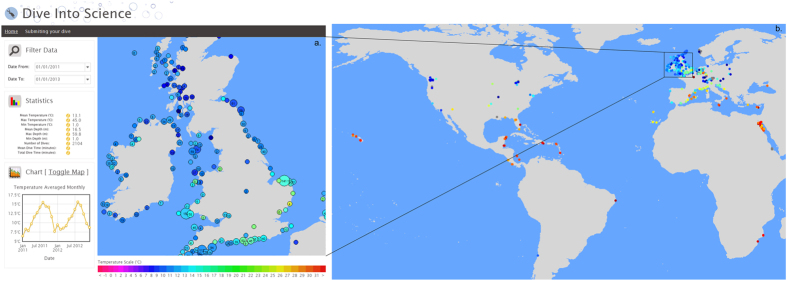
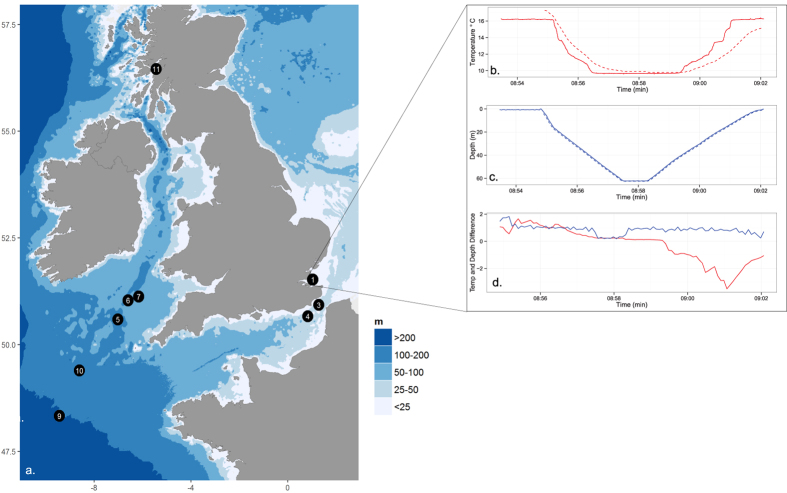
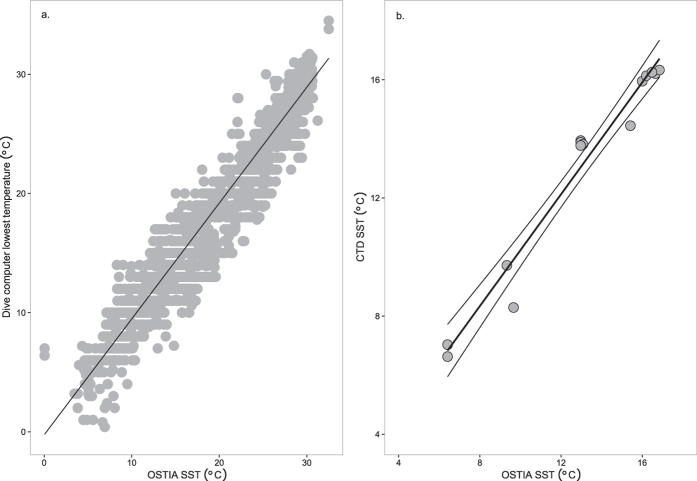
Monitoring temperature of aquatic waters is of great importance, with modelled, satellite and in-situ data providing invaluable insights into long-term environmental change. However, there is often a lack of depth-resolved temperature measurements. Recreational dive computers routinely record temperature and depth, so could provide an alternate and highly novel source of oceanographic information to fill this data gap. In this study, a citizen science approach was used to obtain over 7,000 scuba diver temperature profiles. The accuracy, offset and lag of temperature records was assessed by comparing dive computers with scientific conductivity-temperature-depth instruments and existing surface temperature data. Our results show that, with processing, dive computers can provide a useful and novel tool with which to augment existing monitoring systems all over the globe, but especially in under-sampled or highly changeable coastal environments.
监测水域温度非常重要,模型数据、卫星数据和现场数据为深入了解长期环境变化提供了宝贵的见解。然而,通常缺乏深度解析温度测量数据。休闲潜水电脑会定期记录温度和深度,因此可以提供一种全新的海洋学信息来源,以填补这一数据空白。在本研究中,采用了公民科学方法来获取7000多个水肺潜水员的温度剖面。通过将潜水电脑与科学的电导率-温度-深度仪器以及现有的表层温度数据进行比较,评估了温度记录的准确性、偏差和滞后性。我们的结果表明,经过处理后,潜水电脑可以成为一种有用的新型工具,用于增强全球现有的监测系统,特别是在采样不足或变化剧烈的沿海环境中。