Mottillo Salvatore, Boyle Pierre, Jacobi Cadete Lindsay D, Rouleau Jean-Lucien, Eisenberg Mark J
Divisions of Cardiology and Clinical Epidemiology, Jewish General Hospital-McGill University, Montreal, QC, Canada H3T 1E2; Lady Davis Institute for Medical Research, Jewish General Hospital-McGill University, Montreal, QC, Canada H3T 1E2; Department of Emergency Medicine, McGill University Health Center, Montreal, QC, Canada H4A 3J1; Department of Epidemiology, Biostatistics, and Occupational Health, McGill University, Montreal, QC, Canada H3A 1A2.
Institute of Circulatory and Respiratory Health, Canadian Institutes of Health Research, Ottawa, ON, Canada K1A 0W9.
Can Respir J. 2016;2016:5260134. doi: 10.1155/2016/5260134. Epub 2016 Feb 29.
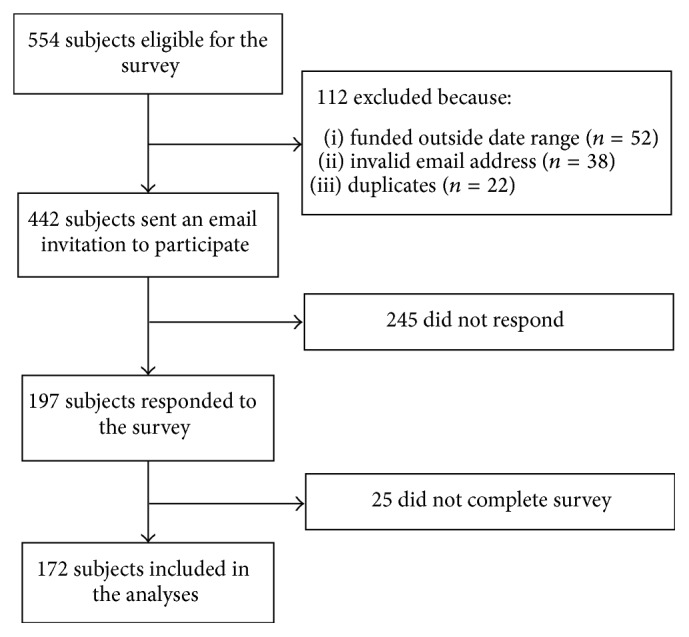
Background. Improving mentorship may help decrease the shortage of young investigators (graduate students, postdoctoral fellows, and new investigators) available to work as independent researchers in cardiovascular and respiratory health. Objectives. To determine (1) the mentoring practices for trainees affiliated with the Canadian Institutes of Health Research (CIHR), Institute of Circulatory and Respiratory Health (ICRH), (2) the positive attributes of mentors, and (3) the recommendations regarding what makes good mentorship. Methods. We conducted a survey and descriptive analysis of young investigators with a CIHR Training and Salary Award from 2010 to 2013 or who submitted an abstract to the ICRH 2014 Young Investigators Forum. Clinicians were compared to nonclinicians. Results. Of 172 participants, 7.0% had no mentor. Only 43.6% had defined goals and 40.7% had defined timelines, while 54.1% had informal forms of mentorship. A significant proportion (33.1%) felt that their current mentorship did not meet their needs. Among clinicians, 22.2% would not have chosen the same mentor again versus 11.4% of nonclinicians. All participants favored mentors who provided guidance on career and work-life balance. Suggestions for improved mentoring included formal mentorship, increased networking, and quality assurance. Conclusion. There is an important need to improve mentoring in cardiovascular and respiratory health.
背景。改善导师指导可能有助于减少心血管和呼吸健康领域中可供担任独立研究员的年轻研究人员(研究生、博士后和新研究员)的短缺。目标。确定(1)与加拿大卫生研究院(CIHR)循环与呼吸健康研究所(ICRH)相关的受训人员的导师指导实践,(2)导师的积极特质,以及(3)关于优质导师指导要素的建议。方法。我们对2010年至2013年获得CIHR培训与薪资奖励或向ICRH 2014年青年研究员论坛提交摘要的年轻研究员进行了调查和描述性分析。将临床医生与非临床医生进行了比较。结果。在172名参与者中,7.0%没有导师。只有43.6%有明确的目标,40.7%有明确的时间安排,而54.1%有非正式的导师指导形式。很大一部分(33.1%)人认为他们目前的导师指导不符合他们的需求。在临床医生中,22.2%不会再次选择同一位导师,而非临床医生的这一比例为11.4%。所有参与者都青睐能在职业和工作 - 生活平衡方面提供指导的导师。关于改善导师指导的建议包括正式的导师指导、加强人际网络和质量保证。结论。迫切需要改善心血管和呼吸健康领域的导师指导。