Corbett Blythe A, Muscatello Rachael A, Blain Scott D
Department of Psychiatry and Behavioral Sciences, Vanderbilt UniversityNashville, TN, USA; Vanderbilt Brain Institute, Neuroscience Graduate Program, Vanderbilt UniversityNashville, TN, USA.
Vanderbilt Brain Institute, Neuroscience Graduate Program, Vanderbilt University Nashville, TN, USA.
Front Neurosci. 2016 Jun 23;10:278. doi: 10.3389/fnins.2016.00278. eCollection 2016.
For many children with Autism Spectrum Disorder (ASD), social interactions can be stressful. Previous research shows that youth with ASD exhibit greater physiological stress response during peer interaction, compared to typically developing (TD) peers. Heightened sensory sensitivity may contribute to maladaptive patterns of stress and anxiety. The current study investigated between-group differences in stress response to peer interaction, as well as the role of sensory sensitivity.
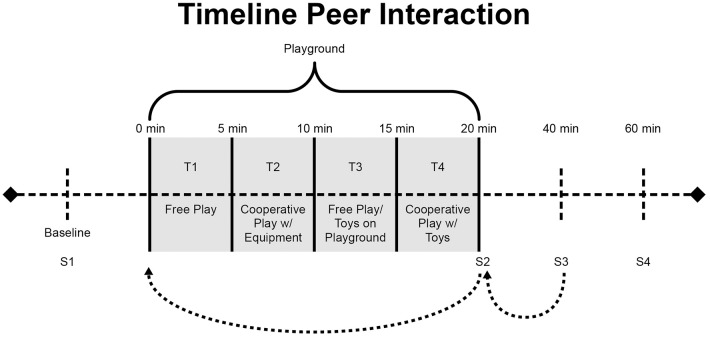
Participants included 80 children (40 ASD) between 8 and 12 years. Children participated in the peer interaction paradigm (PIP), an ecologically valid protocol that simulates real-world social interaction. Salivary cortisol was collected before and after the 20 min PIP. Parents completed questionnaires pertaining to child stress (Stress Survey Schedule) and sensory sensitivity (Short Sensory Profile). Statistical analyses included t-tests and ANCOVA models to examine between-group differences in cortisol and play; Pearson correlations to determine relations between cortisol, play, and questionnaire scores; and moderation analyses to investigate interactions among variables.
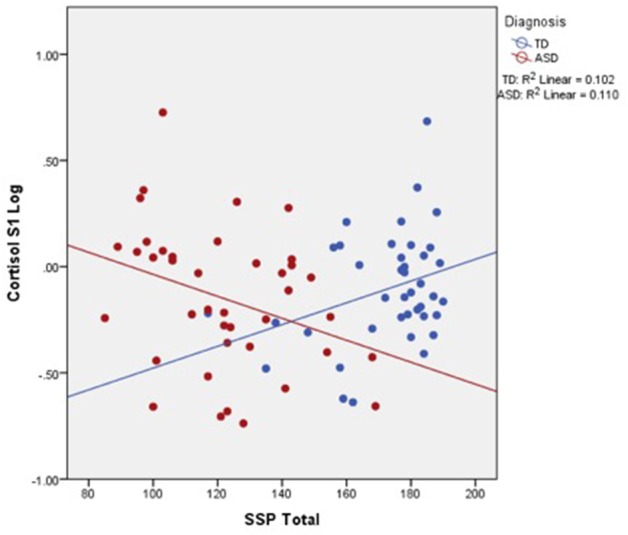
Controlling for baseline cortisol values, children with ASD showed significantly higher cortisol levels than TD peers, in response to the PIP [F (1, 77) = 5.77, p = 0.02]. Cortisol during play was negatively correlated with scores on the SSP (r = -0.242, p = 0.03), and positively correlated with SSS (r = 0.273, p = 0.02) indicating that higher cortisol was associated with greater sensory sensitivity (lower SSP reflects more impairment) and enhanced stress in various contexts (higher SSS reflects more stress). Furthermore, diagnosis was a significant moderator of the relation between cortisol and SSP, at multiple time points during the PIP (p < 0.05).
The current study extends previous findings by showing that higher physiological arousal during play is associated with heightened sensory sensitivity and a pattern of increased stress in various contexts. RESULTS are discussed in a broader context, emphasizing the need to examine relationships between social, behavioral, and physiological profiles in ASD to enhance understanding and improve treatments aimed at ameliorating stress and sensory dysfunction, while enhancing social skills.
对于许多患有自闭症谱系障碍(ASD)的儿童来说,社交互动可能会带来压力。先前的研究表明,与发育正常(TD)的同龄人相比,患有ASD的青少年在同伴互动过程中表现出更大的生理应激反应。更高的感官敏感性可能导致压力和焦虑的适应不良模式。本研究调查了同伴互动应激反应的组间差异以及感官敏感性的作用。
参与者包括80名8至12岁的儿童(40名患有ASD)。儿童参与了同伴互动范式(PIP),这是一种模拟现实世界社交互动的生态有效方案。在20分钟的PIP前后收集唾液皮质醇。父母完成了与儿童压力(压力调查问卷)和感官敏感性(简短感官概况)相关的问卷。统计分析包括t检验和协方差分析模型,以检查皮质醇和游戏中的组间差异;Pearson相关性分析以确定皮质醇、游戏和问卷分数之间的关系;以及调节分析以研究变量之间的相互作用。
在控制基线皮质醇值后,患有ASD的儿童在PIP后显示出比TD同龄人显著更高的皮质醇水平[F(1, 77)= 5.77,p = 0.02]。游戏期间的皮质醇与SSP得分呈负相关(r = -0.242,p = 0.03),与SSS呈正相关(r = 0.273,p = 0.02),表明更高的皮质醇与更高的感官敏感性(更低的SSP反映更多的损伤)和各种情境下增强的压力(更高的SSS反映更多的压力)相关。此外,在PIP期间的多个时间点,诊断是皮质醇与SSP之间关系的显著调节因素(p < 0.05)。
本研究扩展了先前的发现,表明游戏期间更高的生理唤醒与更高的感官敏感性以及各种情境下压力增加的模式相关。在更广泛的背景下讨论了结果,强调需要检查ASD中社交、行为和生理特征之间的关系,以增强理解并改进旨在减轻压力和感官功能障碍同时提高社交技能的治疗方法。