Macedo Fabrício N, Mesquita Thassio R R, Melo Vitor U, Mota Marcelo M, Silva Tharciano L T B, Santana Michael N, Oliveira Larissa R, Santos Robervan V, Miguel Dos Santos Rodrigo, Lauton-Santos Sandra, Santos Marcio R V, Barreto Andre S, Santana-Filho Valter J
Laboratory of Cardiovascular Pharmacology, Department of Physiology, Federal University of Sergipe Sao Cristovao, Brazil.
Laboratory of Cardiovascular Biology and Oxidative Stress, Department of Physiology, Federal University of Sergipe Sao Cristovao, Brazil.
Front Physiol. 2016 Jun 28;7:265. doi: 10.3389/fphys.2016.00265. eCollection 2016.
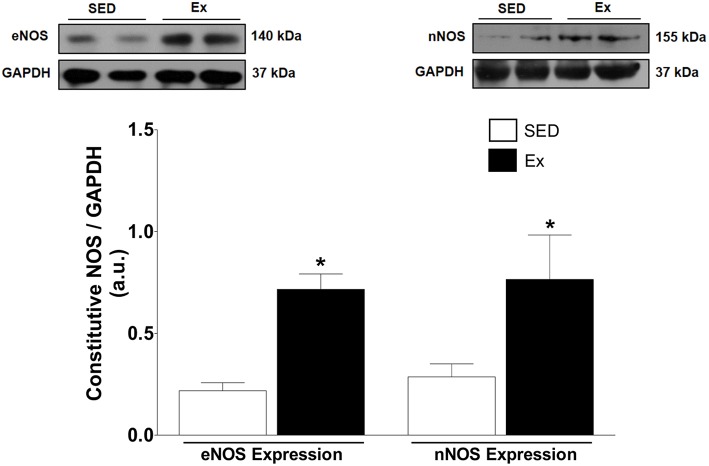
Resistance training is one of the most common kind of exercise used nowadays. Long-term high-intensity resistance training are associated with deleterious effects on vascular adjustments. On the other hand, is unclear whether low-intensity resistance training (LI-RT) is able to induce systemic changes in vascular tone. Thus, we aimed to evaluate the effects of chronic LI-RT on endothelial nitric oxide (NO) bioavailability of mesenteric artery and cardiovascular autonomic modulation in healthy rats. Wistar animals were divided into two groups: exercised (Ex) and sedentary (SED) rats submitted to the resistance (40% of 1RM) or fictitious training for 8 weeks, respectively. After LI-RT, hemodynamic measurements and cardiovascular autonomic modulation by spectral analysis were evaluated. Vascular reactivity, NO production and protein expression of endothelial and neuronal nitric oxide synthase isoforms (eNOS and nNOS, respectively) were evaluated in mesenteric artery. In addition, cardiac superoxide anion production and ventricle morphological changes were also assessed. In vivo measurements revealed a reduction in mean arterial pressure and heart rate after 8 weeks of LI-RT. In vitro studies showed an increased acetylcholine (ACh)-induced vasorelaxation and greater NOS dependence in Ex than SED rats. Hence, decreased phenylephrine-induced vasoconstriction was found in Ex rats. Accordingly, LI-RT increased the NO bioavailability under basal and ACh stimulation conditions, associated with upregulation of eNOS and nNOS protein expression in mesenteric artery. Regarding autonomic control, LI-RT increased spontaneous baroreflex sensitivity, which was associated to reduction in both, cardiac and vascular sympathetic modulation. No changes in cardiac superoxide anion or left ventricle morphometric parameters after LI-RT were observed. In summary, these results suggest that RT promotes beneficial vascular adjustments favoring augmented endothelial NO bioavailability and reduction of sympathetic vascular modulation, without evidence of cardiac overload.
阻力训练是目前最常用的运动类型之一。长期高强度阻力训练与血管调节的有害影响有关。另一方面,尚不清楚低强度阻力训练(LI-RT)是否能够引起血管张力的全身性变化。因此,我们旨在评估慢性LI-RT对健康大鼠肠系膜动脉内皮一氧化氮(NO)生物利用度和心血管自主神经调节的影响。将Wistar动物分为两组:分别进行阻力训练(1RM的40%)或虚拟训练8周的运动组(Ex)和久坐组(SED)大鼠。LI-RT后,通过频谱分析评估血流动力学测量和心血管自主神经调节。评估肠系膜动脉的血管反应性、NO生成以及内皮和神经元一氧化氮合酶同工型(分别为eNOS和nNOS)的蛋白表达。此外,还评估了心脏超氧阴离子生成和心室形态变化。体内测量显示,LI-RT 8周后平均动脉压和心率降低。体外研究表明,与SED大鼠相比,Ex大鼠乙酰胆碱(ACh)诱导的血管舒张增加且对一氧化氮合酶的依赖性更强。因此,在Ex大鼠中发现去氧肾上腺素诱导的血管收缩减弱。相应地,LI-RT在基础和ACh刺激条件下增加了NO生物利用度,这与肠系膜动脉中eNOS和nNOS蛋白表达上调有关。关于自主神经控制,LI-RT增加了自发压力反射敏感性,这与心脏和血管交感神经调节的降低有关。LI-RT后未观察到心脏超氧阴离子或左心室形态学参数的变化。总之,这些结果表明,阻力训练促进有益的血管调节,有利于增加内皮NO生物利用度和降低交感神经血管调节,且无心脏负荷增加的证据。