Gaudelus Baptiste, Virgile Jefferson, Geliot Sabrina, Franck Nicolas
Service Universitaire de Réhabilitation, CL3R, Le Vinatier Hospital , Bron , France.
Service Universitaire de Réhabilitation, CL3R, Le Vinatier Hospital, Bron, France; Département de Réhabilitation Psycho-sociale, St Cyr au Mont d'Or Hospital, St Cyr au Mont d'Or, France.
Front Psychiatry. 2016 Jun 21;7:105. doi: 10.3389/fpsyt.2016.00105. eCollection 2016.
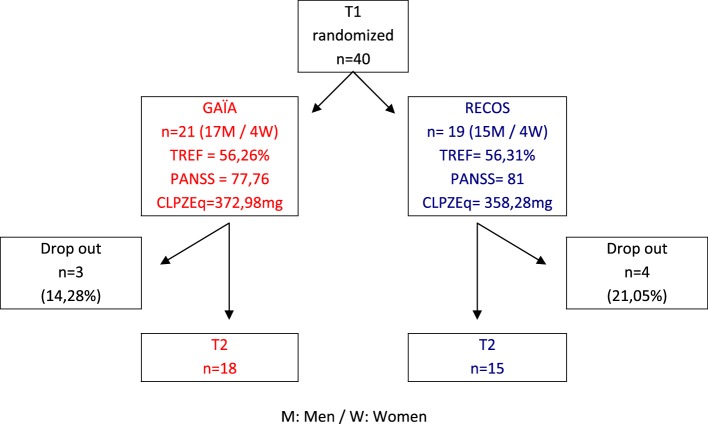
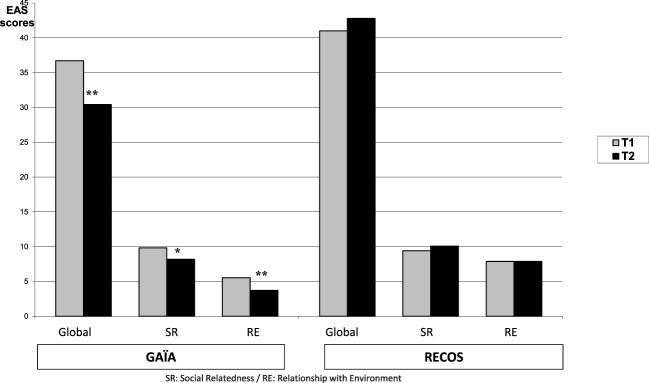
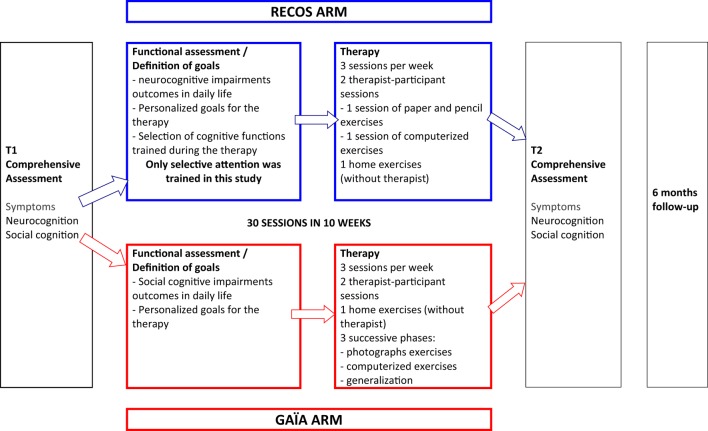
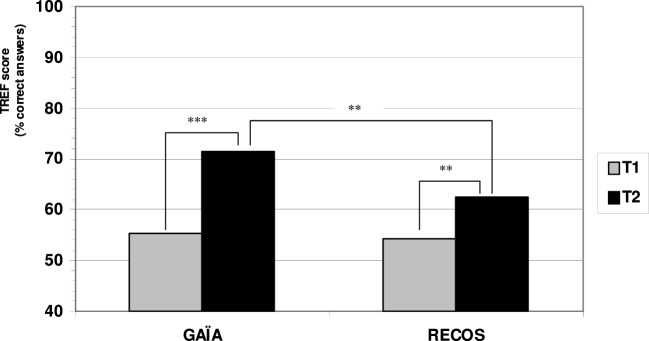
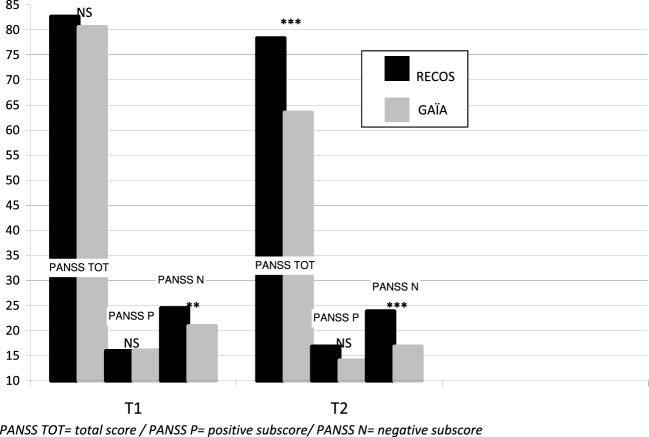
Cognitive impairments associated with schizophrenia are very frequent. They concern both neurocognition and social cognition, including facial emotion recognition. These impairments have a negative impact on the daily functioning, in particular the social and vocational rehabilitation of people with schizophrenia. Previous studies in this area clearly demonstrated the interest of cognitive remediation to improve neurocognitive and social cognitive functioning in schizophrenia. They also established clear links between facial emotion recognition skills and attentional processes. The present study compares the GAÏA s-face program (GAÏA arm), which focuses on facial emotion recognition processes, with the RECOS program (RECOS arm), a neurocognitive remediation therapy focusing on selective attention. Forty people with schizophrenia were randomly distributed between each study arm and assessed pre- (T1) and post- (T2) therapy. The single-blind assessment focused on facial emotion recognition (the main criteria), symptoms, social and subjective functioning, and neurocognitive and social cognitive performance. Both programs were conducted by nurses after a 3-day training session. The study showed a significant improvement in facial emotion recognition performance in both groups, with a significantly larger effect in the GAÏA arm. Symptoms and social functioning also improved in the GAÏA arm, and certain neurocognitive and social cognitive processes improved in both study arms. Further studies are recommended, with larger population samples and a follow-up assessing the long-term preservation of these improvements.
与精神分裂症相关的认知障碍非常常见。它们涉及神经认知和社会认知,包括面部表情识别。这些障碍对日常功能有负面影响,尤其是对精神分裂症患者的社会和职业康复。该领域先前的研究清楚地表明了认知矫正对改善精神分裂症患者神经认知和社会认知功能的作用。它们还明确了面部表情识别技能与注意力过程之间的联系。本研究将专注于面部表情识别过程的GAÏA面部程序(GAÏA组)与专注于选择性注意力的神经认知矫正疗法RECOS程序(RECOS组)进行了比较。40名精神分裂症患者被随机分配到每个研究组,并在治疗前(T1)和治疗后(T2)进行评估。单盲评估集中在面部表情识别(主要标准)、症状、社会和主观功能以及神经认知和社会认知表现上。两个程序均由护士在为期3天的培训课程后实施。研究表明,两组的面部表情识别表现均有显著改善,GAÏA组的效果显著更大。GAÏA组的症状和社会功能也有所改善,两个研究组的某些神经认知和社会认知过程均有所改善。建议进行进一步的研究,采用更大的人群样本并进行随访,以评估这些改善的长期保持情况。