Li Qiuxia, Li Li, Bi Liqi, Xiao Changhong, Lin Zhiming, Cao Shuangyan, Liao Zetao, Gu Jieruo
The Third Affiliated Hospital of Sun Yat-sen University, Guangdong, China.
China-Japan Union Hospital of Jilin University, Changchun, China.
Trials. 2016 Jul 22;17(1):337. doi: 10.1186/s13063-016-1438-6.
Ankylosing spondylitis (AS) is a chronic inflammatory autoimmune disease. Kunxian capsule, a Chinese patent medicine which has been used in the treatment of immunologic diseases for many years in China, has anti-inflammatory and immunoregulatory effects. This study investigates the efficacy and safety of Kunxian capsules in the treatment of AS.
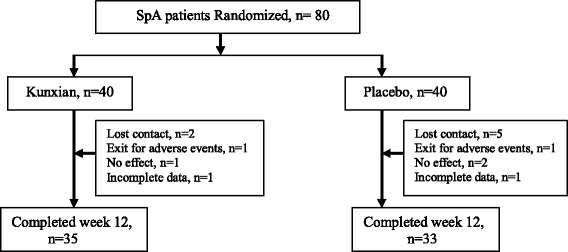
This was a randomized, double-blind, parallel control clinical trial involving 80 patients with AS who fulfilled the modified New York criteria (1984) and had active disease defined by a Bath Ankylosing Spondylitis Disease Activity Index (BASDAI) ≥40 mm under background stable nonsteroidal anti-inflammatory drugs (NSAIDs) for more than 4 weeks. Patients were randomly divided into two groups, the Kunxian group and the placebo group, and Kunxian (0.6 g, three times per day) and the placebo were provided for 12 weeks. The primary endpoint was the Assessment of SpondyloArthritis international Society (ASAS) 20 response rate at week 12. The secondary endpoints were ASAS 40, BASDAI 50, the Bath Ankylosing Spondylitis Functional Index (BASFI), Bath Ankylosing Spondylitis Metrology Index (BASMI), and Ankylosing Spondylitis Disease Activity Score on the basis of C-reactive protein level (ASDAS-CRP) at weeks 2, 6, and 12.
The primary endpoint of ASAS 20 at week 12 was achieved in 13 of 35 patients (37.1 %) among the Kunxian group, compared with 4 of 33 (12.1 %) in the placebo group (p < 0.05). Significant improvement (BASDAI 50) was also observed between the Kunxian group and the placebo group at week 6 (14 (40 %) and 5 (15.5 %), respectively, p < 0.05). At weeks 2, 6, and 12, the ASDAS-CRP level of the Kunxian group was significantly lower than that of the placebo group, especially at week 6 (p < 0.01). Kunxian obviously reduced CRP levels compared to placebo at weeks 2, 6, and 12 (p < 0.05). Compared with the placebo, Kunxian was associated with greater improvements in signs and symptoms of patients with AS from the baseline to week 12, and significant intergroup differences of additional composite indices of disease activity (i.e., erythrocyte sedimentation rate, patient global assessment of disease activity, total back pain, level of morning stiffness, tender joints, and BASFI scores) were also observed.
Kunxian capsule significantly decreased the disease activity of patients with AS.
NCT00953979 . Registered on 5 August 2009.
强直性脊柱炎(AS)是一种慢性炎症性自身免疫性疾病。昆仙胶囊是一种在中国已用于治疗免疫性疾病多年的中成药,具有抗炎和免疫调节作用。本研究旨在探讨昆仙胶囊治疗AS的疗效和安全性。
这是一项随机、双盲、平行对照临床试验,纳入80例符合修订的纽约标准(1984年)且在背景稳定的非甾体抗炎药(NSAIDs)治疗4周以上的情况下,巴斯强直性脊柱炎疾病活动指数(BASDAI)≥40 mm的活动性AS患者。患者被随机分为两组,昆仙组和安慰剂组,给予昆仙(0.6 g,每日3次)和安慰剂,疗程12周。主要终点是第12周时国际脊柱关节炎协会(ASAS)20反应率。次要终点是第2、6和12周时的ASAS 40、BASDAI 50、巴斯强直性脊柱炎功能指数(BASFI)、巴斯强直性脊柱炎计量指数(BASMI)以及基于C反应蛋白水平的强直性脊柱炎疾病活动评分(ASDAS-CRP)。
昆仙组35例患者中有13例(37.1%)在第12周达到ASAS 20主要终点,而安慰剂组33例中有4例(12.1%)达到(p < 0.05)。在第6周时,昆仙组和安慰剂组之间也观察到显著改善(BASDAI 50)(分别为14例(40%)和5例(15.5%),p < 0.05)。在第2、6和12周时,昆仙组的ASDAS-CRP水平显著低于安慰剂组,尤其是在第6周(p < 0.01)。与安慰剂相比,昆仙在第2、6和12周时明显降低了CRP水平(p < 0.05)。与安慰剂相比,昆仙使AS患者从基线到第12周的体征和症状有更大改善,并且还观察到疾病活动的其他综合指标(即红细胞沉降率、患者对疾病活动的整体评估、总背痛、晨僵程度、压痛关节和BASFI评分)存在显著组间差异。
昆仙胶囊显著降低了AS患者的疾病活动度。
NCT00953979。于2009年8月5日注册。