Last Nicholas B, Kolmakova-Partensky Ludmila, Shane Tania, Miller Christopher
Department of Biochemistry, Howard Hughes Medical Institute, Brandeis University, Waltham, United States.
Elife. 2016 Jul 23;5:e18767. doi: 10.7554/eLife.18767.
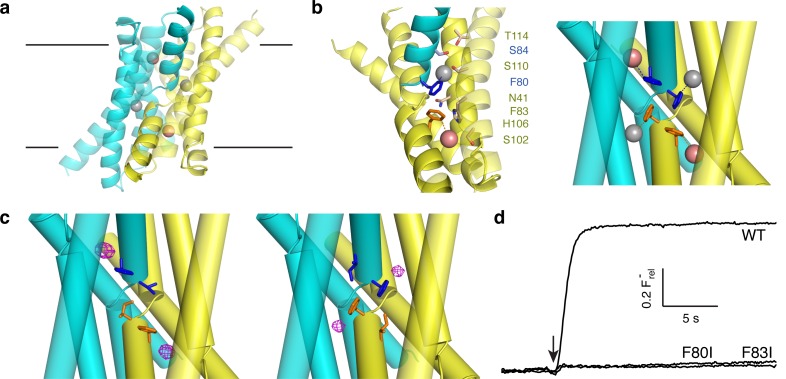
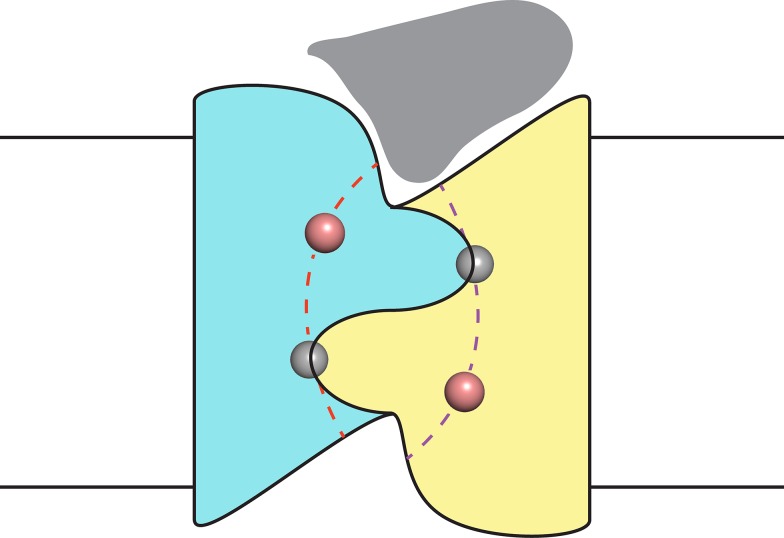
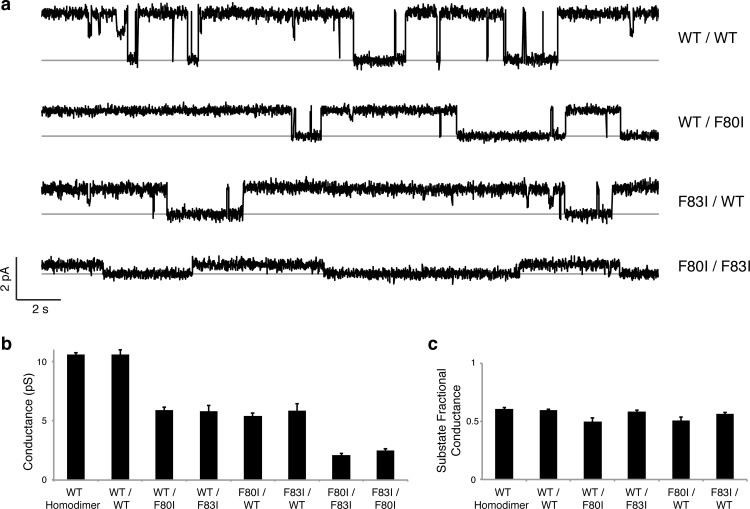
The Fluc family of F(-) ion channels protects prokaryotes and lower eukaryotes from the toxicity of environmental F(-). In bacteria, these channels are built as dual-topology dimers whereby the two subunits assemble in antiparallel transmembrane orientation. Recent crystal structures suggested that Fluc channels contain two separate ion-conduction pathways, each with two F(-) binding sites, but no functional correlates of this unusual architecture have been reported. Experiments here fill this gap by examining the consequences of mutating two conserved F(-)-coordinating phenylalanine residues. Substitution of each phenylalanine specifically extinguishes its associated F(-) binding site in crystal structures and concomitantly inhibits F(-) permeation. Functional analysis of concatemeric channels, which permit mutagenic manipulation of individual pores, show that each pore can be separately inactivated without blocking F(-) conduction through its symmetry-related twin. The results strongly support dual-pathway architecture of Fluc channels.
F(-)离子通道的Fluc家族保护原核生物和低等真核生物免受环境中F(-)的毒性影响。在细菌中,这些通道以双拓扑二聚体形式构建,两个亚基以反平行跨膜方向组装。最近的晶体结构表明,Fluc通道包含两条独立的离子传导途径,每条途径有两个F(-)结合位点,但尚未报道这种不寻常结构的功能相关性。本文通过研究两个保守的F(-)配位苯丙氨酸残基突变的后果填补了这一空白。每个苯丙氨酸的取代在晶体结构中特异性地消除了其相关的F(-)结合位点,并同时抑制F(-)通透。对串联通道的功能分析允许对单个孔进行诱变操作,结果表明每个孔可以单独失活而不会阻断通过其对称相关孪生孔的F(-)传导。这些结果有力地支持了Fluc通道的双途径结构。