Department of Neurology, Washington University, St Louis, Missouri2The Charles F. and Joanne Knight Alzheimer's Disease Research Center, Washington University, St Louis, Missouri.
The Charles F. and Joanne Knight Alzheimer's Disease Research Center, Washington University, St Louis, Missouri3Department of Radiology, Washington University, St Louis, Missouri.
JAMA Neurol. 2016 Sep 1;73(9):1070-7. doi: 10.1001/jamaneurol.2016.2078.
In vivo tau imaging may become a diagnostic marker for Alzheimer disease (AD) and provides insights into the pathophysiology of AD.
To evaluate the usefulness of [18F]-AV-1451 positron emission tomography (PET) imaging to stage AD and assess the associations among β-amyloid (Aβ), tau, and volume loss.
DESIGN, SETTING, AND PARTICIPANTS: An imaging study conducted at Knight Alzheimer Disease Research Center at Washington University in St Louis, Missouri. A total of 59 participants who were cognitively normal (CN) (Clinical Dementia Rating [CDR] score, 0) or had AD dementia (CDR score, >0) were included.
Standardized uptake value ratio (SUVR) of [18F]-AV-1451 in the hippocampus and a priori-defined AD cortical signature regions, cerebrospinal fluid Aβ42, hippocampal volume, and AD signature cortical thickness.
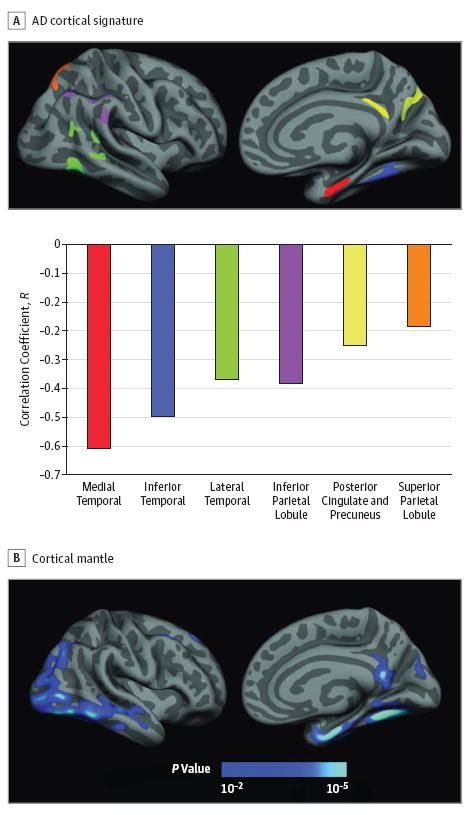
Of the 59 participants, 38 (64%) were male; mean (SD) age was 74 (6) years. The [18F]-AV-1451 SUVR in the hippocampus and AD cortical signature regions distinguished AD from CN participants (area under the receiver operating characteristic curve range [95% CI], 0.89 [0.73-1.00] to 0.98 [0.92-1.00]). An [18F]-AV-1451 SUVR cutoff value of 1.19 (sensitivity, 100%; specificity, 86%) from AD cortical signature regions best separated cerebrospinal fluid Aβ42-positive (Aβ+) AD from cerebrospinal fluid Aβ42-negative (Aβ-) CN participants. This same cutoff also divided Aβ+ CN participants into low vs high tau groups. Moreover, the presence of Aβ+ was associated with an elevated [18F]-AV-1451 SUVR in AD cortical signature regions (Aβ+ participants: mean [SD], 1.3 [0.3]; Aβ- participants: 1.1 [0.1]; F = 4.3, P = .04) but not in the hippocampus. The presence of Aβ+ alone was not related to hippocampal volume or AD signature cortical thickness. An elevated [18F]-AV-1451 SUVR was associated with volumetric loss in both the hippocampus and AD cortical signature regions. The observed [18F]-AV-1451 SUVR volumetric association was modified by Aβ status in the hippocampus but not in AD cortical signature regions. An inverse association between hippocampal [18F]-AV-1451 SUVR and volume was seen in Aβ+ participants (R2 = 0.55; P < .001) but not Aβ- (R2 = 0; P = .97) participants.
Use of [18F]-AV-1451 has a potential for staging of the preclinical and clinical phases of AD. β-Amyloid interacts with hippocampal and cortical tauopathy to affect neurodegeneration. In the absence of Aβ, hippocampal tau deposition may be insufficient for the neurodegenerative process that leads to AD.
体内 tau 成像可能成为阿尔茨海默病(AD)的诊断标志物,并深入了解 AD 的病理生理学。
评估 [18F]-AV-1451 正电子发射断层扫描(PET)成像在 AD 分期中的作用,并评估 β-淀粉样蛋白(Aβ)、tau 和体积损失之间的相关性。
设计、地点和参与者:在密苏里州圣路易斯华盛顿大学的 Knight Alzheimer 疾病研究中心进行的一项影像学研究。共有 59 名认知正常(CN)(临床痴呆评分[CDR],0)或 AD 痴呆(CDR 评分,>0)的参与者入选。
[18F]-AV-1451 在海马体和预先定义的 AD 皮质特征区域的标准化摄取值比(SUVR)、脑脊液 Aβ42、海马体体积和 AD 特征皮质厚度。
59 名参与者中,38 名(64%)为男性;平均(SD)年龄为 74(6)岁。[18F]-AV-1451 海马体和 AD 皮质特征区域的 SUVR 可区分 AD 与 CN 参与者(受试者工作特征曲线下面积范围[95%CI],0.89 [0.73-1.00] 至 0.98 [0.92-1.00])。AD 皮质特征区域中 1.19(敏感性,100%;特异性,86%)的 [18F]-AV-1451 SUVR 截断值可最佳区分脑脊液 Aβ42 阳性(Aβ+)AD 与脑脊液 Aβ42 阴性(Aβ-)CN 参与者。相同的截断值还可将 Aβ+CN 参与者分为低 tau 组和高 tau 组。此外,Aβ+的存在与 AD 皮质特征区域中 [18F]-AV-1451 SUVR 的升高相关(Aβ+参与者:平均[SD],1.3[0.3];Aβ-参与者:1.1[0.1];F=4.3,P=0.04),但与海马体无关。仅存在 Aβ+与海马体体积或 AD 特征皮质厚度无关。升高的 [18F]-AV-1451 SUVR 与海马体和 AD 皮质特征区域的体积损失有关。观察到的 [18F]-AV-1451 SUVR 体积关联在海马体中受 Aβ 状态的影响,但在 AD 皮质特征区域中不受影响。在 Aβ+参与者中观察到海马体 [18F]-AV-1451 SUVR 与体积之间的负相关(R2=0.55;P<0.001),而在 Aβ-参与者中则无(R2=0;P=0.97)。
[18F]-AV-1451 的使用有可能对 AD 的临床前和临床阶段进行分期。β-淀粉样蛋白与海马体和皮质 tau 病变相互作用,影响神经退行性变。在没有 Aβ 的情况下,海马体 tau 沉积可能不足以导致 AD 的神经退行性过程。