Childers Jane B, Paik Jae H, Flores Melissa, Lai Gabrielle, Dolan Megan
Department of Psychology, Trinity University.
Psychology Department, San Francisco State University.
Cogn Sci. 2017 Apr;41 Suppl 4(Suppl 4):808-830. doi: 10.1111/cogs.12398. Epub 2016 Jul 25.
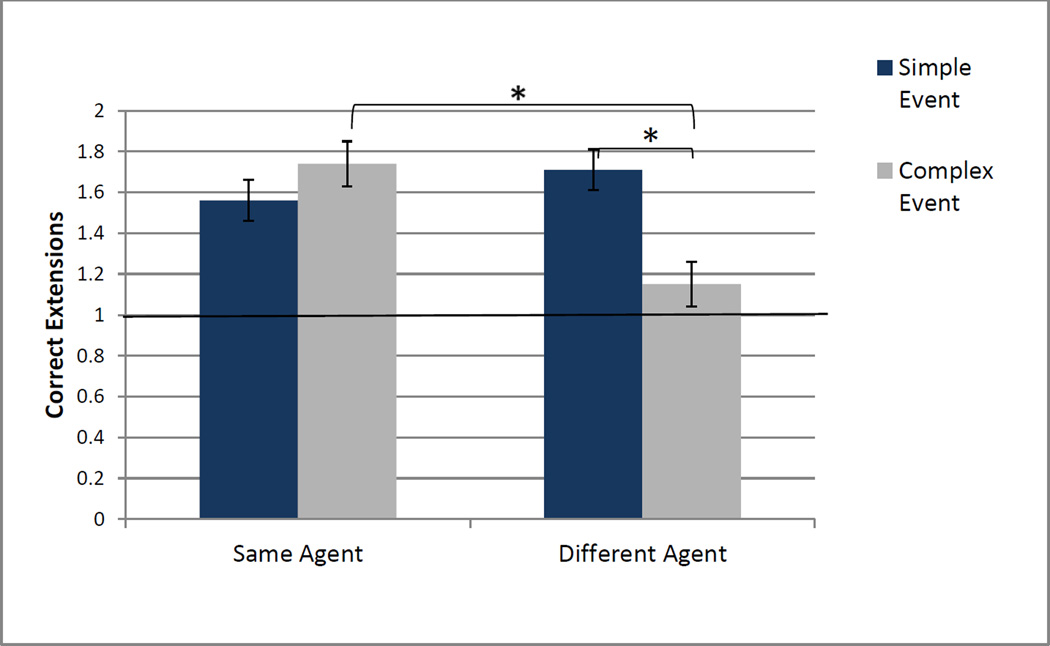
Extending new verbs is important in becoming a productive speaker of a language. Prior results show children have difficulty extending verbs when they have seen events with varied agents. This study further examines the impact of variability on verb learning and asks whether variability interacts with event complexity or differs by language. Children (aged 2½ to 3 years) in the United States, China, Korea, and Singapore learned verbs linked to simple and complex events. Sets of events included one or three agents, and children were asked to extend the verb at test. Children learning verbs linked to simple movements performed similarly across conditions. However, children learning verbs linked to events with multiple objects were less successful if those events were enacted by multiple agents. A follow-up study rules out an influence of event order. Overall, similar patterns of results emerged across languages, suggesting common cognitive processes support children's verb learning.
扩展新动词对于成为一名语言表达丰富的使用者很重要。先前的研究结果表明,当儿童看到由不同施动者参与的事件时,他们在扩展动词方面会遇到困难。本研究进一步考察了变化性对动词学习的影响,并探讨变化性是否与事件复杂性相互作用,或者因语言而异。来自美国、中国、韩国和新加坡的2.5至3岁儿童学习与简单和复杂事件相关的动词。事件集包括一个或三个施动者,并且要求儿童在测试时扩展动词。学习与简单动作相关动词的儿童在各种条件下表现相似。然而,如果与多个物体相关的事件是由多个施动者完成的,那么学习这些动词的儿童则不太成功。一项后续研究排除了事件顺序的影响。总体而言,不同语言中出现了相似的结果模式,这表明共同的认知过程支持儿童的动词学习。