Klopfenstein Michael, Howard Judith, Rossetti Menga, Geissbühler Urs
Vetsuisse Faculty, University of Berne, Berne, 3012, Switzerland.
Clinical Diagnostic Laboratory, Vetsuisse Faculty, University of Berne, Berne, 3012, Switzerland.
BMC Vet Res. 2016 Jul 25;12(1):153. doi: 10.1186/s12917-016-0782-9.
New regulations by the Swiss Federal Food Safety and Veterinary Office provide for the monitoring of breed health by Swiss breeding clubs. In collaboration with the Swiss Bernese Mountain Dog Club, the purpose of this study was to investigate the causes of death in purebred dogs registered by the club and born in 2001 and 2002.
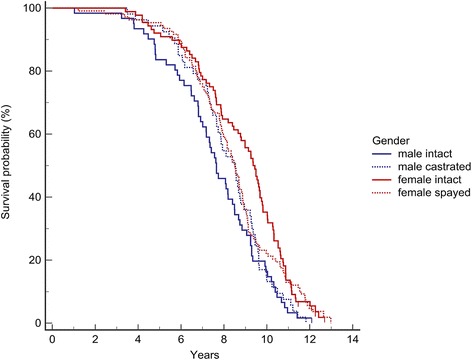
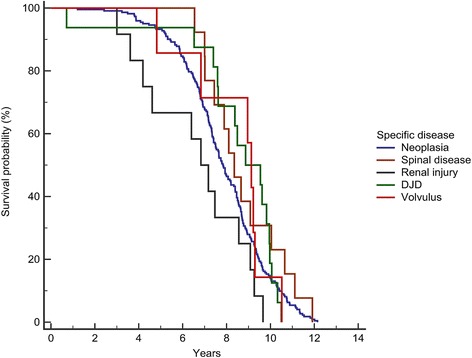
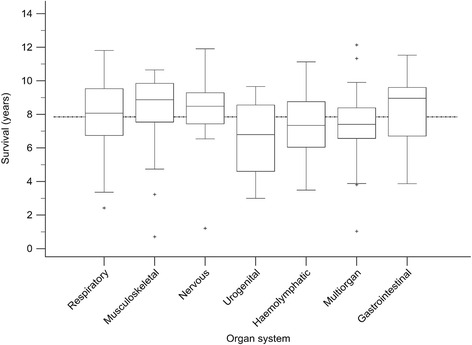
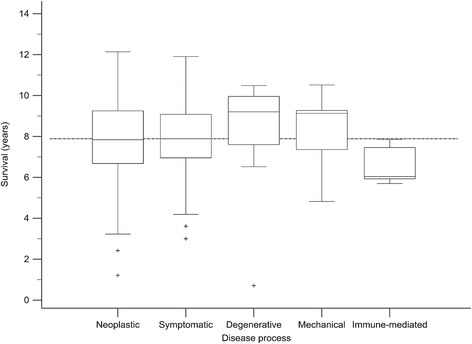
Of a total of 1290 Bernese mountain dogs (BMDs) born in 2001 and 2002 in Switzerland, data was collected from owners and veterinarians using a questionnaire designed for this study from 389 dogs (30.2 %). By the end of the study, 381/389 dogs (97.9 %) had died. The median life expectancy of all dogs was 8.4 years (IQR, 6.9-9.7). Female dogs had a significantly longer median survival (8.8 years; IQR, 7.1-10.3) than male dogs (7.7 years; IQR, 6.6-9.3) (P < 0.00). The cause of death was unknown in 89/381 dogs (23.4 %). For the remaining dogs, the most frequent causes of death were neoplasia (222/381, 58.3 %), degenerative joint disease (16/381, 4.2 %), spinal disorders (13/381, 3.4 %), renal injury (12/381, 3.1 %), and gastric or mesenteric volvulus (7/381, 1.8 %). However, large numbers of dogs were diagnosed with neoplasia without histopathologic or cytologic confirmation. Dogs with neoplasms had a shorter median survival than dogs with other disorders. The shortest median survival (6.8 years) was found for dogs with renal injury.
Findings of this study confirm a high prevalence of neoplasia and associated low life expectancy in BMDs. The results underline a need for more widespread precise diagnostics and further research on malignant tumours in this breed to improve overall breed health.
瑞士联邦食品安全和兽医办公室的新规定要求瑞士育种俱乐部对品种健康状况进行监测。本研究与瑞士伯恩山犬俱乐部合作,旨在调查该俱乐部登记的、于2001年和2002年出生的纯种犬的死亡原因。
在2001年和2002年出生于瑞士的总共1290只伯恩山犬中,使用为本研究设计的问卷从389只犬(30.2%)的主人和兽医处收集了数据。到研究结束时,389只犬中有381只(97.9%)死亡。所有犬的中位预期寿命为8.4岁(四分位距,6.9 - 9.7)。雌性犬的中位生存期(8.8岁;四分位距,7.1 - 10.3)显著长于雄性犬(7.7岁;四分位距,6.6 - 9.3)(P < 0.00)。381只犬中有89只(23.4%)的死亡原因不明。对于其余的犬,最常见的死亡原因是肿瘤(222/381,58.3%)、退行性关节病(16/381,4.2%)、脊柱疾病(13/381,3.4%)、肾损伤(12/381,3.1%)和胃或肠系膜扭转(7/381,1.8%)。然而,大量犬被诊断患有肿瘤但未经组织病理学或细胞学证实。患有肿瘤的犬的中位生存期比患有其他疾病的犬短。肾损伤的犬的中位生存期最短(6.8岁)。
本研究结果证实伯恩山犬中肿瘤患病率高且预期寿命低。结果强调需要更广泛地进行精确诊断,并对该品种的恶性肿瘤进行进一步研究,以改善整体品种健康状况。