Baumann P S, Griffa A, Fournier M, Golay P, Ferrari C, Alameda L, Cuenod M, Thiran J-P, Hagmann P, Do K Q, Conus P
Department of Psychiatry, Unit for Research in Schizophrenia, Center for Psychiatric Neuroscience, Centre Hospitalier Universitaire Vaudois, Lausanne University Hospital (CHUV), University of Lausanne, Lausanne, Switzerland.
Department of Psychiatry, Service of General Psychiatry, Centre Hospitalier Universitaire Vaudois, Lausanne University Hospital (CHUV), Lausanne, Switzerland.
Transl Psychiatry. 2016 Jul 26;6(7):e859. doi: 10.1038/tp.2016.117.
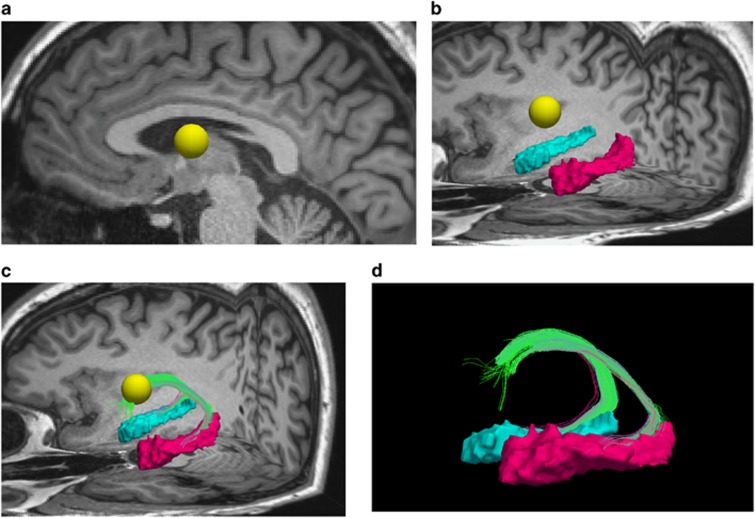
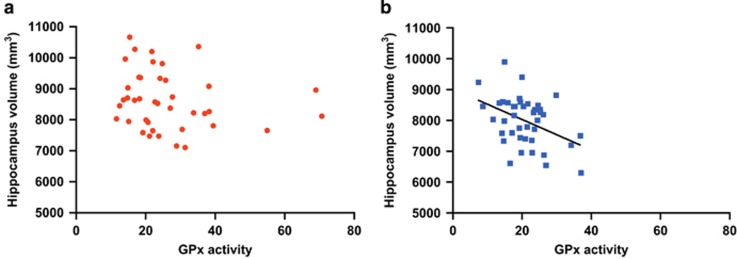
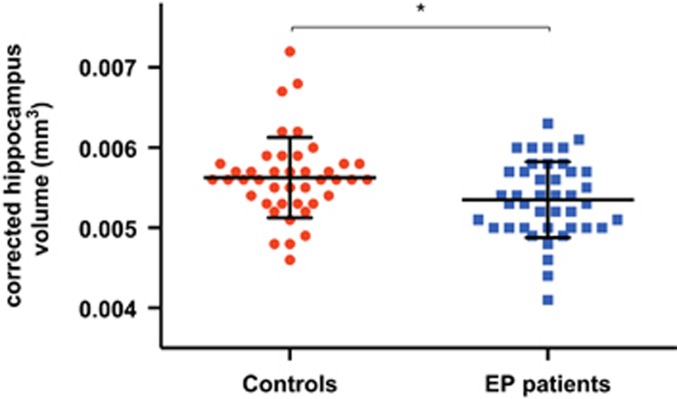
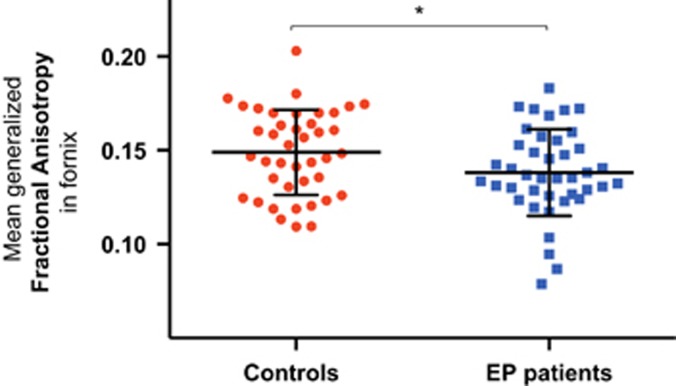
Several lines of evidence implicate the fornix-hippocampus circuit in schizophrenia. In early-phase psychosis, this circuit has not been extensively investigated and the underlying mechanisms affecting the circuit are unknown. The hippocampus and fornix are vulnerable to oxidative stress at peripuberty in a glutathione (GSH)-deficient animal model. The purposes of the current study were to assess the integrity of the fornix-hippocampus circuit in early-psychosis patients (EP), and to study its relationship with peripheral redox markers. Diffusion spectrum imaging and T1-weighted magnetic resonance imaging (MRI) were used to assess the fornix and hippocampus in 42 EP patients compared with 42 gender- and age-matched healthy controls. Generalized fractional anisotropy (gFA) and volumetric properties were used to measure fornix and hippocampal integrity, respectively. Correlation analysis was used to quantify the relationship of gFA in the fornix and hippocampal volume, with blood GSH levels and glutathione peroxidase (GPx) activity. Patients compared with controls exhibited lower gFA in the fornix as well as smaller volume in the hippocampus. In EP, but not in controls, smaller hippocampal volume was associated with high GPx activity. Disruption of the fornix-hippocampus circuit is already present in the early stages of psychosis. Higher blood GPx activity is associated with smaller hippocampal volume, which may support a role of oxidative stress in disease mechanisms.
多项证据表明穹窿 - 海马回路与精神分裂症有关。在早期精神病阶段,该回路尚未得到广泛研究,影响该回路的潜在机制也尚不清楚。在谷胱甘肽(GSH)缺乏的动物模型中,海马和穹窿在青春期前后易受氧化应激影响。本研究的目的是评估早期精神病患者(EP)穹窿 - 海马回路的完整性,并研究其与外周氧化还原标志物的关系。与42名年龄和性别匹配的健康对照相比,使用扩散光谱成像和T1加权磁共振成像(MRI)对42名EP患者的穹窿和海马进行评估。分别使用广义分数各向异性(gFA)和体积特性来测量穹窿和海马的完整性。采用相关分析来量化穹窿中gFA与海马体积、血液GSH水平和谷胱甘肽过氧化物酶(GPx)活性之间的关系。与对照组相比,患者的穹窿gFA较低,海马体积较小。在EP患者中,而非对照组中,较小的海马体积与高GPx活性相关。穹窿 - 海马回路的破坏在精神病早期就已存在。较高的血液GPx活性与较小的海马体积相关,这可能支持氧化应激在疾病机制中的作用。