Al-Kzayer Lika'a Fasih Y, Keizer Peter, Abdulraheem Farah T, Sano Kenji, Kamata Minoru, Sakashita Kazuo, Habbaba Laith A Y, Koike Kenichi
Department of Paediatrics, Shinshu University School of Medicine, 3-1-1, Asahi, Matsumoto, Nagano, 390-8621, Japan.
Department of Emergency Medicine, Dr. G. B. Cross Memorial Hospital, Eastern Health, Clarenville, Newfoundland and Labrador, Canada.
BMC Pediatr. 2016 Jul 26;16:111. doi: 10.1186/s12887-016-0653-3.
Kaposi's sarcoma (KS), an endothelial neoplasm, is associated with human herpes virus (HHV) -8 infection. KS has four clinical sub-types: Mediterranean/classic, African/endemic, human immunodeficiency virus (HIV) -associated/epidemic, and transplantation-related/iatrogenic. Immunosuppression is an important cofactor in KS process. Classic KS (CKS) is exceedingly rare in children and when occurs, it is much more disseminated than adults. The epidemic, HIV-associated and the iatrogenic forms of childhood KS are a result of a profound and acquired T-cell deficiency. To our knowledge, this is the first paediatric KS case report from Iraq. Our patient was showing an unusual aggressive course of the disease while receiving Valproic acid (VPA) of the potential immune-suppressive effect.
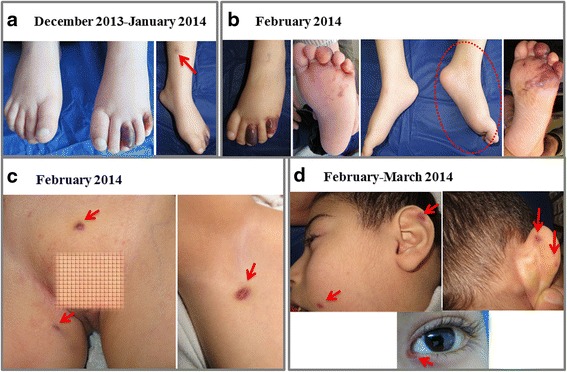
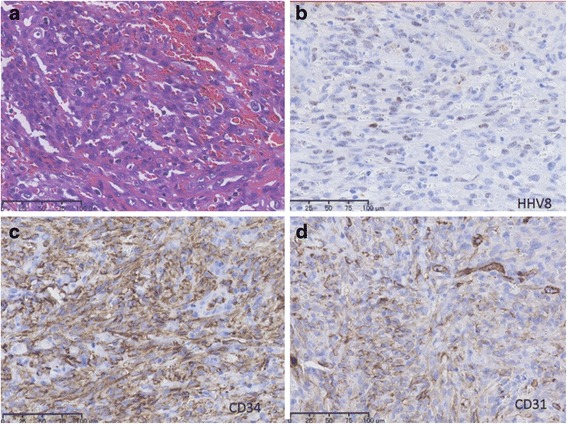
A six-year-old Iraqi boy, who had cerebral palsy (CP) and epilepsy since the age of 9-months, had received VPA to control his seizures. He developed skin discoloration followed by nodules that disseminated proximally from the lower extremities to the groin, face, ears and oral cavity, and then he died from severe respiratory distress after 110 days from the disease evolution. KS diagnosis was proved by a skin biopsy. As the patient was of Arab-Asian ethnicity and was HIV-seronegative status, accordingly, his condition best fitted the classic form of KS. However, recent studies showed the link of VPA with the reactivation of HHV-8. Moreover, accumulated experimental and clinical data elucidated that VPA induces T-cell suppression. Given that there was a lack of facilities to perform the laboratory immunological diagnostic tests in Iraq, the VPA-induced effect on immunity in our case (iatrogenic KS) could not be evaluated.
Our report demonstrates a rare, rapidly progressing paediatric KS case and highlights the possible role of the 5-years' administration of VPA and its challenging effect on cellular immunity based on recent studies. Thus, VPA could have promoted the development of the KS in our patient. This report also recalls the need of paediatricians to consider KS especially when the skin lesion appears at the child's foot even in countries outside the geographical map of the disease.
卡波西肉瘤(KS)是一种内皮肿瘤,与人类疱疹病毒(HHV)-8感染相关。KS有四种临床亚型:地中海/经典型、非洲/地方性、人类免疫缺陷病毒(HIV)相关/流行型以及移植相关/医源性。免疫抑制是KS发病过程中的一个重要辅助因素。经典型KS(CKS)在儿童中极为罕见,一旦发生,其播散程度比成人更严重。儿童期KS的流行型、HIV相关型和医源性形式是严重后天性T细胞缺乏的结果。据我们所知,这是伊拉克首例儿科KS病例报告。我们的患者在接受具有潜在免疫抑制作用的丙戊酸(VPA)时,病情呈现出异常侵袭性的病程。
一名6岁伊拉克男孩,自9个月大起患有脑瘫(CP)和癫痫,一直接受VPA来控制癫痫发作。他出现皮肤变色,随后出现结节,结节从下肢近端向腹股沟、面部、耳朵和口腔播散,在疾病进展110天后,因严重呼吸窘迫死亡。皮肤活检证实为KS诊断。由于该患者为阿拉伯 - 亚洲族裔且HIV血清学阴性,因此,他的病情最符合经典型KS。然而,最近的研究表明VPA与HHV - 8的重新激活有关。此外,积累的实验和临床数据表明VPA可诱导T细胞抑制。鉴于伊拉克缺乏进行实验室免疫诊断测试的设施,无法评估VPA在我们病例中(医源性KS)对免疫的影响。
我们的报告展示了一例罕见的、进展迅速的儿科KS病例,并根据最近的研究强调了5年VPA治疗的可能作用及其对细胞免疫的挑战性影响。因此,VPA可能促进了我们患者KS的发展。本报告还提醒儿科医生,即使在该疾病地理分布范围之外的国家,当儿童足部出现皮肤病变时,也需要考虑KS。