Nikiforuk Aidan M, Leung Anders, Cook Bradley W M, Court Deborah A, Kobasa Darwyn, Theriault Steven S
Applied Biosafety Research Program, National Microbiology Laboratory at the Canadian Science Centre for Human and Animal Health, Public Health Agency of Canada, 1015 Arlington Street, Winnipeg, Manitoba, R3E 3P6, Canada; National Microbiology Laboratory at the J. C. Wilt Infectious Diseases Research Centre, Public Health Agency of Canada, 745 Logan Street, Winnipeg, Manitoba, R3E 3L5, Canada; High Containment Respiratory Viruses Group, Special Pathogens Program, National Microbiology Laboratory at the Canadian Science Centre for Human and Animal Health, Public Health Agency of Canada, 1015 Arlington Street, Winnipeg, Manitoba, R3E 3R2, Canada; Department of Microbiology, The University of Manitoba, Winnipeg, Manitoba, R3T 2N2, Canada.
High Containment Respiratory Viruses Group, Special Pathogens Program, National Microbiology Laboratory at the Canadian Science Centre for Human and Animal Health, Public Health Agency of Canada, 1015 Arlington Street, Winnipeg, Manitoba, R3E 3R2, Canada.
J Virol Methods. 2016 Oct;236:178-183. doi: 10.1016/j.jviromet.2016.07.022. Epub 2016 Jul 25.
Viral Infectious clone systems serve as robust platforms to study viral gene or replicative function by reverse genetics, formulate vaccines and adapt a wild type-virus to an animal host. Since the development of the first viral infectious clone system for the poliovirus, novel strategies of viral genome construction have allowed for the assembly of viral genomes across the identified viral families. However, the molecular profiles of some viruses make their genome more difficult to construct than others. Two factors that affect the difficulty of infectious clone construction are genome length and genome complexity.
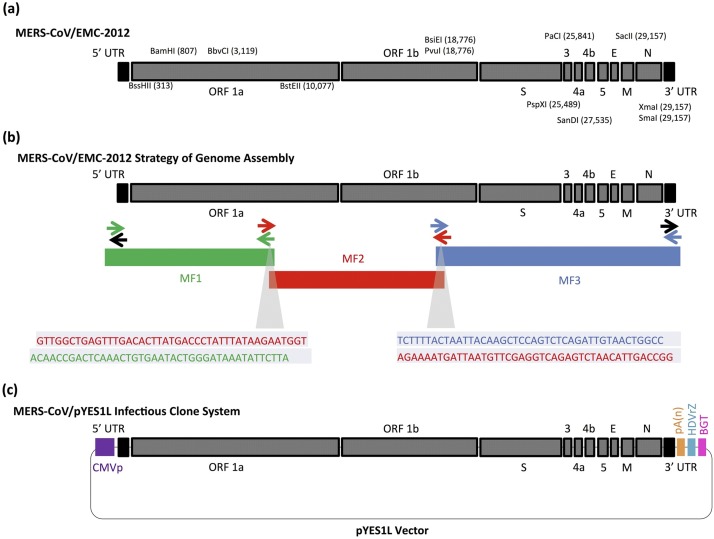
This work examines the available strategies for overcoming the obstacles of assembling the long and complex RNA genomes of coronaviruses and reports one-step construction of an infectious clone system for the Middle East Respiratory Syndrome coronavirus (MERS-CoV) by homologous recombination in S. cerevisiae.
Future use of this methodology will shorten the time between emergence of a novel viral pathogen and construction of an infectious clone system. Completion of a viral infectious clone system facilitates further study of a virus's biology, improvement of diagnostic tests, vaccine production and the screening of antiviral compounds.
病毒感染性克隆系统是通过反向遗传学研究病毒基因或复制功能、研制疫苗以及使野生型病毒适应动物宿主的强大平台。自从首个脊髓灰质炎病毒感染性克隆系统开发以来,新的病毒基因组构建策略已使得跨已识别病毒科组装病毒基因组成为可能。然而,某些病毒的分子特征使其基因组比其他病毒的基因组更难构建。影响感染性克隆构建难度的两个因素是基因组长度和基因组复杂性。
这项工作研究了克服组装冠状病毒长而复杂的RNA基因组障碍的可用策略,并报告了通过酿酒酵母中的同源重组一步构建中东呼吸综合征冠状病毒(MERS-CoV)感染性克隆系统的方法。
该方法的未来应用将缩短新型病毒病原体出现与感染性克隆系统构建之间的时间。病毒感染性克隆系统的完成有助于进一步研究病毒生物学、改进诊断测试、生产疫苗以及筛选抗病毒化合物。