Zhang Zhe-Qing, Lu Qing-Gui, Huang Jie, Jiao Chang-Ya, Huang Shao-Ming, Mao Li-Mei
Department of Nutrition and Food Hygiene, Guangdong Provincial Key Laboratory of Tropical Disease Research, School of Public Health, Southern Medical University, Guangzhou, 510515, People's Republic of China.
BMC Pregnancy Childbirth. 2016 Jul 27;16(1):189. doi: 10.1186/s12884-016-0978-9.
Adiponectin is an adipocyte hormone involved in energy homeostasis and metabolism. However, its role in early infancy is poorly understood.
We recruited a total of 443 pregnant women and their children in this prospective study. Cord blood samples were successfully obtained from 331 neonates. Maternal and umbilical blood serum adiponectin were measured. The weight-, height- and BMI-for-age Z scores of infants at birth and at 3, 6 and 12 months of age were assessed.
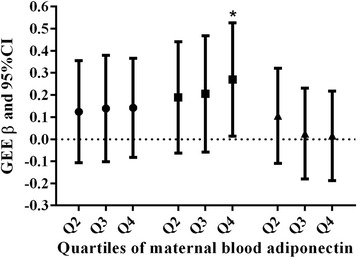
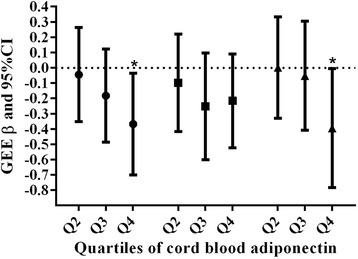
Multiple linear regression analysis indicated that cord blood but not maternal serum adiponectin was positively associated with all of the anthropometric measures at birth (P < 0.01). Using Generalized Estimating Equation model after adjustment for sex, time, maternal age, gestational age, prepregnancy BMI, weight gain during pregnancy, maternal education, parity, history of miscarriage and mode of delivery, for every 1-μg/ml increment of maternal serum adiponectin, the height-for-age Z score during the first year of life increased by 0.026 (P =0.013) on average, and the height-for-age Z score of infants in the highest quartile of maternal serum adiponectin was 0.270 (95 % CI: 0.013-0.527) higher than those in the lowest quartile. The changes in weight-for-age Z score from birth decreased by 0.67 × 10(-2) on average with every 1-μg/ml additional increase of cord blood adiponectin (P = 0.047). The infants in the highest quartile of cord blood adiponectin showed a -0.368 (95 % CI, -0.701--0.035) decrease in weight-for-age Z score change from birth compared with those in the lowest quartile.
Cord blood adiponectin concentration is a determinant of infant birth size and weight gain in the first year of life. Circulating maternal adiponectin during pregnancy may predict postnatal height growth.
脂联素是一种参与能量稳态和代谢的脂肪细胞激素。然而,其在婴儿早期的作用尚不清楚。
在这项前瞻性研究中,我们共招募了443名孕妇及其子女。成功从331名新生儿中获取了脐带血样本。测量了母体和脐带血血清脂联素水平。评估了婴儿出生时以及3、6和12月龄时的体重、身高和年龄别BMI Z评分。
多元线性回归分析表明,脐带血而非母体血清脂联素与出生时所有人体测量指标呈正相关(P<0.01)。在对性别、时间、母亲年龄、孕周、孕前BMI、孕期体重增加、母亲教育程度、产次、流产史和分娩方式进行调整后,使用广义估计方程模型,母体血清脂联素每增加1μg/ml,1岁以内婴儿的年龄别身高Z评分平均增加0.026(P = 0.013),母体血清脂联素处于最高四分位数的婴儿的年龄别身高Z评分比最低四分位数的婴儿高0.270(95%CI:0.013 - 0.527)。脐带血脂联素每额外增加1μg/ml,出生时年龄别体重Z评分的变化平均降低0.67×10⁻²(P = 0.047)。脐带血脂联素处于最高四分位数的婴儿出生时年龄别体重Z评分变化比最低四分位数的婴儿降低了 - 0.368(95%CI, - 0.701 - - 0.035)。
脐带血脂联素浓度是婴儿出生大小和1岁以内体重增加的一个决定因素。孕期循环中的母体脂联素可能预测出生后的身高增长。