Liu Yilan, Chen Sha, Chen Jinjin, Zhou Jiemin, Wang Yanyan, Yang Maohua, Qi Xianni, Xing Jianmin, Wang Qinhong, Ma Yanhe
Tianjin Institute of Industrial Biotechnology, Chinese Academy of Sciences, 32 XiQiDao, Tianjin Airport Economic Area, Tianjin, 300308, China.
Institute of Chinese Materia Medica, China Academy of Chinese Medical Sciences, No. 16, Nanxiaojie, Dongzhimennei, Beijing, 100700, China.
Microb Cell Fact. 2016 Jul 27;15(1):129. doi: 10.1186/s12934-016-0524-5.
Microbial biofuel synthesis attracting increasing attention. Great advances have been made in producing fatty alcohols from fatty acyl-CoAs and fatty acids in Escherichia coli. However, the low titers and limited knowledge regarding the basic characteristics of fatty alcohols, such as location and toxicity, have hampered large-scale industrialization. Further research is still needed.
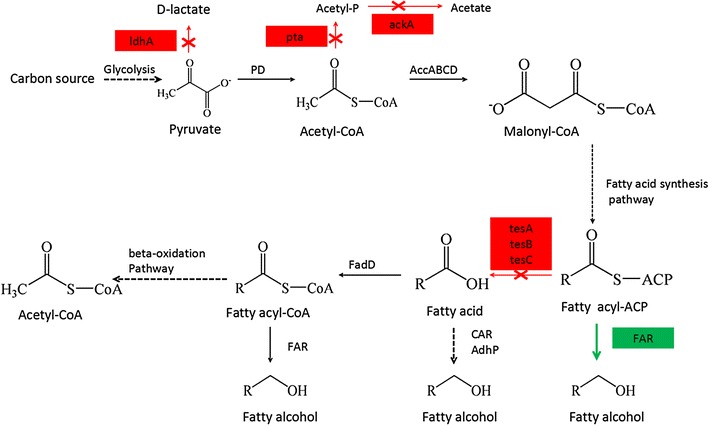
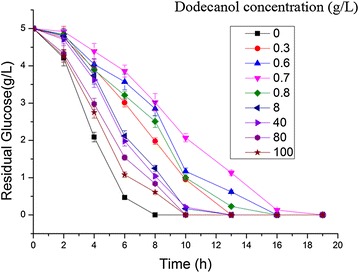
In this study, we designed a novel and efficient strategy to enhance fatty alcohol production by inducing fatty acid starvation. We report the first use of deletions of acyl-ACP thioesterases to enhance fatty alcohol production. Transcriptional analysis was conducted to investigate the mechanism of the designed strategy. Then, fatty alcohol production was further enhanced by deletion of genes from competing pathways. Fatty alcohols were shown to be extracellular products with low toxicity. The final strain, E. coli MGL2, produced fatty alcohols at the remarkable level of 6.33 g/L under fed-batch fermentation, representing the highest reported titer of fatty alcohols produced by microorganisms.
Deletions of genes responsible for synthesis of fatty acids and competing products are promising strategies for fatty alcohol production. Our investigation of the location and toxicity of fatty alcohols suggest bright future for fatty alcohol production in E. coli.
微生物生物燃料合成正日益受到关注。在大肠杆菌中利用脂肪酰辅酶A和脂肪酸生产脂肪醇方面已取得了重大进展。然而,低产量以及对脂肪醇基本特性(如定位和毒性)的了解有限,阻碍了大规模工业化生产。仍需进一步研究。
在本研究中,我们设计了一种新颖且高效的策略,通过诱导脂肪酸饥饿来提高脂肪醇产量。我们首次报道利用缺失酰基-ACP硫酯酶来提高脂肪醇产量。进行了转录分析以研究该设计策略的机制。然后,通过缺失竞争途径的基因进一步提高了脂肪醇产量。结果表明脂肪醇是细胞外产物且毒性较低。最终菌株大肠杆菌MGL2在补料分批发酵条件下以6.33 g/L的显著水平生产脂肪醇,这是微生物生产脂肪醇所报道的最高产量。
缺失负责脂肪酸和竞争产物合成的基因是生产脂肪醇的有前景的策略。我们对脂肪醇定位和毒性的研究表明大肠杆菌生产脂肪醇前景光明。