Becker Kerstin, Siegert Sabine, Toliat Mohammad Reza, Du Juanjiangmeng, Casper Ramona, Dolmans Guido H, Werker Paul M, Tinschert Sigrid, Franke Andre, Gieger Christian, Strauch Konstantin, Nothnagel Michael, Nürnberg Peter, Hennies Hans Christian
Cologne Center for Genomics, University of Cologne, Cologne, Germany.
Cluster of Excellence on Cellular Stress Responses in Aging-associated Diseases, University of Cologne, Cologne, Germany.
PLoS One. 2016 Jul 28;11(7):e0158101. doi: 10.1371/journal.pone.0158101. eCollection 2016.
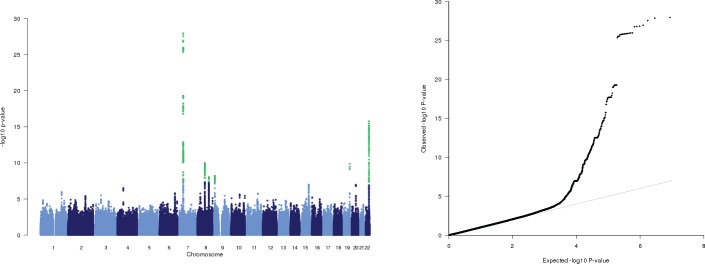
Dupuytren´s disease, a fibromatosis of the connective tissue in the palm, is a common complex disease with a strong genetic component. Up to date nine genetic loci have been found to be associated with the disease. Six of these loci contain genes that code for Wnt signalling proteins. In spite of this striking first insight into the genetic factors in Dupuytren´s disease, much of the inherited risk in Dupuytren´s disease still needs to be discovered. The already identified loci jointly explain ~1% of the heritability in this disease. To further elucidate the genetic basis of Dupuytren´s disease, we performed a genome-wide meta-analysis combining three genome-wide association study (GWAS) data sets, comprising 1,580 cases and 4,480 controls. We corroborated all nine previously identified loci, six of these with genome-wide significance (p-value < 5x10⁻⁸). In addition, we identified 14 new suggestive loci (p-value < 10-5). Intriguingly, several of these new loci contain genes associated with Wnt signalling and therefore represent excellent candidates for replication. Next, we compared whole-transcriptome data between patient- and control-derived tissue samples and found the Wnt/β-catenin pathway to be the top deregulated pathway in patient samples. We then conducted network and pathway analyses in order to identify protein networks that are enriched for genes highlighted in the GWAS meta-analysis and expression data sets. We found further evidence that the Wnt signalling pathways in conjunction with other pathways may play a critical role in Dupuytren´s disease.
掌腱膜挛缩症是一种手掌结缔组织的纤维瘤病,是一种具有强烈遗传成分的常见复杂疾病。迄今为止,已发现9个基因位点与该疾病相关。其中6个位点包含编码Wnt信号蛋白的基因。尽管对掌腱膜挛缩症的遗传因素有了这一惊人的初步认识,但掌腱膜挛缩症的许多遗传风险仍有待发现。已确定的位点共同解释了该疾病约1%的遗传力。为了进一步阐明掌腱膜挛缩症的遗传基础,我们进行了一项全基因组荟萃分析,合并了三个全基因组关联研究(GWAS)数据集,包括1580例病例和4480例对照。我们证实了所有9个先前确定的位点,其中6个具有全基因组显著性(p值<5×10⁻⁸)。此外,我们还确定了14个新的提示性位点(p值<10-5)。有趣的是,这些新位点中有几个包含与Wnt信号相关的基因,因此是复制的优秀候选对象。接下来,我们比较了患者和对照来源的组织样本之间的全转录组数据,发现Wnt/β-连环蛋白通路是患者样本中失调最严重的通路。然后,我们进行了网络和通路分析,以识别在GWAS荟萃分析和表达数据集中突出显示的基因富集的蛋白质网络。我们发现了进一步的证据,表明Wnt信号通路与其他通路一起可能在掌腱膜挛缩症中起关键作用。