Cha Won Chul, Ahn Ki Ok, Shin Sang Do, Park Jeong Ho, Cho Jin Sung
Department of Emergency Medicine, Samsung Medical Center, Seoul, Korea.; Laboratory of Emergency Medical Service, Biomedical Research Institute, Seoul National University Hospital, Seoul, Korea.
Department of Emergency Medicine, Seoul National University Hospital, Seoul, Korea.; Laboratory of Emergency Medical Service, Biomedical Research Institute, Seoul National University Hospital, Seoul, Korea.
J Korean Med Sci. 2016 Aug;31(8):1331-6. doi: 10.3346/jkms.2016.31.8.1331. Epub 2016 May 18.
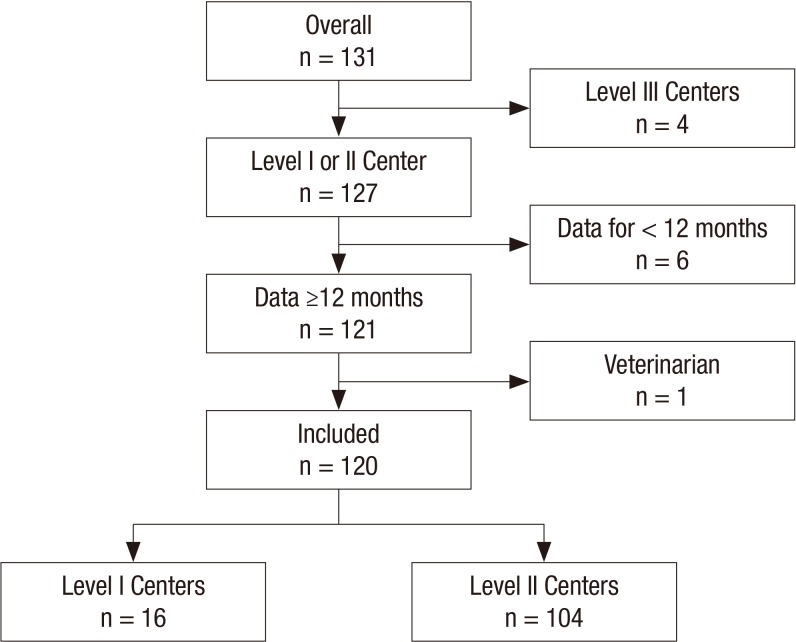
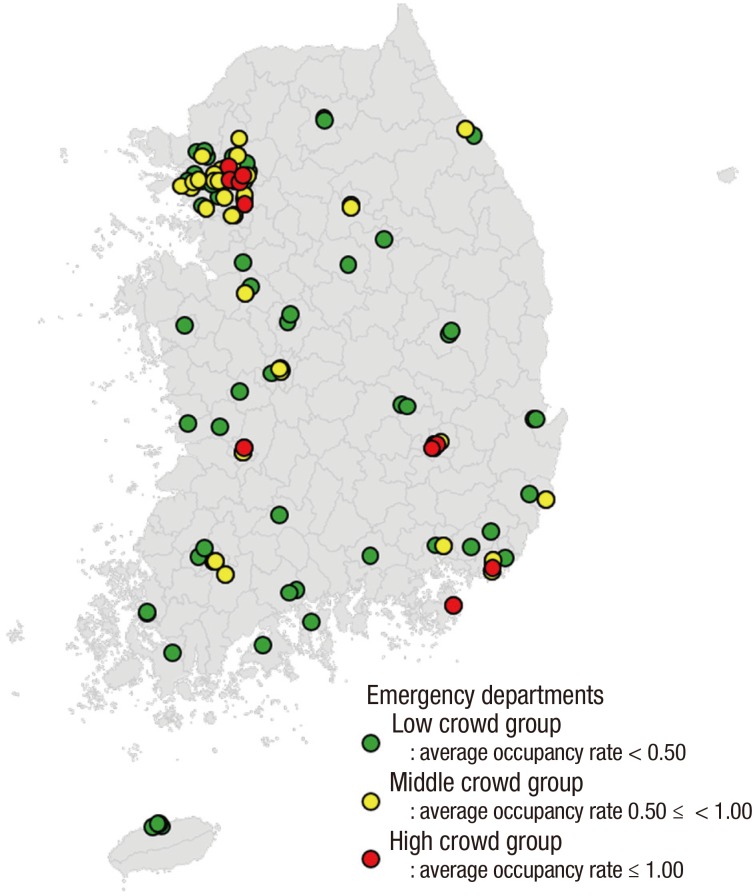
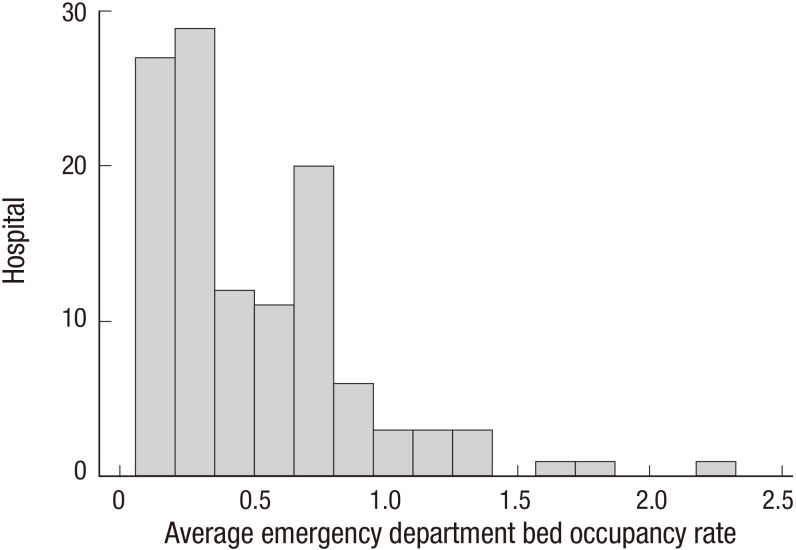
In this study, we evaluated national differences in emergency department (ED) crowding to identify factors significantly associated with crowding in institutes and communities across Korea. This was a cross-sectional nationwide observational study using data abstracted from the National Emergency Department Information System (NEDIS). We calculated mean occupancy rates to quantify ED crowding status and divided EDs into three groups according to their occupancy rates (cutoffs: 0.5 and 1.0). Factors potentially related to ED crowding were collected from the NEDIS. We performed a multivariate regression analysis to identify variables significantly associated with ED crowding. A total of 120 EDs were included in the final analysis. Of these, 73 were categorized as 'low crowded' (LC, occupancy rate < 0.50), 37 as 'middle crowded' (MC, 0.50 ≤ occupancy rate < 1.00), 10 EDs as 'high crowded' (HC, 1.00 ≤ occupancy rate). The mean ED occupancy rate varied widely, from 0.06 to 2.33. The median value was 0.39 with interquartile ranges (IQRs) from 0.20 to 0.71. Multivariate analysis revealed that after adjustment, ED crowding was significantly associated with the number of visits, percentage of patients referred, number of nurses, and ED disposition. This nationwide study observed significant variety in ED crowding. Several input, throughput, and output factors were associated with crowding.
在本研究中,我们评估了急诊科拥挤情况的国家差异,以确定韩国各机构和社区中与拥挤显著相关的因素。这是一项全国性横断面观察性研究,使用从国家急诊科信息系统(NEDIS)提取的数据。我们计算了平均占用率以量化急诊科拥挤状况,并根据占用率将急诊科分为三组(临界值:0.5和1.0)。从NEDIS收集了可能与急诊科拥挤相关的因素。我们进行了多变量回归分析,以确定与急诊科拥挤显著相关的变量。最终分析纳入了总共120个急诊科。其中,73个被归类为“低拥挤”(LC,占用率<0.50),37个为“中等拥挤”(MC,0.50≤占用率<1.00),10个急诊科为“高拥挤”(HC,1.00≤占用率)。急诊科平均占用率差异很大,从0.06到2.33。中位数为0.39,四分位间距(IQR)为0.20至0.71。多变量分析显示,调整后,急诊科拥挤与就诊次数、转诊患者百分比、护士数量和急诊科处置显著相关。这项全国性研究观察到急诊科拥挤存在显著差异。几个输入、通量和输出因素与拥挤有关。