Majak Paweł, Jerzyńska Joanna, Bojo Magdalena, Brzozowska Agnieszka, Koczkowska Magdalena, Sielski Piotr, Stelmach Włodzimierz, Stelmach Rafał, Janas Anna, Stelmach Iwona
Department of Internal Medicine, Asthma and Allergy, Barlicki University Hospital, Medical University of Lodz, Lodz, Poland.
Department of Paediatrics and Allergy, Medical University of Lodz, Lodz, Poland.
Arch Med Sci. 2016 Aug 1;12(4):778-84. doi: 10.5114/aoms.2015.48547. Epub 2016 Jul 1.
Markers of exhaled breath condensate (EBC) correlate with lung function impairment, airway remodeling and different aspects of the disease such as exercise-induced bronchoconstriction (EIB). Aim of the study was to determine the cytokine profile in EBC of children with asthma after an exercise treadmill challenge in order to obtain clinically useful information about mechanisms of EIB; also, to assess correlations between cytokine concentrations in EBC and clinical characteristics of the patients.
The study population consisted of 25 randomly selected children, aged 8 to 19 years, with asthma and EIB symptoms despite the use of control medications. Patients on the day of the study visit underwent fractional exhaled nitric oxide measurement (FeNO) and baseline spirometry, performed an exercise treadmill challenge (ETC), and EBC samples were obtained at the end of the ETC.
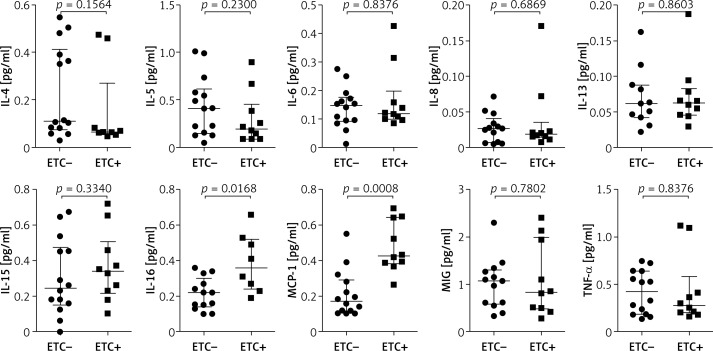
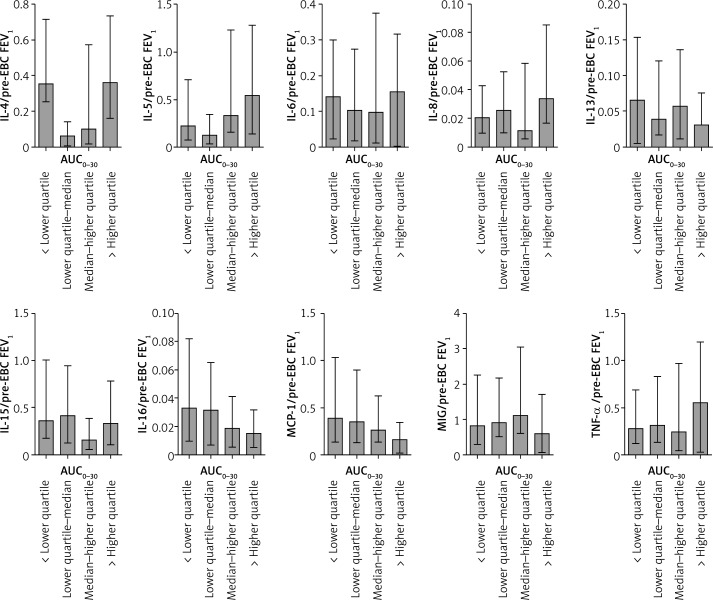
In asthmatic children with positive ETC, monocyte hemotactic protein-1 (MCP-1) and IL-16 adjusted to pre-EBC forced expiratory volume in 1 s (FEV1) were significantly higher compared to children with negative ETC (p = 0.022 and p = 0.017 respectively). After adjustment to pre-EBC FEV1 other cytokines (IL-4, IL-5, IL-6, IL-8, MIG, TNF-α) were not related to post-exercise changes in FEV1.
We observed a specific inflammatory profile in the airways of asthmatic children with bronchoconstriction induced by exercise. The concentration of cytokines in EBC depended on the post-exercise decrease in FEV1, which was measured by the area under the curve (AUC). MCP-1 and IL-16, adjusted to pre-EBC FEV1, were significantly higher in children with a positive exercise challenge compared to those with a negative one.
呼出气冷凝物(EBC)标志物与肺功能损害、气道重塑以及疾病的不同方面相关,如运动诱发的支气管收缩(EIB)。本研究的目的是确定哮喘儿童在运动平板试验激发后EBC中的细胞因子谱,以获取有关EIB机制的临床有用信息;同时,评估EBC中细胞因子浓度与患者临床特征之间的相关性。
研究人群包括25名随机选择的8至19岁哮喘儿童,尽管使用了控制药物仍有EIB症状。研究当天,患者接受呼出一氧化氮分数测量(FeNO)和基线肺功能测定,进行运动平板试验激发(ETC),并在ETC结束时采集EBC样本。
在ETC阳性的哮喘儿童中,单核细胞趋化蛋白-1(MCP-1)和IL-16经1秒用力呼气容积(FEV1)校正后,与ETC阴性的儿童相比显著更高(分别为p = 0.022和p = 0.017)。经EBC前FEV1校正后,其他细胞因子(IL-4、IL-5、IL-6、IL-8、MIG、TNF-α)与运动后FEV1的变化无关。
我们观察到运动诱发支气管收缩的哮喘儿童气道中存在特定的炎症谱。EBC中细胞因子的浓度取决于运动后FEV1的下降,通过曲线下面积(AUC)测量。与运动激发阴性的儿童相比,运动激发阳性的儿童经EBC前FEV1校正后的MCP-1和IL-16显著更高。