Wędrychowicz Andrzej, Tomasik Przemysław, Zając Andrzej, Fyderek Krzysztof
Department of Pediatrics, Gastroenterology and Nutrition, Jagiellonian University Medical College, Krakow, Poland.
Department of Clinical Biochemistry, Jagiellonian University Medical College, Krakow, Poland.
Arch Med Sci. 2018 Jan;14(1):107-114. doi: 10.5114/aoms.2017.68696. Epub 2017 Jun 30.
Interleukin-1β (IL-1β), interleukin-1 receptor antagonist (IL-1ra) and interleukin-6 (IL-6) contribute to the pathogenesis of ulcerative colitis (UC). The aim of our study was to evaluate the serum and stool IL-1β, IL-1ra and IL-6 concentrations as potential prognostic factors in children with UC.
Thirty-eight children with UC (20 active, 18 inactive) and 14 healthy controls were prospectively included in the study. IL-1β, IL-1ra and IL-6 concentrations were measured in serum and stool supernatants at inclusion to the study using ELISA immunoassays. The children were followed up over 5 years, and at each follow-up clinical disease activity, quantity and severity of relapses, nutritional status, endoscopic and histopathologic activity, disease complications and the treatment regimen were evaluated.
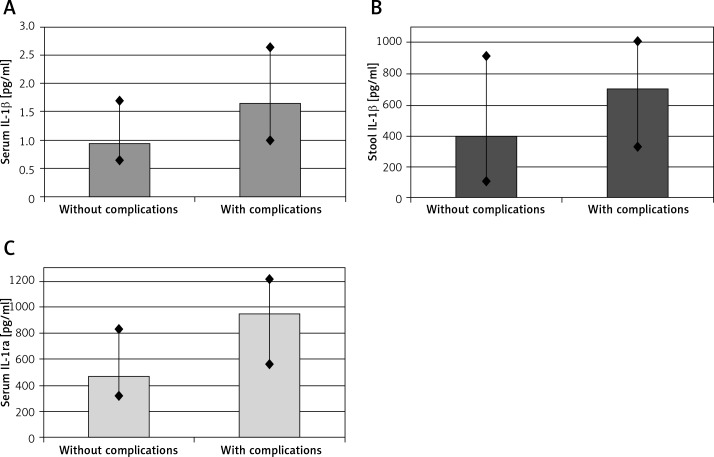
In children with active and inactive UC who had relapsed during a 5-year follow-up period compared to the non-relapse groups we found significantly increased serum IL-1β (1.34 vs. 0.98 pg/ml, < 0.05, and 1.02 vs. 0.68 pg/ml, < 0.01, respectively,) and IL-1ra (718.0 vs. 453.2 pg/ml, < 0.05, and 567.4 vs. 365.1 pg/ml, < 0.01, respectively). Additionally, in children who had experienced complications during a 5-year follow-up period we observed significantly increased serum and stool IL-1β ( < 0.05) and serum IL-1ra ( < 0.01) compared to the group without complications.
We concluded that serum IL-1β and IL-1ra and to a lesser extend stool IL-1β concentrations may be useful prognostic factors in children with active and inactive UC over a short-term follow-up period, which may help to identify children that require more aggressive therapy due to an increased risk of relapse or complications resulting from UC.
白细胞介素-1β(IL-1β)、白细胞介素-1受体拮抗剂(IL-1ra)和白细胞介素-6(IL-6)参与溃疡性结肠炎(UC)的发病机制。我们研究的目的是评估血清和粪便中IL-1β、IL-1ra和IL-6的浓度,作为UC患儿潜在的预后因素。
前瞻性纳入38例UC患儿(20例活动期,18例非活动期)和14例健康对照。在纳入研究时,使用ELISA免疫分析法测定血清和粪便上清液中IL-1β、IL-1ra和IL-6的浓度。对患儿进行了5年的随访,每次随访时评估临床疾病活动度、复发的数量和严重程度、营养状况、内镜和组织病理学活动度、疾病并发症及治疗方案。
在5年随访期内复发的活动期和非活动期UC患儿中,与未复发组相比,我们发现血清IL-1β(分别为1.34 vs. 0.98 pg/ml,P<0.05;1.02 vs. 0.68 pg/ml,P<0.01)和IL-1ra(分别为718.0 vs. 453.2 pg/ml,P<0.05;567.4 vs. 365.1 pg/ml,P<0.01)显著升高。此外,在5年随访期内出现并发症的患儿中,与无并发症组相比,我们观察到血清和粪便IL-1β(P<0.05)以及血清IL-1ra(P<0.01)显著升高。
我们得出结论,血清IL-1β和IL-1ra以及程度较轻的粪便IL-1β浓度可能是活动期和非活动期UC患儿短期随访中的有用预后因素,这可能有助于识别因UC复发或并发症风险增加而需要更积极治疗的患儿。