Parkinson Jane, Minton Jon, Lewsey James, Bouttell Janet, McCartney Gerry
Public Health Observatory, NHS Health Scotland, Glasgow, UK.
Urban Studies, School of Social and Political Sciences, University of Glasgow, Glasgow, UK.
J Epidemiol Community Health. 2017 Feb;71(2):194-200. doi: 10.1136/jech-2016-207296. Epub 2016 Jul 18.
Mortality rates are higher in Scotland relative to England and Wales, even after accounting for deprivation. This 'excess' mortality is partly due to higher mortality from alcohol-related and drug-related deaths, violence and suicide (particularly in young adults). This study investigated whether cohort effects from exposure to neoliberal politics from the 1980s might explain the recent trends in suicide in Scotland.
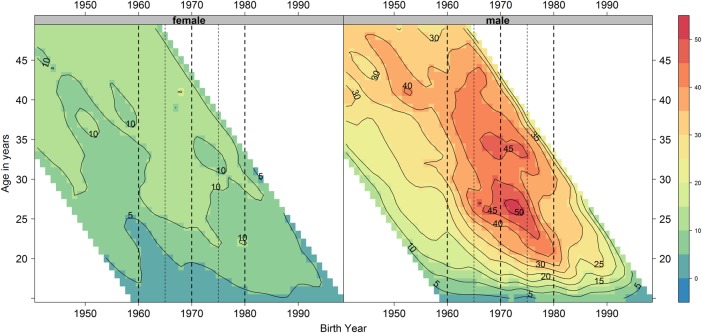
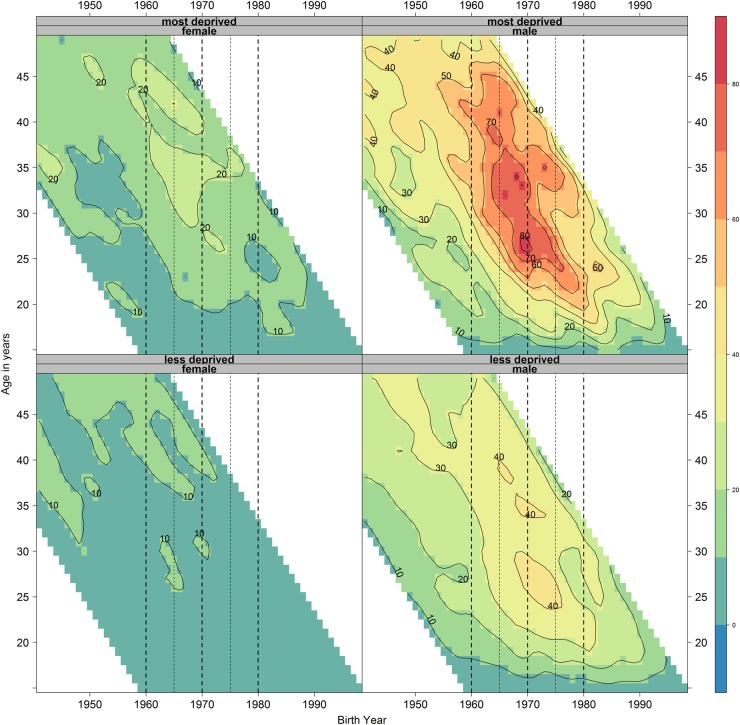
We analysed suicide deaths data from 1974 to 2013 by sex and deprivation using shaded contour plots and intrinsic estimator regression modelling to identify and quantify relative age, period and cohort effects.
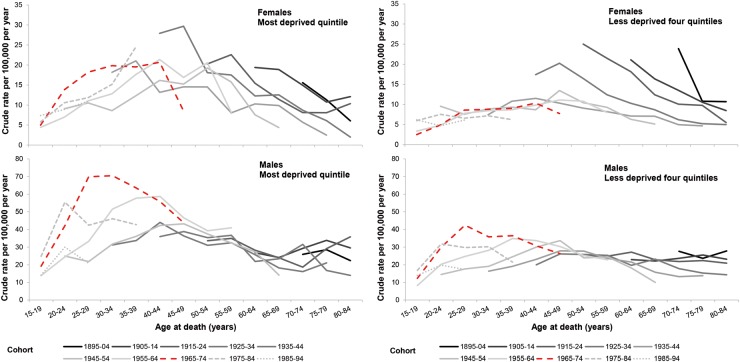
Suicide was most common in young adults (aged around 25-40 years) living in deprived areas, with a younger peak in men. The peak age for suicide fell around 1990, especially for men for whom it dropped quickly from around 50 to 30 years. There was evidence of an increased risk of suicide for the cohort born between 1960 and 1980, especially among men living in the most deprived areas (of around 30%). The cohort at highest risk occurred earlier in the most deprived areas, 1965-1969 compared with 1970-1974.
The risk of suicide increased in Scotland for those born between 1960 and 1980, especially for men living in the most deprived areas, which resulted in a rise in age-standardised rates for suicide among young adults during the 1990s. This is consistent with the hypothesis that exposure to neoliberal politics created a delayed negative health impact.
即便考虑到贫困因素,苏格兰的死亡率仍高于英格兰和威尔士。这种“超额”死亡率部分归因于与酒精和毒品相关的死亡、暴力及自杀(尤其是在年轻人中)导致的较高死亡率。本研究调查了自20世纪80年代接触新自由主义政治所产生的队列效应是否可以解释苏格兰近期的自杀趋势。
我们使用阴影等高线图和内在估计回归模型,按性别和贫困程度分析了1974年至2013年的自杀死亡数据,以识别和量化相对年龄、时期和队列效应。
自杀在生活在贫困地区的年轻人(年龄约25至40岁)中最为常见,男性的自杀高峰年龄更小。自杀高峰年龄在1990年左右下降,尤其是男性,其自杀高峰年龄从约50岁迅速降至30岁。有证据表明,1960年至1980年出生的队列自杀风险增加,尤其是生活在最贫困地区的男性(约30%)。在最贫困地区,自杀风险最高的队列出现得更早,1965 - 1969年出生的队列比1970 - 1974年出生的队列风险更高。
1960年至1980年出生的苏格兰人自杀风险增加,尤其是生活在最贫困地区的男性,这导致20世纪90年代年轻人中年龄标准化自杀率上升。这与接触新自由主义政治产生延迟的负面健康影响这一假设相一致。