Public Health Observatory, NHS Health Scotland, Glasgow, UK
Public Health Observatory, NHS Health Scotland, Glasgow, UK.
Heart. 2020 Apr;106(8):584-589. doi: 10.1136/heartjnl-2019-315029. Epub 2019 Sep 20.
We aimed to explore whether age, period or cohort effects explain the trends and inequalities in ischaemic heart disease (IHD) and cerebrovascular disease (CeVD) mortality in Scotland.
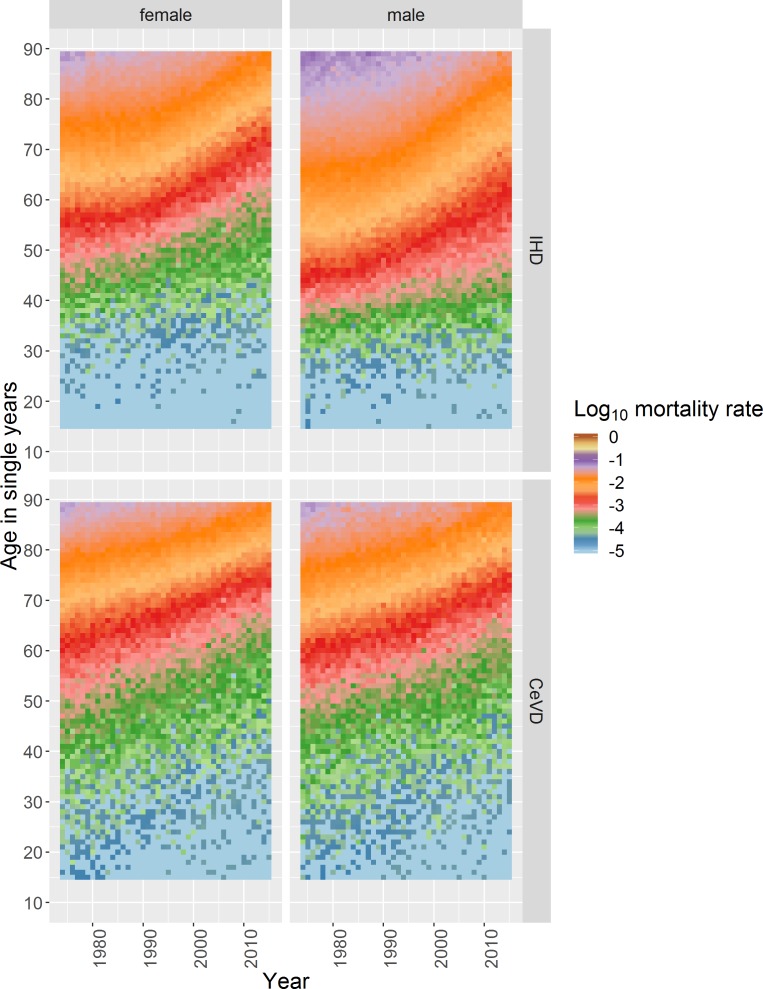
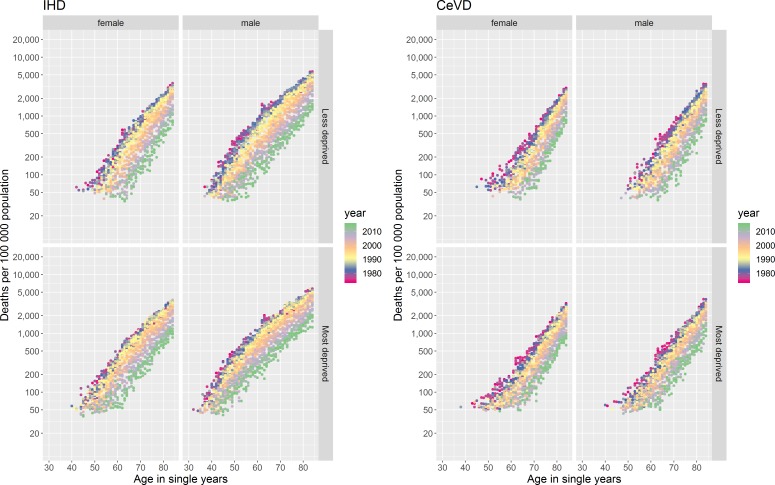
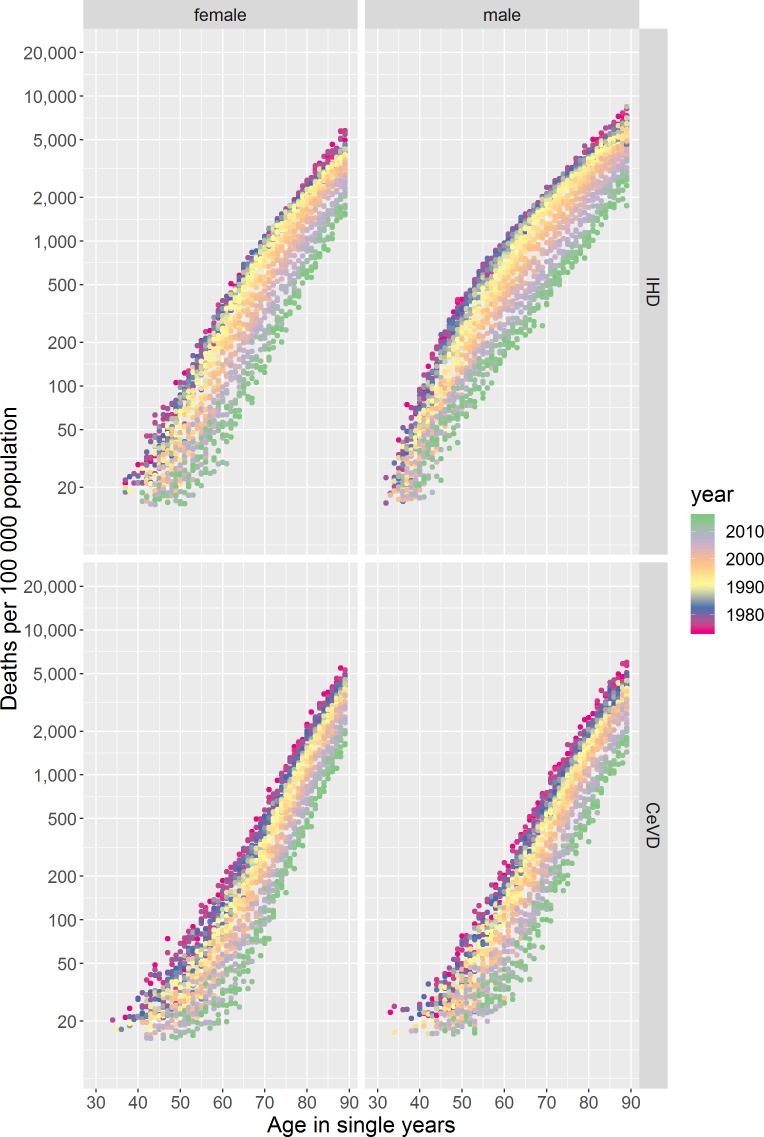
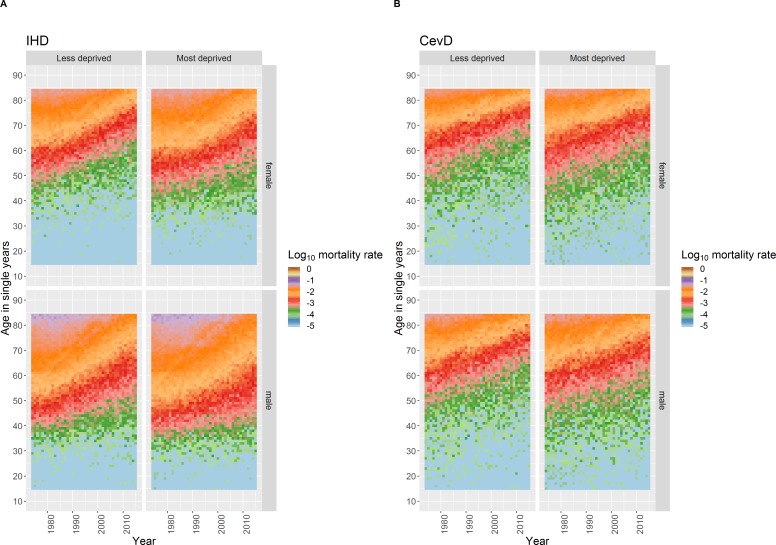
We analysed IHD and CeVD deaths for 1974-2015 by sex, age and area deprivation, visually explored the data using heatmaps and dotplots and built regression models.
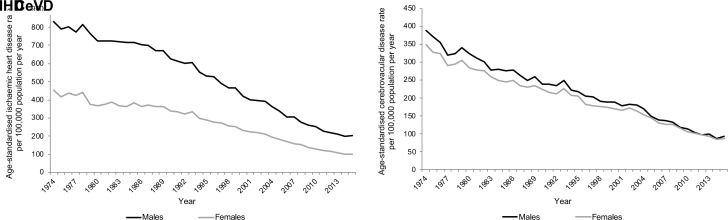
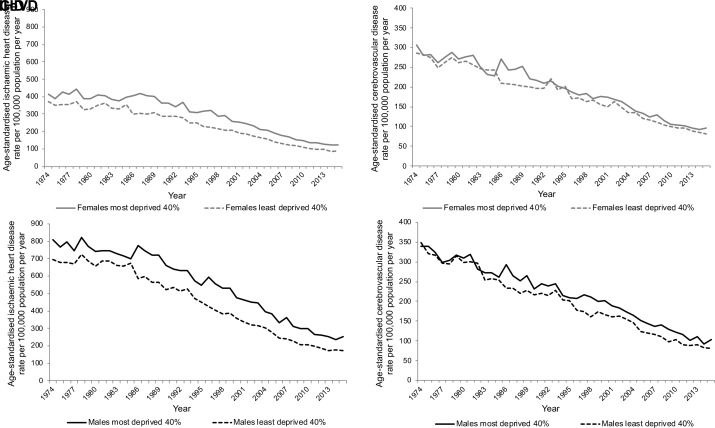
CeVD mortality improved steadily over time while IHD mortality improved more rapidly from the late 1980s. Age effects were evident; both outcomes showed an exponential relationship with age for all except males for IHD in the 1980s and 1990s. The mortality profiles by age became older, although improvement was slower for those aged <50 years for IHD, especially for males, and faster for CeVD in females aged <65 years. Rates were higher, and inequalities greater, among males, especially for IHD. For IHD, increased risk for males over females reduced with age (incidence rate ratio for 41-50 year old males=4.28 (95% CI 4.12 to 4.44) and 1.17 (95% CI 1.16 to 1.18) for 71-80 year olds). Inequalities in IHD mortality by area deprivation persisted over time, increasing from around 10% to around 25% higher risk in the most deprived areas between 1974 and 1986 before declining in absolute terms from around 2000. Inequalities for CeVD increased after the late 1980s.
IHD and CeVD mortality in Scotland exhibit age but not recent distinct period or cohort effects. The improvements in mortality rates have been more sustained for CeVD and inequalities greater for IHD.
本研究旨在探讨年龄、时期还是队列效应对苏格兰缺血性心脏病(IHD)和脑血管疾病(CeVD)死亡率的趋势和差异是否存在解释作用。
我们分析了 1974 年至 2015 年期间按性别、年龄和地区贫困程度划分的 IHD 和 CeVD 死亡病例,使用热图和点图直观地展示了数据,并建立了回归模型。
CeVD 死亡率随时间稳步改善,而 IHD 死亡率自 20 世纪 80 年代末以来则迅速改善。年龄效应明显;除了 20 世纪 80 年代和 90 年代的男性 IHD 之外,所有年龄段的两种结果都表现出与年龄的指数关系。除了 IHD 中年龄 <50 岁的人群(尤其是男性)和 CeVD 中年龄 <65 岁的女性之外,各年龄段的死亡率曲线变得更加老化,但改善速度较慢。男性的死亡率更高,不平等程度更大,尤其是 IHD。对于 IHD,男性相对于女性的风险增加随年龄而降低(41-50 岁男性的发病率比为 4.28(95%CI 4.12-4.44)和 71-80 岁男性的 1.17(95%CI 1.16-1.18))。IHD 死亡率的地区贫困程度不平等随着时间的推移持续存在,1974 年至 1986 年期间,最贫困地区的风险增加了约 10%至 25%,而绝对值从 2000 年左右开始下降。CeVD 的不平等现象在 20 世纪 80 年代末之后有所增加。
苏格兰的 IHD 和 CeVD 死亡率存在年龄效应,但不存在近期明显的时期或队列效应。死亡率的改善在 CeVD 中更为持续,而 IHD 中的不平等现象更为严重。