Aizenbud Dror, Aizenbud Itay, Reznick Abraham Z, Avezov Katia
Department of Orthodontics and Craniofacial Anomalies, School of Graduate Dentistry, Rambam Health Care Campus, Oral Biology Research Laboratory, Technion-Ruth and Bruce Rappaport Faculty of Medicine, Haifa, Israel.
Hebrew University, Hadassah, School of Dental Medicine, Jerusalem, Israel.
Rambam Maimonides Med J. 2016 Jul 28;7(3):e0024. doi: 10.5041/RMMJ.10251.
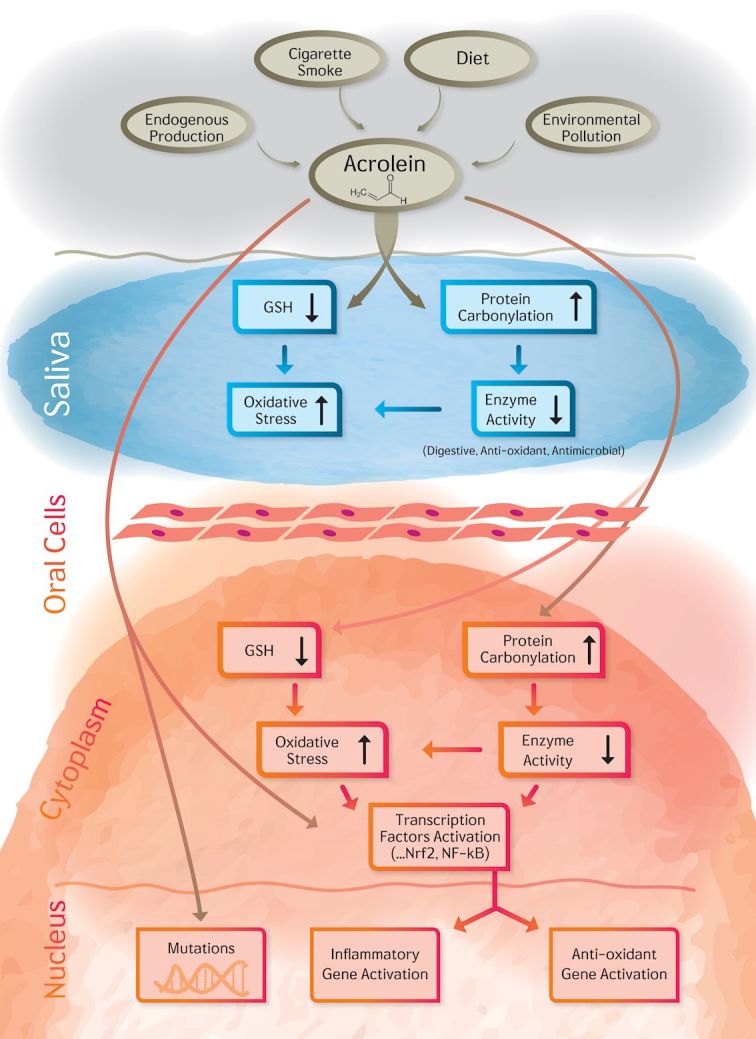
Acrolein is a highly reactive unsaturated aldehyde widely present in the environment, particularly as a product of tobacco smoke. Our previous studies indicated the adverse consequences of even short-term acrolein exposure and proposed a molecular mechanism of its potential harmful effect on oral cavity keratinocytic cells. In this paper we chose to review the broad spectrum of acrolein sources such as pollution, food, and smoking. Consequently, in this paper we consider a high level of oral exposure to acrolein through these sources and discuss the noxious effects it has on the oral cavity including on salivary quality and contents, oral resistance to oxidative stress, and stress mechanism activation in a variety of oral cells.
丙烯醛是一种高反应性不饱和醛,广泛存在于环境中,尤其是作为烟草烟雾的产物。我们之前的研究表明,即使短期接触丙烯醛也会产生不良后果,并提出了其对口腔角质形成细胞潜在有害作用的分子机制。在本文中,我们选择综述丙烯醛的广泛来源,如污染、食物和吸烟。因此,在本文中,我们考虑通过这些来源导致的高水平口腔丙烯醛暴露,并讨论其对口腔的有害影响,包括对唾液质量和成分、口腔抗氧化应激能力以及多种口腔细胞应激机制激活的影响。