Flores Dalmacio, Leblanc Natalie, Barroso Julie
Duke University School of Nursing, 307 Trent Drive, Durham NC 27710, United States.
University of Miami School of Nursing, United States.
Int J Nurs Stud. 2016 Oct;62:126-36. doi: 10.1016/j.ijnurstu.2016.07.016. Epub 2016 Jul 25.
To report the findings of a metasynthesis review of qualitative studies on patient and provider experiences and perspectives on linkage and retention in HIV care.
The review is an extraction, aggregation, interpretation and synthesis of qualitative findings based on the Sandelowski and Barroso method.
A search of the literature was conducted in the databases Cumulative Index to Nursing and Allied Health, PubMed and PsycInfo for articles published from 2008 to 2013. Inclusion criteria were qualitative research articles published in English from across the world and in peer-reviewed journals. Literature reviews, conference abstracts and grey literature were excluded from this metasynthesis.
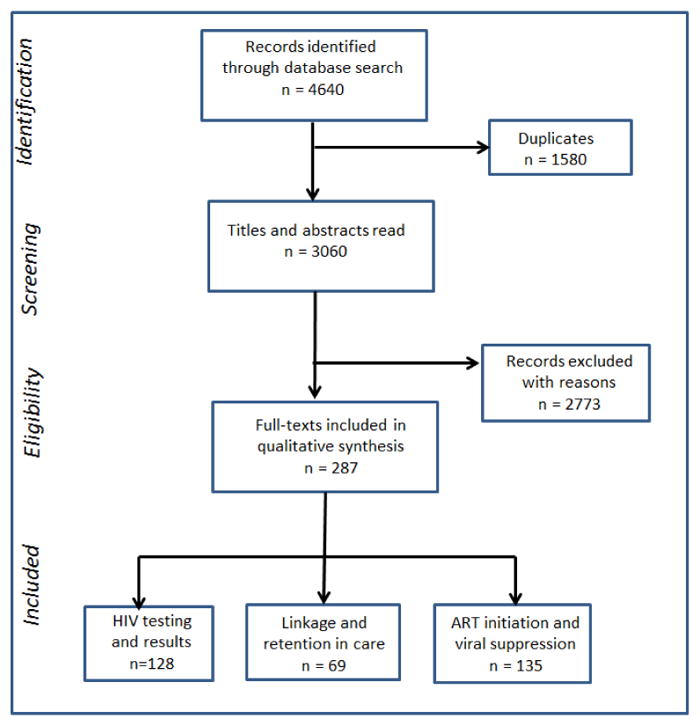
The review consisted of a) comprehensive search, b) study classification, c) abstraction of findings, d) synthesis. Of the 4640 citations screened, 69 articles were included for this metasynthesis.
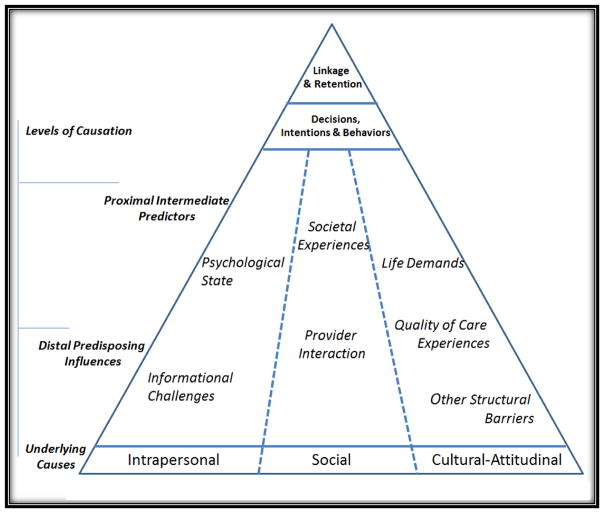
69 unique articles from 44 countries were included. This metasynthesis takes into account the perspectives of at least 2263 HIV-positive participants (740 men, 1008 women, 78 transgender individuals and 437 unspecified sex) and 994 healthcare providers, family members and community members. The most salient barriers and facilitators to HIV linkage and retention in HIV care affirm ecological factors that are mostly beyond individual patients' control. Triadic streams of influence concurrently affect care engagement that include a person's psychological state upon diagnosis and their informational challenges (intrapersonal stream); one-on-one interactions with providers and their immediate community (social stream); and life demands, overall quality of care experiences and other structural barriers (cultural-attitudinal stream). Each stream's influence on HIV care engagement varies at any given point to reflect an individual's evolving and unique experiences with HIV infection throughout the illness trajectory.
There is sufficient evidence that detail how to best link and retain patients in HIV care. Themes identified indicate going beyond individual-level factors and towards shifting attention and resources to systems that patients navigate. Forceful structural-level actions are needed to correct these long-identified barriers and enhance care engagement facilitators.
报告一项关于患者及医护人员在艾滋病护理中关联与留存方面的经历和观点的定性研究的元整合综述结果。
该综述基于桑德洛斯基和巴罗索方法对定性研究结果进行提取、汇总、解读与整合。
在护理及相关健康累积索引数据库、PubMed和PsycInfo中检索2008年至2013年发表的文章。纳入标准为全球范围内以英文发表且经同行评审的定性研究文章。本元整合排除文献综述、会议摘要和灰色文献。
该综述包括a)全面检索,b)研究分类,c)结果提取,d)整合。在筛选的4640条引用文献中,有69篇文章被纳入本元整合。
纳入了来自44个国家的69篇独特文章。本元整合考虑了至少2263名艾滋病毒阳性参与者(740名男性、1008名女性、78名跨性别者和437名未明确性别的参与者)以及994名医护人员、家庭成员和社区成员的观点。艾滋病毒护理关联与留存最显著的障碍和促进因素确认了大多超出个体患者控制范围的生态因素。三重影响流同时影响护理参与度,包括诊断时一个人的心理状态及其信息挑战(个人内部流);与医护人员及其直接社区的一对一互动(社会流);以及生活需求、护理体验的总体质量和其他结构障碍(文化态度流)。在任何给定时刻,每个流对艾滋病毒护理参与度的影响各不相同,以反映个体在整个疾病轨迹中与艾滋病毒感染不断演变的独特经历。
有充分证据详细说明了如何最好地使患者与艾滋病护理建立关联并使其留存。确定的主题表明要超越个体层面因素,将注意力和资源转向患者所经历的系统。需要采取有力的结构层面行动来纠正这些长期存在的障碍,并增强护理参与促进因素。