Marasco Silvana, Quayle Margaret, Summerhayes Robyn, Šutalo Ilija D, Liovic Petar
Cardiothoracic Surgery Department, the Alfred Hospital, 55 Commercial Rd, Prahran, 3181, Australia.
Department of Surgery, Monash University, Melbourne, VIC, Australia.
J Cardiothorac Surg. 2016 Aug 5;11(1):126. doi: 10.1186/s13019-016-0510-3.
Surgical management of fractured ribs with internal fixation is an increasingly accepted therapy. Concurrently, specific rib fixation prostheses are being developed which should improve results and minimise hardware and rib/splint construct failures. The Synthes titanium intramedullary splint lends itself to difficult to access areas such as posterior rib fractures and fractures under the scapula. We analyse a case series of patients in whom this rib fixation prosthesis has been used.
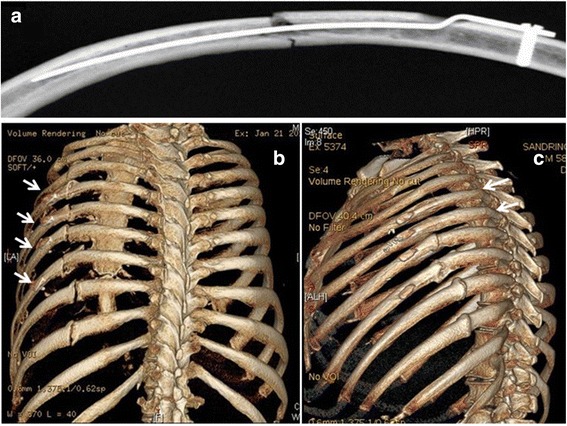
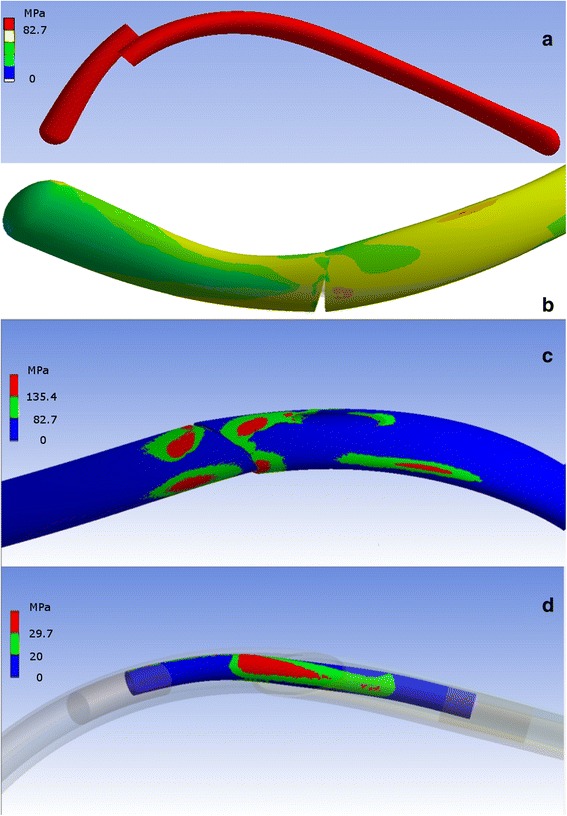
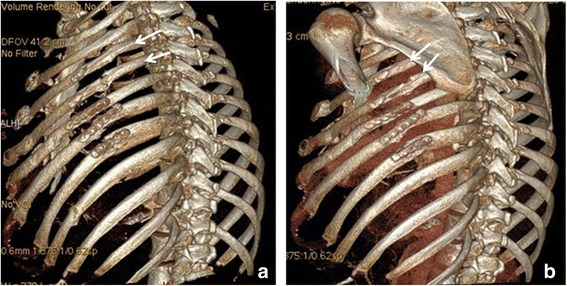
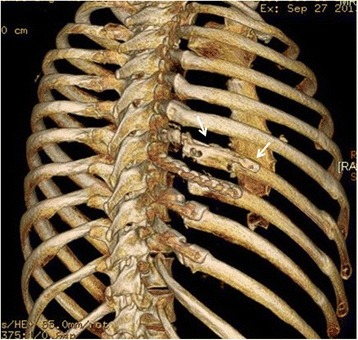
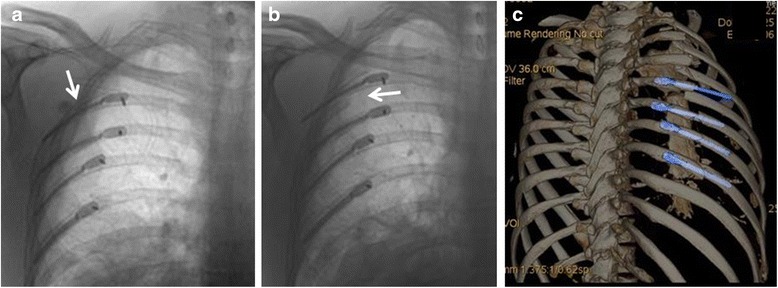
Fifteen patients received 35 intramedullary splints. Follow up at 3 and 6 months was performed with three dimensional computed tomography scanning to assess for bone alignment, callus formation and healing, residual deformity, hardware failure or cut through. Computerized finite element analysis (FEA) was used to model forces acting on a posterior fracture with and without an intramedullary fixation splint in situ.
Complete healing (bony union) was noted in only 3 (9 %) of the fractures fixed with splints by 3 months. Partial healing (cartilaginous union) was noted in 28 of the 33 fractures (85 %), and non healing was noted in only 2 (6 %). In both those two patients, failure at the rib / splint interface was noted after both patients reported sneezing. No hardware failures were noted. By 6 months the fractures which had shown partial healing, had all completely healed. There were no late failures (between 3 and 6 months) of either hardware or rib/splint interfaces. FEA modelling identified sites of increased stress in the rib at the rib / splint interface and in a modelled intramedullary splint where it spans the fracture.
Further analysis of outcomes with intramedullary splints is warranted as well as further development of intramedullary rib fixation solutions.
肋骨骨折内固定的手术治疗是一种越来越被认可的治疗方法。同时,正在研发特定的肋骨固定假体,有望改善治疗效果并减少内固定器械及肋骨/夹板结构失败的情况。Synthes钛制髓内夹板适用于难以触及的部位,如后肋骨骨折和肩胛骨下骨折。我们分析了一系列使用这种肋骨固定假体的患者病例。
15例患者接受了35块髓内夹板治疗。在3个月和6个月时进行三维计算机断层扫描随访,以评估骨对齐情况、骨痂形成与愈合、残余畸形、内固定器械失败或穿透情况。使用计算机有限元分析(FEA)对有和没有髓内固定夹板的后肋骨骨折所受作用力进行建模。
到3个月时,用夹板固定的骨折中仅有3例(9%)实现完全愈合(骨性愈合)。33例骨折中有28例(85%)实现部分愈合(软骨性愈合),仅有2例(6%)未愈合。在这两名患者中,两人均在打喷嚏后出现肋骨/夹板界面处失败。未发现内固定器械失败情况。到6个月时,曾表现为部分愈合的骨折均已完全愈合。在3至6个月期间,未出现内固定器械或肋骨/夹板界面的晚期失败情况。FEA建模确定了肋骨/夹板界面处肋骨以及跨越骨折处的模拟髓内夹板中应力增加的部位。
有必要对髓内夹板的治疗结果进行进一步分析,并进一步研发髓内肋骨固定解决方案。