Cadete Raquel M, de Las Heras Alejandro M, Sandström Anders G, Ferreira Carla, Gírio Francisco, Gorwa-Grauslund Marie-Françoise, Rosa Carlos A, Fonseca César
Departamento de Microbiologia, ICB, C.P. 486, Universidade Federal de Minas Gerais, Belo Horizonte, Minas Gerais 31270-901 Brazil ; Laboratório Nacional de Energia e Geologia, I.P., Unidade de Bioenergia, Estrada do Paço do Lumiar 22, 1649-038 Lisbon, Portugal ; Department of Applied Microbiology, Lund University, PO Box 124, 22100 Lund, Sweden.
Department of Applied Microbiology, Lund University, PO Box 124, 22100 Lund, Sweden.
Biotechnol Biofuels. 2016 Aug 5;9:167. doi: 10.1186/s13068-016-0570-6. eCollection 2016.
The production of ethanol and other fuels and chemicals from lignocellulosic materials is dependent of efficient xylose conversion. Xylose fermentation capacity in yeasts is usually linked to xylose reductase (XR) accepting NADH as cofactor. The XR from Scheffersomyces stipitis, which is able to use NADH as cofactor but still prefers NADPH, has been used to generate recombinant xylose-fermenting Saccharomyces cerevisiae. Novel xylose-fermenting yeasts species, as those from the Spathaspora clade, have been described and are potential sources of novel genes to improve xylose fermentation in S. cerevisiae.
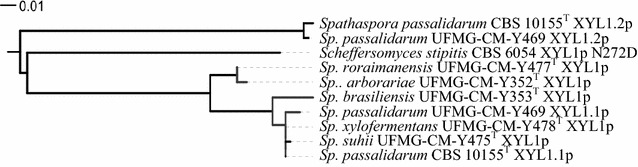
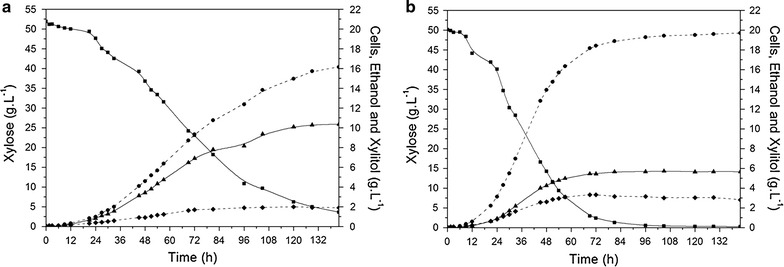
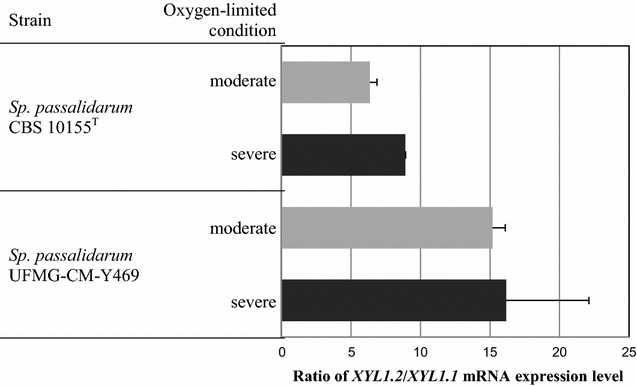
Xylose fermentation by six strains from different Spathaspora species isolated in Brazil, plus the Sp. passalidarum type strain (CBS 10155(T)), was characterized under two oxygen-limited conditions. The best xylose-fermenting strains belong to the Sp. passalidarum species, and their highest ethanol titers, yields, and productivities were correlated to higher XR activity with NADH than with NADPH. Among the different Spathaspora species, Sp. passalidarum appears to be the sole harboring two XYL1 genes: XYL1.1, similar to the XYL1 found in other Spathaspora and yeast species and XYL1.2, with relatively higher expression level. XYL1.1p and XYL1.2p from Sp. passalidarum were expressed in S. cerevisiae TMB 3044 and XYL1.1p was confirmed to be strictly NADPH-dependent, while XYL1.2p to use both NADPH and NADH, with higher activity with the later. Recombinant S. cerevisiae strains expressing XYL1.1p did not show anaerobic growth in xylose medium. Under anaerobic xylose fermentation, S. cerevisiae TMB 3504, which expresses XYL1.2p from Sp. passalidarum, revealed significant higher ethanol yield and productivity than S. cerevisiae TMB 3422, which harbors XYL1p N272D from Sc. stipitis in the same isogenic background (0.40 vs 0.34 g gCDW (-1) and 0.33 vs 0.18 g gCDW (-1) h(-1), respectively).
This work explored a new clade of xylose-fermenting yeasts (Spathaspora species) towards the engineering of S. cerevisiae for improved xylose fermentation. The new S. cerevisiae TMB 3504 displays higher XR activity with NADH than with NADPH, with consequent improved ethanol yield and productivity and low xylitol production. This meaningful advance in anaerobic xylose fermentation by recombinant S. cerevisiae (using the XR/XDH pathway) paves the way for the development of novel industrial pentose-fermenting strains.
从木质纤维素材料生产乙醇及其他燃料和化学品依赖于高效的木糖转化。酵母中的木糖发酵能力通常与接受NADH作为辅因子的木糖还原酶(XR)相关。树干毕赤酵母的XR能够使用NADH作为辅因子,但仍更偏好NADPH,已被用于构建重组木糖发酵酿酒酵母。已描述了新型木糖发酵酵母物种,如来自Spathaspora进化枝的那些,它们是改善酿酒酵母木糖发酵的新基因的潜在来源。
对从巴西分离的六种不同Spathaspora物种的菌株,以及Spathaspora passalidarum模式菌株(CBS 10155(T))在两种限氧条件下的木糖发酵特性进行了研究。最佳木糖发酵菌株属于Spathaspora passalidarum物种,其最高乙醇滴度、产率和生产率与使用NADH时比使用NADPH时更高的XR活性相关。在不同的Spathaspora物种中,Spathaspora passalidarum似乎是唯一含有两个XYL1基因的:XYL1.1,与其他Spathaspora和酵母物种中发现的XYL1相似,以及XYL1.2,其表达水平相对较高。来自Spathaspora passalidarum的XYL1.1p和XYL1.2p在酿酒酵母TMB 3044中表达,并且XYL1.1p被证实严格依赖NADPH,而XYL1.2p可同时使用NADPH和NADH,对后者的活性更高。表达XYL1.1p的重组酿酒酵母菌株在木糖培养基中未显示厌氧生长。在厌氧木糖发酵条件下,表达来自Spathaspora passalidarum的XYL1.2p的酿酒酵母TMB 3504显示出比在相同同基因背景下含有树干毕赤酵母XYL1p N272D的酿酒酵母TMB 3422显著更高的乙醇产率和生产率(分别为0.40对0.34 g gCDW(-1)和0.33对0.18 g gCDW(-1) h(-1))。
这项工作探索了一个新的木糖发酵酵母进化枝(Spathaspora物种),以用于酿酒酵母的工程改造以改善木糖发酵。新的酿酒酵母TMB 3504显示出使用NADH时比使用NADPH时更高的XR活性,从而提高了乙醇产率和生产率,并降低了木糖醇产量。重组酿酒酵母(使用XR/XDH途径)在厌氧木糖发酵方面的这一有意义进展为新型工业戊糖发酵菌株的开发铺平了道路。