Laboratory of Molecular Cell Biology, Institute of Botany and Microbiology, KU Leuven, Belgium.
Department of Molecular Microbiology, VIB, Kasteelpark Arenberg 31, B-3001 Leuven, Heverlee, Flanders, Belgium.
Biotechnol Biofuels. 2013 Jun 21;6(1):89. doi: 10.1186/1754-6834-6-89.
The production of bioethanol from lignocellulose hydrolysates requires a robust, D-xylose-fermenting and inhibitor-tolerant microorganism as catalyst. The purpose of the present work was to develop such a strain from a prime industrial yeast strain, Ethanol Red, used for bioethanol production.
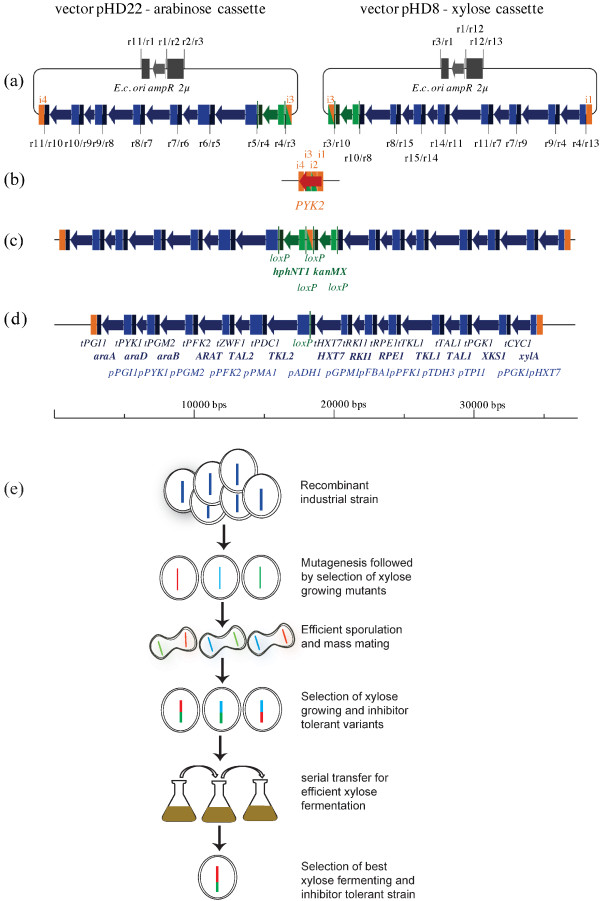
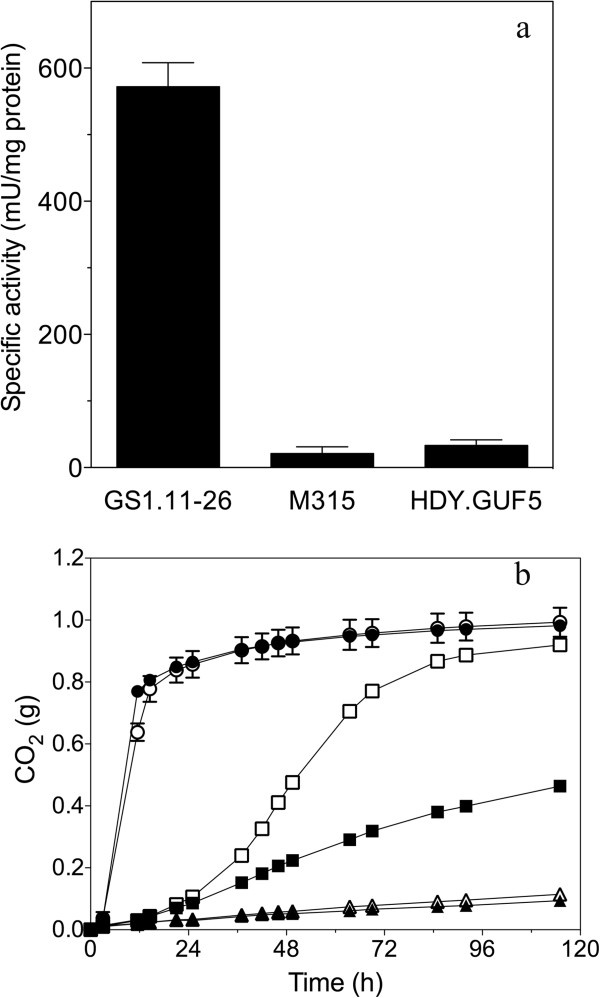
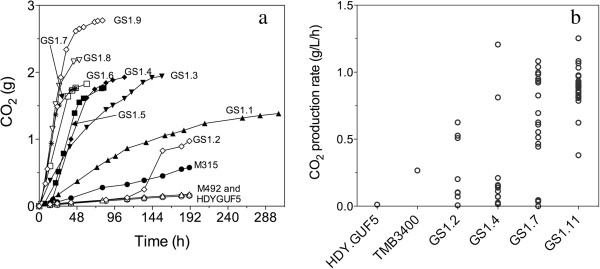
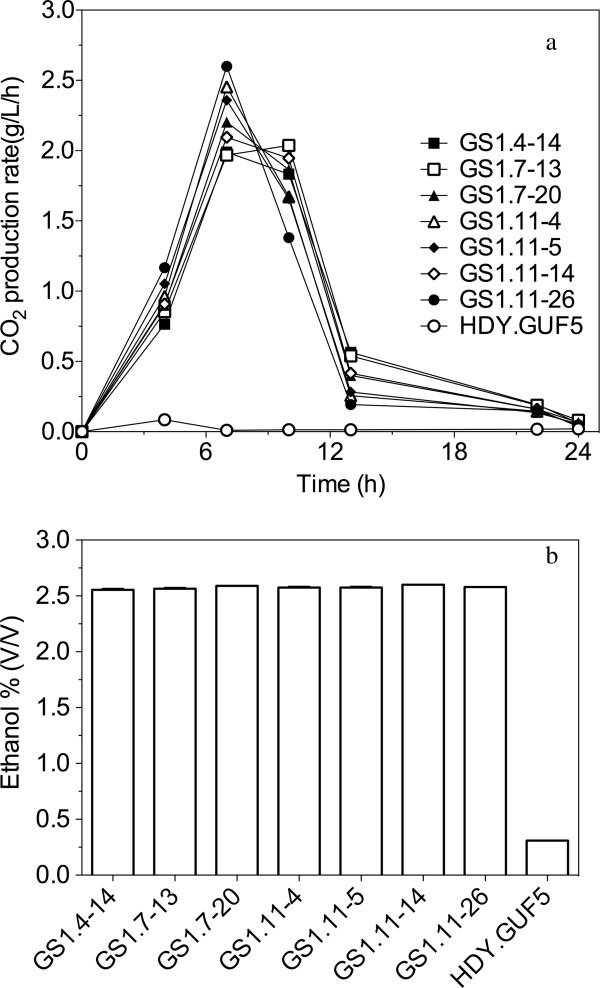
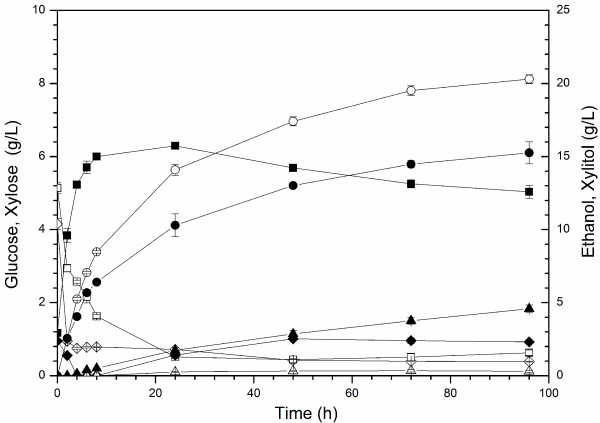
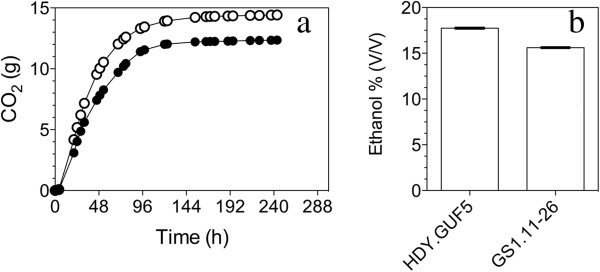
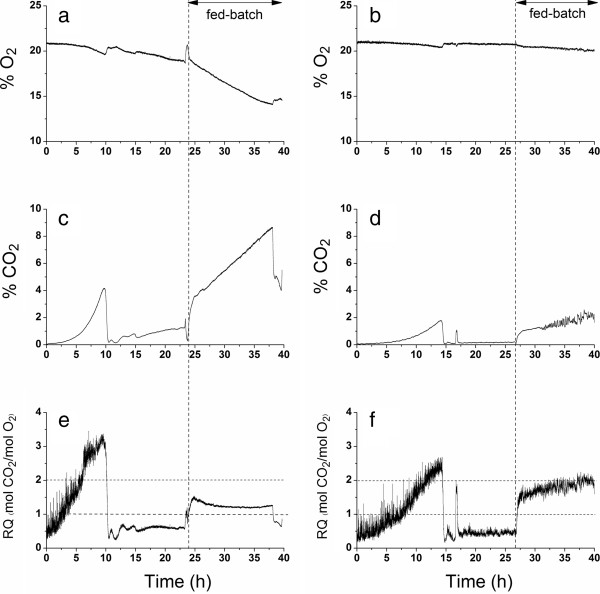
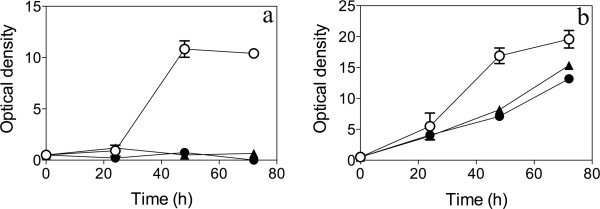
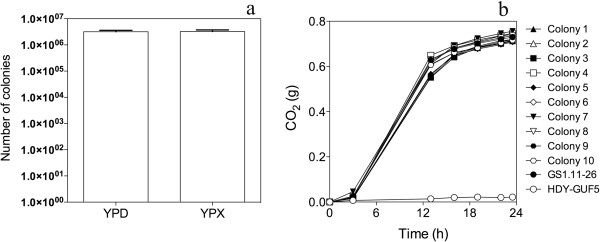
An expression cassette containing 13 genes including Clostridium phytofermentans XylA, encoding D-xylose isomerase (XI), and enzymes of the pentose phosphate pathway was inserted in two copies in the genome of Ethanol Red. Subsequent EMS mutagenesis, genome shuffling and selection in D-xylose-enriched lignocellulose hydrolysate, followed by multiple rounds of evolutionary engineering in complex medium with D-xylose, gradually established efficient D-xylose fermentation. The best-performing strain, GS1.11-26, showed a maximum specific D-xylose consumption rate of 1.1 g/g DW/h in synthetic medium, with complete attenuation of 35 g/L D-xylose in about 17 h. In separate hydrolysis and fermentation of lignocellulose hydrolysates of Arundo donax (giant reed), spruce and a wheat straw/hay mixture, the maximum specific D-xylose consumption rate was 0.36, 0.23 and 1.1 g/g DW inoculum/h, and the final ethanol titer was 4.2, 3.9 and 5.8% (v/v), respectively. In simultaneous saccharification and fermentation of Arundo hydrolysate, GS1.11-26 produced 32% more ethanol than the parent strain Ethanol Red, due to efficient D-xylose utilization. The high D-xylose fermentation capacity was stable after extended growth in glucose. Cell extracts of strain GS1.11-26 displayed 17-fold higher XI activity compared to the parent strain, but overexpression of XI alone was not enough to establish D-xylose fermentation. The high D-xylose consumption rate was due to synergistic interaction between the high XI activity and one or more mutations in the genome. The GS1.11-26 had a partial respiratory defect causing a reduced aerobic growth rate.
An industrial yeast strain for bioethanol production with lignocellulose hydrolysates has been developed in the genetic background of a strain widely used for commercial bioethanol production. The strain uses glucose and D-xylose with high consumption rates and partial cofermentation in various lignocellulose hydrolysates with very high ethanol yield. The GS1.11-26 strain shows highly promising potential for further development of an all-round robust yeast strain for efficient fermentation of various lignocellulose hydrolysates.
从木质纤维素水解物中生产生物乙醇需要一种具有强大的、能够发酵 D-木糖和耐受抑制剂的微生物作为催化剂。本研究的目的是从用于生物乙醇生产的主要工业酵母 Ethanol Red 中开发出这样一种菌株。
在 Ethanol Red 的基因组中插入了两个包含 13 个基因的表达盒,其中包括编码 D-木糖异构酶(XI)的 Clostridium phytofermentans XylA 和戊糖磷酸途径的酶。随后,通过 EMS 诱变、基因组改组和在富含 D-木糖的木质纤维素水解物中的选择,以及在含有 D-木糖的复杂培养基中的多轮进化工程,逐渐建立了高效的 D-木糖发酵。表现最好的菌株 GS1.11-26 在合成培养基中的最大比 D-木糖消耗速率为 1.1 g/g DW/h,在约 17 小时内完全衰减 35 g/L D-木糖。在单独水解和发酵芦竹(giant reed)、云杉和小麦秸秆/干草混合物的木质纤维素水解物时,最大比 D-木糖消耗速率分别为 0.36、0.23 和 1.1 g/g DW 接种物/h,最终乙醇浓度分别为 4.2%、3.9%和 5.8%(v/v)。在芦竹水解物的同步糖化和发酵中,GS1.11-26 产生的乙醇比亲本菌株 Ethanol Red 多 32%,这是由于 D-木糖的有效利用。在葡萄糖中延长生长后,高 D-木糖发酵能力保持稳定。与亲本菌株相比,菌株 GS1.11-26 的细胞提取物显示出 17 倍更高的 XI 活性,但 XI 的过表达本身不足以建立 D-木糖发酵。高 D-木糖消耗速率是由于 XI 活性高和基因组中的一个或多个突变之间的协同作用所致。GS1.11-26 具有部分呼吸缺陷,导致需氧生长速率降低。
在广泛用于商业生物乙醇生产的菌株的遗传背景下,开发出了一种用于生物乙醇生产的木质纤维素水解物的工业酵母菌株。该菌株在各种木质纤维素水解物中以高消耗率使用葡萄糖和 D-木糖,并进行部分共发酵,具有非常高的乙醇产率。GS1.11-26 菌株在进一步开发高效发酵各种木质纤维素水解物的全面稳健酵母菌株方面具有非常有前景的潜力。