Yoon Mi-Kyung, Kim Soon-Young, Ko Hye-Sun, Lee Myung-Soo
Gyeonggi Mental Health Center, Yongin Mental Hospital, 245 beon-gil, Jangan-gu, Suwon, Gyeonggi Province South Korea.
Gyeonggi Mental Health Center, Yongin Mental Hospital, 245 beon-gil, Jangan-gu, Suwon, Gyeonggi Province South Korea ; Yongin Mental Hospital, 940 Jungbudaero, Giheung-gu, Yongin, Gyeonggi Province South Korea.
Int J Ment Health Syst. 2016 Aug 8;10:51. doi: 10.1186/s13033-016-0083-5. eCollection 2016.
Korea has experienced diverse kind of disasters these days. Among them the 2015 middle eastern respiratory syndrome (MERS) outbreak imposed great psychological stress on almost all Korean citizens. Following the MERS outbreak, government is reviewing overall infectious disease management system and prioritizing the establishment of mental health service systems for infectious disease. This study makes suggestions for implementing disaster-related mental health service systems by analyzing the example of Gyeonggi Province, which proactively intervened with residents' psychological problems caused by the large-scale outbreak of an infectious disease.
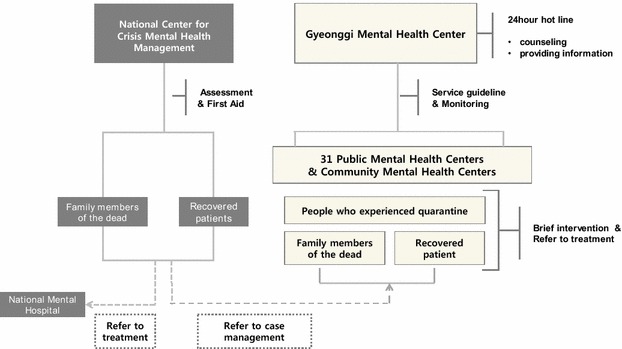
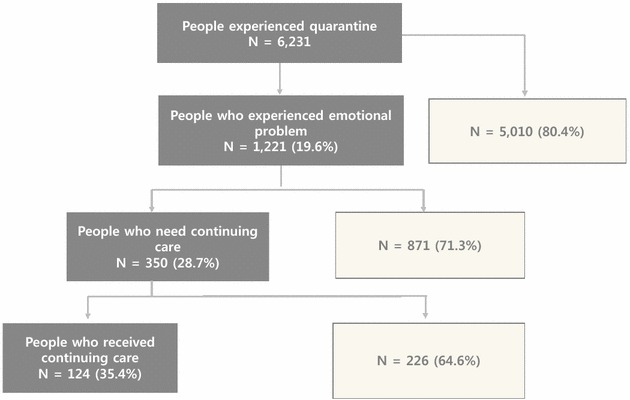
Mental health service system for MERS victims had the following two parts: a mental health service for people who had been placed in quarantine and a service provided to families of patients who had died or recovered patients. The government of Gyeonggi province, public health centers, regional and local Community Mental Health Centers and the National Center for Crisis Mental Health Management participated in this service system. Among 1221 Gyeonggi people placed in quarantine and who experienced psychological and emotional difficulties, 350 required continuing services; 124 of this group received continuing services. That is, 35 % of people who required psychological intervention received contact from service providers and received the required services.
This study reflects a proactive monitoring system for thousands of people placed under quarantine for the first time in Korea. It is significant that the service utilization rate by a proactive manner, that is the professionals administering it actively approached and contacted people with problems rather than passively providing information was much higher than other general mental health situation in Korea. The core value of public mental health services is adequate public accessibility; it is therefore essential for governments to strengthen their professional competence and establish effective systems. These criteria should also be applied to psychological problems caused by disastrous infectious disease outbreaks.
近年来韩国经历了各种各样的灾难。其中,2015年中东呼吸综合征(MERS)疫情给几乎所有韩国公民都带来了巨大的心理压力。MERS疫情爆发后,政府正在审查整体传染病管理系统,并将建立传染病心理健康服务系统作为优先事项。本研究通过分析京畿道的案例,为实施与灾难相关的心理健康服务系统提出建议,该地区积极干预了由传染病大规模爆发引起的居民心理问题。
针对MERS受害者的心理健康服务系统有以下两个部分:为被隔离人员提供的心理健康服务,以及为死亡患者家属或康复患者提供的服务。京畿道政府、公共卫生中心、地区和地方社区心理健康中心以及国家危机心理健康管理中心参与了该服务系统。在1221名被隔离且经历心理和情绪困扰的京畿道居民中,350人需要持续服务;这一组中有124人接受了持续服务。也就是说,需要心理干预的人中,35%的人得到了服务提供者的联系并接受了所需服务。
本研究反映了韩国首次对数千名被隔离人员建立的主动监测系统。重要的是,通过主动方式的服务利用率,即专业人员积极主动地接触有问题的人而不是被动提供信息,远高于韩国其他一般心理健康情况。公共心理健康服务的核心价值是足够的公众可及性;因此,政府加强专业能力并建立有效系统至关重要。这些标准也应适用于由灾难性传染病爆发引起的心理问题。