Baxter Bryan S, Edelman Bradley J, Nesbitt Nicholas, He Bin
Department of Biomedical Engineering, University of Minnesota, Minneapolis, MN, USA.
Department of Biomedical Engineering, University of Minnesota, Minneapolis, MN, USA; Institute for Engineering in Medicine, University of Minnesota, Minneapolis, MN, USA.
Brain Stimul. 2016 Nov-Dec;9(6):834-841. doi: 10.1016/j.brs.2016.07.003. Epub 2016 Jul 15.
Transcranial direct current stimulation (tDCS) has been used to alter the excitability of neurons within the cerebral cortex. Improvements in motor learning have been found in multiple studies when tDCS was applied to the motor cortex before or during task learning. The motor cortex is also active during the performance of motor imagination, a cognitive task during which a person imagines, but does not execute, a movement. Motor imagery can be used with noninvasive brain computer interfaces (BCIs) to control virtual objects in up to three dimensions, but to master control of such devices requires long training times.
To evaluate the effect of high-definition tDCS on the performance and underlying electrophysiology of motor imagery based BCI.
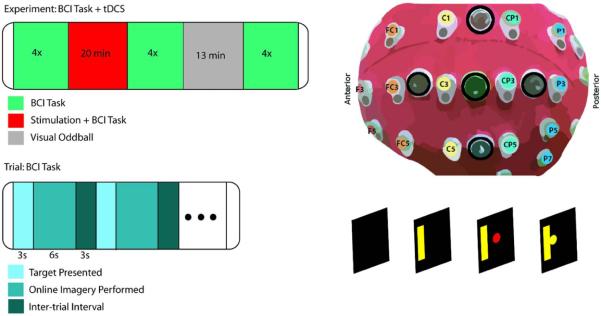
We utilize high-definition tDCS to investigate the effect of stimulation on motor imagery-based BCI performance across and within sessions over multiple training days.
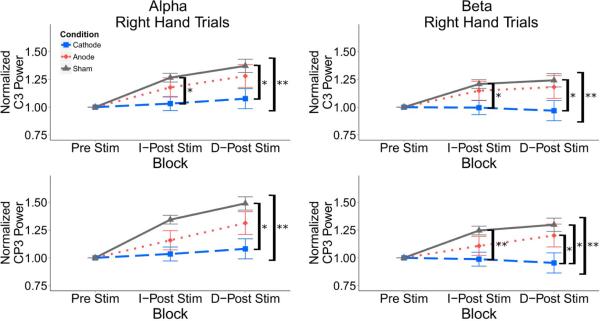
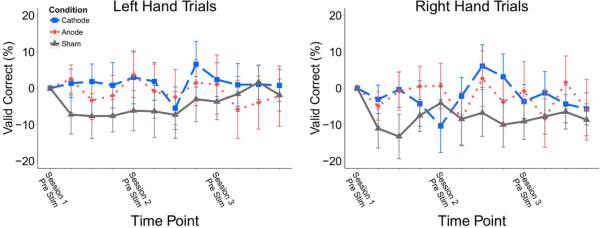
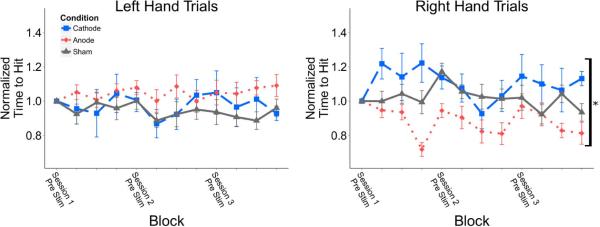
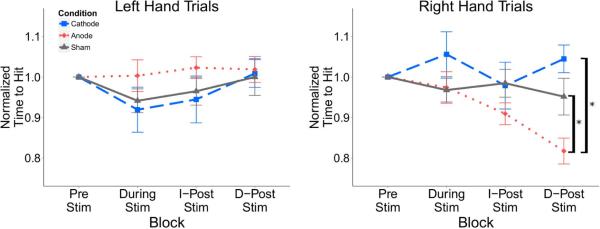
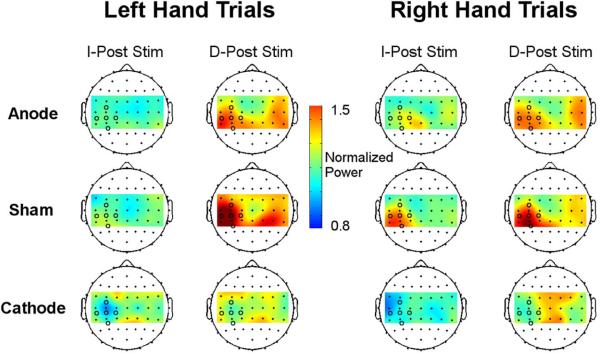
We report a decreased time-to-hit with anodal stimulation both within and across sessions. We also found differing electrophysiological changes of the stimulated sensorimotor cortex during online BCI task performance for left vs. right trials. Cathodal stimulation led to a decrease in alpha and beta band power during task performance compared to sham stimulation for right hand imagination trials.
These results suggest that unilateral tDCS over the sensorimotor motor cortex differentially affects cortical areas based on task specific neural activation.
经颅直流电刺激(tDCS)已被用于改变大脑皮层内神经元的兴奋性。多项研究发现,在任务学习之前或期间将tDCS应用于运动皮层时,运动学习能力会得到改善。在运动想象(一种认知任务,即一个人想象但不执行运动)过程中,运动皮层也会被激活。运动想象可与非侵入性脑机接口(BCI)配合使用,以控制多达三维的虚拟物体,但要掌握此类设备的控制需要较长的训练时间。
评估高清tDCS对基于运动想象的BCI性能及潜在电生理学的影响。
我们利用高清tDCS研究刺激在多个训练日的不同时段及各时段内对基于运动想象的BCI性能的影响。
我们报告了在各时段内及不同时段间,阳极刺激均使击中目标的时间减少。我们还发现在线BCI任务执行期间,针对左侧与右侧试验,受刺激的感觉运动皮层的电生理变化存在差异。与假刺激相比,阴极刺激导致右手想象试验任务执行期间α和β波段功率降低。
这些结果表明,感觉运动皮层上的单侧tDCS根据任务特定的神经激活对皮层区域产生不同影响。