Ahnert Peter, Creutz Petra, Scholz Markus, Schütte Hartwig, Engel Christoph, Hossain Hamid, Chakraborty Trinad, Bauer Michael, Kiehntopf Michael, Völker Uwe, Hammerschmidt Sven, Loeffler Markus, Suttorp Norbert
Institute for Medical Informatics, Statistics, and Epidemiology (IMISE), Medical Faculty, University of Leipzig, Haertelstr. 16-18, 04107, Leipzig, Germany.
Department of Infectious Disease and Respiratory Medicine, Charité - University Medicine Berlin, Campus Virchowklinikum, Augustenburgerplatz 1, 13353, Berlin, Germany.
BMC Pulm Med. 2016 Jul 28;16(1):108. doi: 10.1186/s12890-016-0255-8.
Community acquired pneumonia (CAP) is a high incidence disease resulting in about 260,000 hospital admissions per year in Germany, more than myocardial infarction or stroke. Worldwide, CAP is the most frequent infectious disease with high lethality ranging from 1.2 % in those 20-29 years old to over 10 % in patients older than 70 years, even in industrial nations. CAP poses numerous medical challenges, which the PROGRESS (Pneumonia Research Network on Genetic Resistance and Susceptibility for the Evolution of Severe Sepsis) network aims to tackle: Operationalization of disease severity throughout the course of disease, outcome prediction for hospitalized patients and prediction of transitions from uncomplicated CAP to severe CAP, and finally, to CAP with sepsis and organ failure as a life-threatening condition. It is a major aim of PROGRESS to understand and predict patient heterogeneity regarding outcome in the hospital and to develop novel treatment concepts.
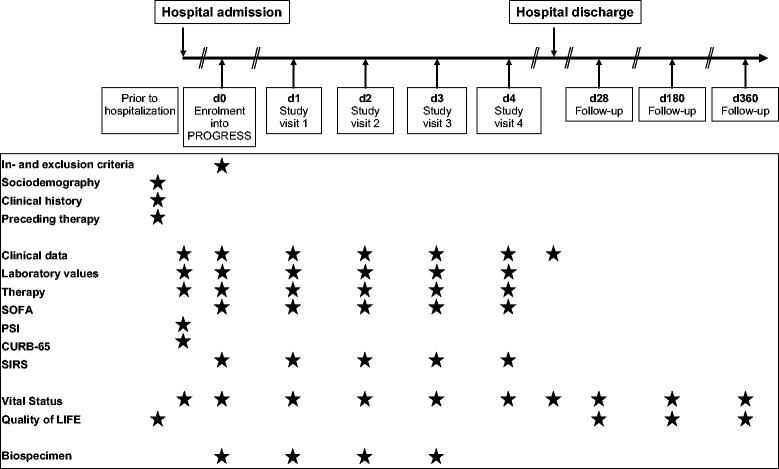
PROGRESS was designed as a clinical, observational, multi-center study of patients with CAP requiring hospitalization. More than 1600 patients selected for low burden of co-morbidities have been enrolled, aiming at a total of 3000. Course of disease, along with therapy, was closely monitored by daily assessments and long-term follow-up. Daily blood samples allow in depth molecular-genetic characterization of patients. We established a well-organized workflow for sample logistics and a comprehensive data management system to collect and manage data from more than 50 study centers in Germany and Austria. Samples are stored in a central biobank and clinical data are stored in a central data base which also integrates all data from molecular assessments.
With the PROGRESS study, we established a comprehensive data base of high quality clinical and molecular data allowing investigation of pressing research questions regarding CAP. In-depth molecular characterization will contribute to the discovery of disease mechanisms and establishment of diagnostic and predictive biomarkers. A strength of PROGRESS is the focus on younger patients with low burden of co-morbidities, allowing a more direct look at host biology with less confounding. As a resulting limitation, insights from PROGRESS will require validation in representative patient cohorts to assess clinical utility.
The PROGRESS study was retrospectively registered on May 24(th), 2016 with ClinicalTrials.gov: NCT02782013.
社区获得性肺炎(CAP)是一种高发病,在德国每年导致约26万例住院病例,超过心肌梗死或中风。在全球范围内,CAP是最常见的传染病,致死率很高,在20至29岁人群中为1.2%,在70岁以上患者中超过10%,即使在工业化国家也是如此。CAP带来了众多医学挑战,PROGRESS(严重脓毒症演变的遗传抗性和易感性肺炎研究网络)网络旨在应对这些挑战:在疾病全过程中对疾病严重程度进行操作化评估、对住院患者的预后进行预测以及对从非复杂性CAP向严重CAP的转变进行预测,最终,对伴有脓毒症和器官衰竭这一危及生命状况的CAP进行预测。了解并预测患者在医院预后的异质性以及开发新的治疗理念是PROGRESS的一个主要目标。
PROGRESS被设计为一项针对需要住院治疗的CAP患者的临床观察性多中心研究。已招募了1600多名合并症负担较轻的患者,目标是总共招募3000名。通过每日评估和长期随访密切监测疾病进程以及治疗情况。每日采集血样以便对患者进行深入的分子遗传学特征分析。我们建立了一个组织有序的样本物流工作流程以及一个全面的数据管理系统,以收集和管理来自德国和奥地利50多个研究中心的数据。样本存储在一个中央生物样本库中,临床数据存储在一个中央数据库中,该数据库还整合了来自分子评估的所有数据。
通过PROGRESS研究,我们建立了一个高质量临床和分子数据的综合数据库,可用于研究有关CAP的紧迫研究问题。深入的分子特征分析将有助于发现疾病机制并建立诊断和预测生物标志物。PROGRESS的一个优势是专注于合并症负担较轻的年轻患者,从而能够在较少混杂因素的情况下更直接地观察宿主生物学。作为一个由此产生的局限性,PROGRESS的见解需要在具有代表性的患者队列中进行验证,以评估其临床实用性。
PROGRESS研究于2016年5月24日在ClinicalTrials.gov上进行了回顾性注册:NCT02782013。