Betlazar Calina, Middleton Ryan J, Banati Richard B, Liu Guo-Jun
Bioanalytics group, Life Sciences, Australian Nuclear Science and Technology Organisation (ANSTO), New Illawarra Road, Lucas Heights, NSW 2234, Australia; Discipline of Medical Imaging & Radiation Sciences, Faculty of Health Sciences, The University of Sydney, 75 East Street, Lidcombe, NSW 2141, Australia.
Bioanalytics group, Life Sciences, Australian Nuclear Science and Technology Organisation (ANSTO), New Illawarra Road, Lucas Heights, NSW 2234, Australia.
Redox Biol. 2016 Oct;9:144-156. doi: 10.1016/j.redox.2016.08.002. Epub 2016 Aug 10.
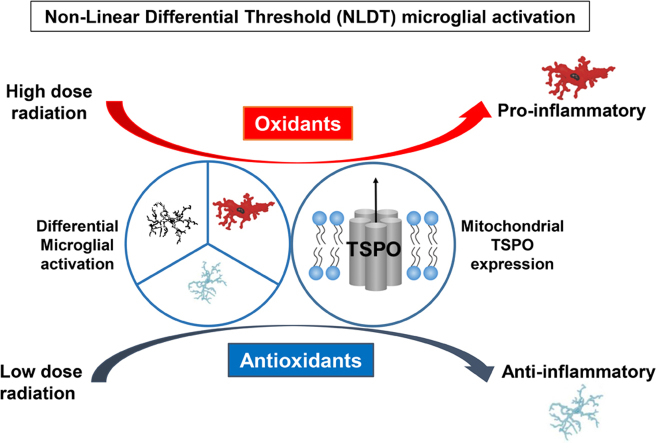
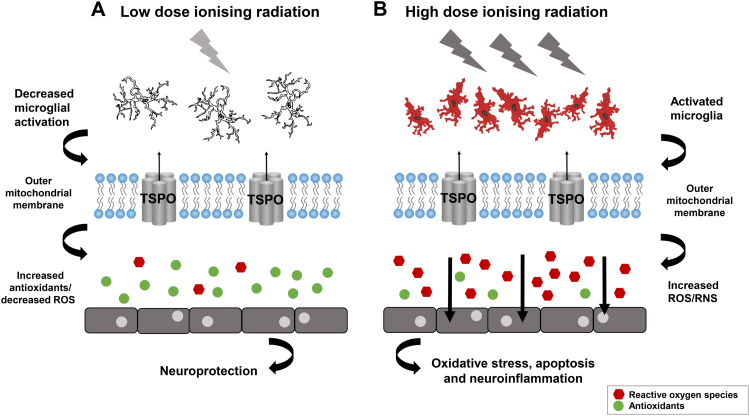
Responses of the central nervous system (CNS) to stressors and injuries, such as ionising radiation, are modulated by the concomitant responses of the brains innate immune effector cells, microglia. Exposure to high doses of ionising radiation in brain tissue leads to the expression and release of biochemical mediators of 'neuroinflammation', such as pro-inflammatory cytokines and reactive oxygen species (ROS), leading to tissue destruction. Contrastingly, low dose ionising radiation may reduce vulnerability to subsequent exposure of ionising radiation, largely through the stimulation of adaptive responses, such as antioxidant defences. These disparate responses may be reflective of non-linear differential microglial activation at low and high doses, manifesting as an anti-inflammatory or pro-inflammatory functional state. Biomarkers of pathology in the brain, such as the mitochondrial Translocator Protein 18kDa (TSPO), have facilitated in vivo characterisation of microglial activation and 'neuroinflammation' in many pathological states of the CNS, though the exact function of TSPO in these responses remains elusive. Based on the known responsiveness of TSPO expression to a wide range of noxious stimuli, we discuss TSPO as a potential biomarker of radiation-induced effects.
中枢神经系统(CNS)对诸如电离辐射等应激源和损伤的反应,会受到大脑固有免疫效应细胞——小胶质细胞的伴随反应的调节。脑组织暴露于高剂量电离辐射会导致“神经炎症”的生化介质表达和释放,如促炎细胞因子和活性氧(ROS),进而导致组织破坏。相反,低剂量电离辐射可能会降低后续暴露于电离辐射时的易感性,这主要是通过刺激适应性反应,如抗氧化防御来实现的。这些不同的反应可能反映了低剂量和高剂量下小胶质细胞的非线性差异激活,表现为抗炎或促炎功能状态。脑病理学的生物标志物,如线粒体转位蛋白18kDa(TSPO),有助于在体内表征中枢神经系统许多病理状态下的小胶质细胞激活和“神经炎症”,尽管TSPO在这些反应中的具体功能仍不清楚。基于TSPO表达对多种有害刺激的已知反应性,我们将TSPO作为辐射诱导效应的潜在生物标志物进行讨论。