Wilm Bettina, Tamburrini Riccardo, Orlando Giuseppe, Murray Patricia
Institute of Translational Medicine, Centre for Preclinical Imaging, University of Liverpool, Crown Street, Liverpool, L69 3BX UK.
Department of Surgery, Section of Transplantation, Wake Forest School of Medicine,Wake Forest Baptist Hospital, Medical Center Blvd, Winston Salem, NC 27157 USA.
Curr Transplant Rep. 2016;3:207-220. doi: 10.1007/s40472-016-0107-8. Epub 2016 Jun 9.
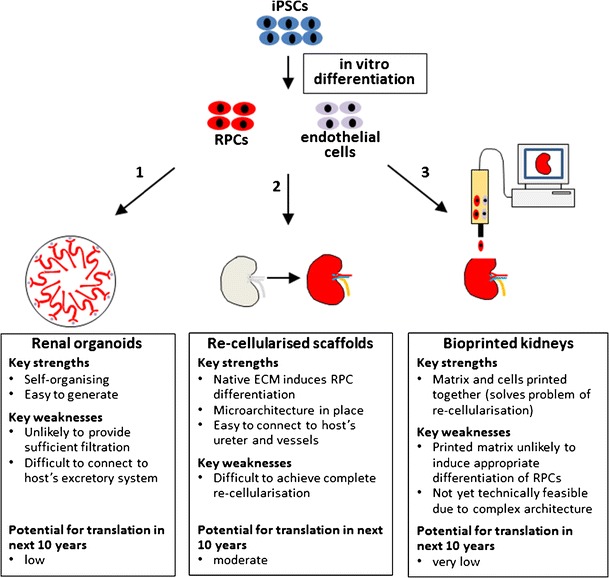
Worldwide, increasing numbers of patients are developing end-stage renal disease, and at present, the only treatment options are dialysis or kidney transplantation. Dialysis is associated with increased morbidity and mortality, poor life quality and high economic costs. Transplantation is by far the better option, but there are insufficient numbers of donor kidneys available. Therefore, there is an urgent need to explore alternative approaches. In this review, we discuss how this problem could potentially be addressed by using autologous cells and appropriate scaffolds to develop 'bioengineered' kidneys for transplantation. In particular, we will highlight recent breakthroughs in pluripotent stem cell biology that have led to the development of autologous renal progenitor cells capable of differentiating to all renal cell types and will discuss how these cells could be combined with appropriate scaffolds to develop a bioengineered kidney.
在全球范围内,越来越多的患者正发展为终末期肾病,目前,唯一的治疗选择是透析或肾脏移植。透析与发病率和死亡率增加、生活质量差以及高经济成本相关。移植是迄今为止更好的选择,但可用的供体肾脏数量不足。因此,迫切需要探索替代方法。在本综述中,我们讨论了如何通过使用自体细胞和合适的支架来开发用于移植的“生物工程”肾脏,从而潜在地解决这一问题。特别是,我们将重点介绍多能干细胞生物学的最新突破,这些突破已导致能够分化为所有肾细胞类型的自体肾祖细胞的开发,并将讨论如何将这些细胞与合适的支架结合以开发生物工程肾脏。