Whiddett Dick, Hunter Inga, McDonald Barry, Norris Tony, Waldon John
School of Management, College of Business, Massey University, Palmerston North, New Zealand.
Institute of Natural and Mathematical Sciences, Massey University, Auckland, New Zealand.
BMJ Open. 2016 Aug 23;6(8):e011640. doi: 10.1136/bmjopen-2016-011640.
In light of recent health policy, to examine factors which influence the public's willingness to consent to share their health information in a national electronic health record (EHR).
Data were collected in a national telephone survey in 2008. Respondents were presented with vignettes that described situations in which their health information was shared and asked if they would consent to such sharing. The subset, consisting of the 18 vignettes that covered proving care, was reanalysed in depth using new statistical methods in 2016.
Adult population of New Zealand accessible by telephone landline.
4209 adults aged 18+ years in the full data set, 2438 of which are included in the selected subset.
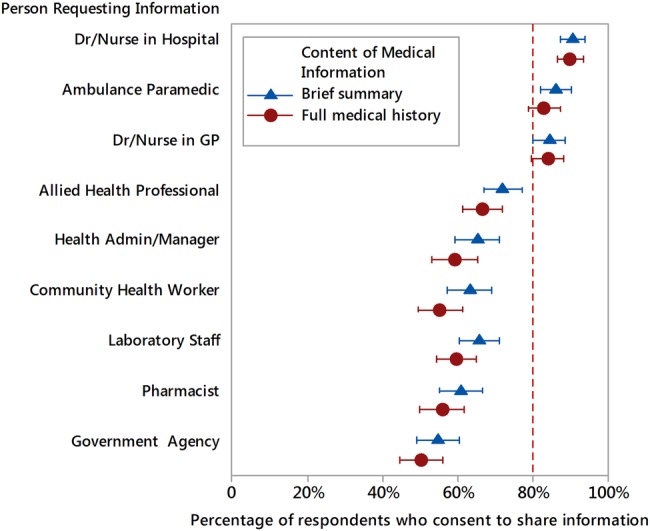
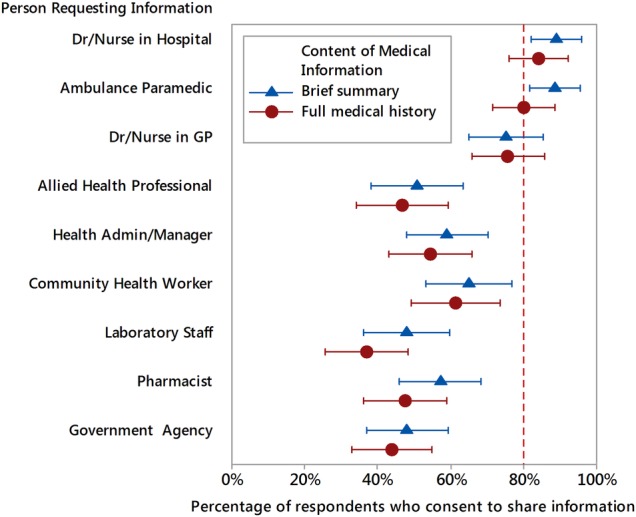
For each of 18 vignettes, we measured the percentage of respondents who would consent for their information to be shared for 2 groups; for those who did not consider that their records contained sensitive information, and for those who did or refused to say.
Rates of consent ranged from 89% (95% CI 87% to 92%) for sharing of information with hospital doctors and nurses to 51% (47% to 55%) for government agencies. Mixed-effects logistic regression was used to identify factors which had significant impact on consent. The role of the recipient and the level of detail influenced respondents' willingness to consent (p<0.0001 for both factors). Of the individual characteristics, the biggest impact was that respondents whose records contain sensitive information (or who refused to answer) were less willing to consent (p<0.0001).
A proportion of the population are reluctant to share their health information beyond doctors, nurses and paramedics, particularly when records contain sensitive information. These findings may have adverse implications for healthcare strategies based on widespread sharing of information. Further research is needed to understand and overcome peoples' ambivalence towards sharing their information.
鉴于近期的卫生政策,研究影响公众同意在国家电子健康记录(EHR)中共享其健康信息意愿的因素。
2008年通过全国电话调查收集数据。向受访者展示描述其健康信息被共享情况的短文,并询问他们是否会同意这种共享。2016年使用新的统计方法对包含18篇涉及提供医疗护理短文的子集进行了深入重新分析。
通过固定电话可联系到的新西兰成年人口。
完整数据集中有4209名18岁及以上成年人,其中2438人包含在选定子集中。
对于18篇短文中的每一篇,我们测量了两组受访者中同意共享其信息的百分比;一组是那些不认为自己的记录包含敏感信息的人,另一组是那些认为包含敏感信息或拒绝说明的人。
同意率从与医院医生和护士共享信息的89%(95%可信区间87%至92%)到与政府机构共享信息的51%(47%至55%)不等。使用混合效应逻辑回归来确定对同意有显著影响的因素。接收者的角色和细节程度影响受访者的同意意愿(两个因素的p值均<0.0001)。在个人特征方面,最大的影响是其记录包含敏感信息(或拒绝回答)的受访者不太愿意同意(p<0.0001)。
一部分人群不愿在医生、护士和护理人员之外共享其健康信息,尤其是当记录包含敏感信息时。这些发现可能对基于广泛信息共享的医疗保健策略产生不利影响。需要进一步研究以理解并克服人们在信息共享方面的矛盾态度。