
急性呼吸窘迫综合征患者吸气末暂停延长:对气体交换和力学的影响。
End-inspiratory pause prolongation in acute respiratory distress syndrome patients: effects on gas exchange and mechanics.
作者信息
Aguirre-Bermeo Hernan, Morán Indalecio, Bottiroli Maurizio, Italiano Stefano, Parrilla Francisco José, Plazolles Eugenia, Roche-Campo Ferran, Mancebo Jordi
机构信息
Servei de Medicina Intensiva, Hospital de la Santa Creu i Sant Pau, Universidad Autònoma de Barcelona (UAB), Sant Quintí, 89, 08041, Barcelona, Spain.
Anestesia e Rianimazione 3, Ospedale Niguarda Ca' Granda, Milan, Italy.
出版信息
Ann Intensive Care. 2016 Dec;6(1):81. doi: 10.1186/s13613-016-0183-z. Epub 2016 Aug 24.
BACKGROUND
End-inspiratory pause (EIP) prolongation decreases dead space-to-tidal volume ratio (Vd/Vt) and PaCO2. We do not know the physiological benefits of this approach to improve respiratory system mechanics in acute respiratory distress syndrome (ARDS) patients when mild hypercapnia is of no concern.
METHODS
The investigation was conducted in an intensive care unit of a university hospital, and 13 ARDS patients were included. The study was designed in three phases. First phase, baseline measurements were taken. Second phase, the EIP was prolonged until one of the following was achieved: (1) EIP of 0.7 s; (2) intrinsic positive end-expiratory pressure ≥1 cmH2O; or (3) inspiratory-expiratory ratio 1:1. Third phase, the Vt was decreased (30 mL every 30 min) until PaCO2 equal to baseline was reached. FiO2, PEEP, airflow and respiratory rate were kept constant.
RESULTS
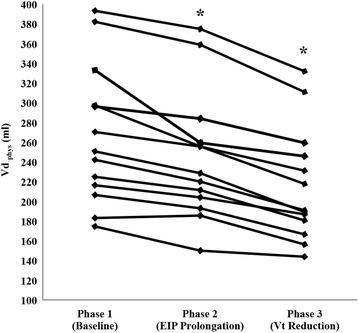
EIP was prolonged from 0.12 ± 0.04 to 0.7 s in all patients. This decreased the Vd/Vt and PaCO2 (0.70 ± 0.07 to 0.64 ± 0.08, p < 0.001 and 54 ± 9 to 50 ± 8 mmHg, p = 0.001, respectively). In the third phase, the decrease in Vt (from 6.3 ± 0.8 to 5.6 ± 0.8 mL/Kg PBW, p < 0.001) allowed to decrease plateau pressure and driving pressure (24 ± 3 to 22 ± 3 cmH2O, p < 0.001 and 13.4 ± 3.6 to 10.9 ± 3.1 cmH2O, p < 0.001, respectively) and increased respiratory system compliance from 29 ± 9 to 32 ± 11 mL/cmH2O (p = 0.001). PaO2 did not significantly change.
CONCLUSIONS
Prolonging EIP allowed a significant decrease in Vt without changes in PaCO2 in passively ventilated ARDS patients. This produced a significant decrease in plateau pressure and driving pressure and significantly increased respiratory system compliance, which suggests less overdistension and less dynamic strain.
背景
吸气末暂停(EIP)延长可降低死腔与潮气量之比(Vd/Vt)及动脉血二氧化碳分压(PaCO2)。在急性呼吸窘迫综合征(ARDS)患者中,当对轻度高碳酸血症无需担忧时,我们尚不清楚这种改善呼吸系统力学的方法所带来的生理益处。
方法
研究在一所大学医院的重症监护病房进行,纳入了13例ARDS患者。该研究分为三个阶段设计。第一阶段,进行基线测量。第二阶段,延长EIP直至达到以下情况之一:(1)EIP为0.7秒;(2)内源性呼气末正压≥1厘米水柱;或(3)吸呼比为1:1。第三阶段,降低潮气量(每30分钟降低30毫升)直至PaCO2达到基线水平。吸氧浓度(FiO2)、呼气末正压(PEEP)、气流和呼吸频率保持恒定。
结果
所有患者的EIP从0.12±0.04秒延长至0.7秒。这降低了Vd/Vt及PaCO2(分别从0.70±0.07降至0.64±0.08,p<0.001;从54±9降至50±8毫米汞柱,p=0.001)。在第三阶段,潮气量的降低(从6.3±0.8降至5.6±0.8毫升/千克理想体重,p<0.001)使得平台压和驱动压降低(分别从24±3降至22±3厘米水柱,p<0.001;从13.4±3.6降至10.9±3.1厘米水柱,p<0.001),呼吸系统顺应性从29±9提高至32±11毫升/厘米水柱(p=0.001)。动脉血氧分压(PaO2)无显著变化。
结论
在被动通气的ARDS患者中,延长EIP可在不改变PaCO2的情况下显著降低潮气量。这使得平台压和驱动压显著降低,呼吸系统顺应性显著提高,这表明过度扩张和动态应变减少。

 Zotero 插件