Kazimierczak Anna, Krzesiński Paweł, Gielerak Grzegorz, Uziębło-Życzkowska Beata, Smurzyński Paweł, Ryczek Robert, Cwetsch Andrzej, Skrobowski Andrzej
Department of Cardiology and Internal Diseases, Military Institute of Medicine, Warsaw, Poland.
Med Sci Monit. 2016 Aug 25;22:2989-98. doi: 10.12659/msm.899632.
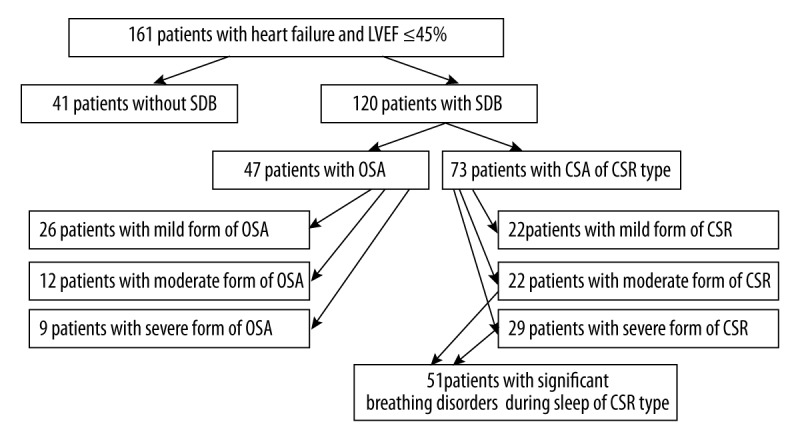
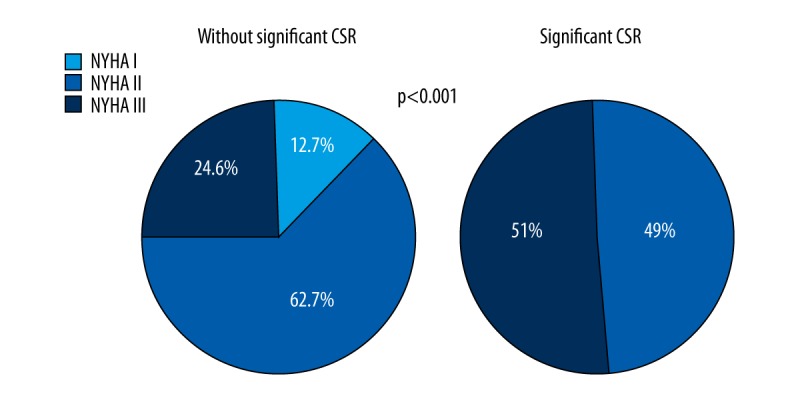
BACKGROUND Advanced heart failure (HF) is commonly accompanied by central sleep apnea (CSA) with Cheyne-Stokes respiration (CSR). The aim of this study was to evaluate the relationship between CSA/CSR and other clinical features of HF, with particular emphasis on cardiovascular hemodynamics. MATERIAL AND METHODS In 161 stable HF patients with left ventricular ejection fraction (LVEF) ≤45% (NYHA class I-III; mean LVEF 32.8%) the clinical evaluation included: LVEF; left and right ventricular end-diastolic diameter (LVDd, RVDd); ratio of early transmitral flow velocity to early diastolic septal mitral annulus velocity (E/e') assessed by echocardiography; stroke index (SI); heart rate (HR); cardiac index (CI); and systemic vascular resistance index (SVRI) assessed by impedance cardiography (ICG). The comparison was performed between 2 subgroups: one with moderate/severe CSA/CSR - CSR_ [+] (n=51), and one with mild or no CSA/CSR - CSR_ [-] (n=110). RESULTS CSR_ [+] patients presented more advanced NYHA class (p<0.001) and more frequently had permanent atrial fibrillation (p=0.018). Moreover, they had: lower LVEF (p<0.0001); higher LVDd (p<0.0001), RVDd (p<0.001), and E/e' (p<0.001); lower SI (p<0.001) and CI (p=0.009); and higher HR (p=0.044) and SVRI (p=0.016). The following predictors of CSR_ [+] were identified: NYHA class (OR=3.34 per class, p<0.001, which was the only independent predictor); atrial fibrillation (OR=2.29, p=0.019); RV enlargement (OR=2.75, p=0.005); LVEF<35% (OR=3.38, p=0.001); E/e' (OR=3.15; p=0.003); and SI<35 ml/m2 (OR=2.96, p=0.003). CONCLUSIONS Presence of CSA/CSR in HF is associated with NYHA class, atrial fibrillation and more advanced impairment of cardiovascular structure and hemodynamics. Patient functional state remains the main determinant of CSR.
晚期心力衰竭(HF)常伴有中枢性睡眠呼吸暂停(CSA)及陈-施呼吸(CSR)。本研究旨在评估CSA/CSR与HF其他临床特征之间的关系,尤其着重于心血管血流动力学。
161例左心室射血分数(LVEF)≤45%的稳定HF患者(纽约心脏协会心功能分级I-III级;平均LVEF 32.8%),临床评估包括:LVEF;左、右心室舒张末期内径(LVDd、RVDd);经超声心动图评估的二尖瓣血流舒张早期峰值流速与二尖瓣环舒张早期运动速度比值(E/e');每搏指数(SI);心率(HR);心脏指数(CI);以及经阻抗心动图(ICG)评估的全身血管阻力指数(SVRI)。对两个亚组进行比较:一个是中度/重度CSA/CSR组——CSR_ [+](n = 51),另一个是轻度或无CSA/CSR组——CSR_ [-](n = 110)。
CSR_ [+]组患者纽约心脏协会心功能分级更高(p < 0.001),永久性心房颤动更为常见(p = 0.018)。此外,他们有:更低的LVEF(p < 0.0001);更高的LVDd(p < 0.0001)、RVDd(p < 0.001)和E/e'(p < 0.001);更低的SI(p < 0.001)和CI(p = 0.009);以及更高的HR(p = 0.044)和SVRI(p = 0.016)。确定了以下CSR_ [+]的预测因素:纽约心脏协会心功能分级(每升高一级OR = 3.34,p < 0.001,这是唯一的独立预测因素);心房颤动(OR = 2.29,p = 0.