Mazeri Stella, Sargison Neil, Kelly Robert F, Bronsvoort Barend M deC, Handel Ian
The Roslin Institute, University of Edinburgh, Edinburgh, United Kingdom.
Royal (Dick) School of Veterinary Studies, University of Edinburgh, Edinburgh, United Kingdom.
PLoS One. 2016 Aug 26;11(8):e0161621. doi: 10.1371/journal.pone.0161621. eCollection 2016.
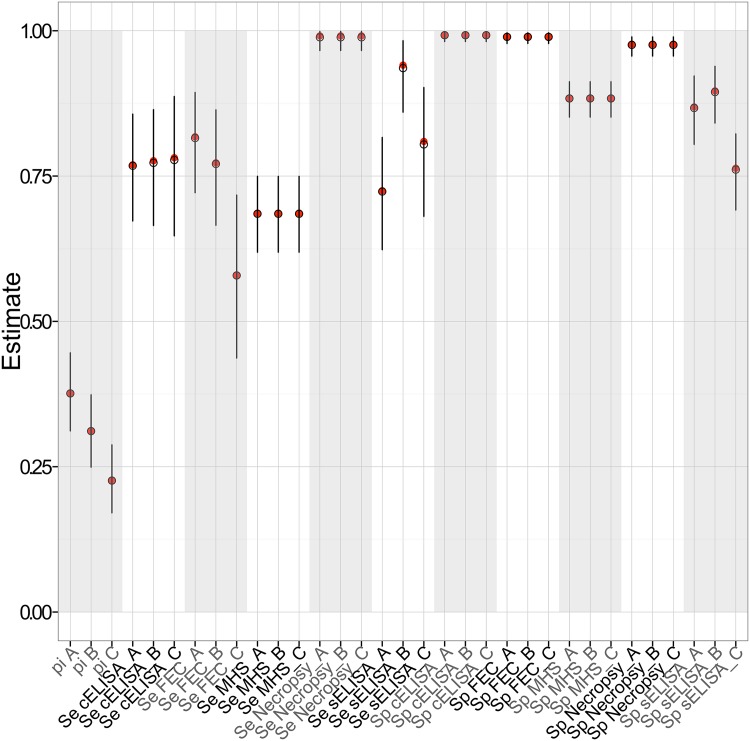
The clinical and economic importance of fasciolosis has been recognised for centuries, yet diagnostic tests available for cattle are far from perfect. Test evaluation has mainly been carried out using gold standard approaches or under experimental settings, the limitations of which are well known. In this study, a Bayesian no gold standard approach was used to estimate the diagnostic sensitivity and specificity of five tests for fasciolosis in cattle. These included detailed liver necropsy including gall bladder egg count, faecal egg counting, a commercially available copro-antigen ELISA, an in-house serum excretory/secretory antibody ELISA and routine abattoir liver inspection. In total 619 cattle slaughtered at one of Scotland's biggest abattoirs were sampled, during three sampling periods spanning summer 2013, winter 2014 and autumn 2014. Test sensitivities and specificities were estimated using an extension of the Hui Walter no gold standard model, where estimates were allowed to vary between seasons if tests were a priori believed to perform differently for any reason. The results of this analysis provide novel information on the performance of these tests in a naturally infected cattle population and at different times of the year where different levels of acute or chronic infection are expected. Accurate estimates of sensitivity and specificity will allow for routine abattoir liver inspection to be used as a tool for monitoring the epidemiology of F. hepatica as well as evaluating herd health planning. Furthermore, the results provide evidence to suggest that the copro-antigen ELISA does not cross-react with Calicophoron daubneyi rumen fluke parasites, while the serum antibody ELISA does.
几个世纪以来,人们已经认识到肝片吸虫病的临床和经济重要性,但现有的牛诊断测试远非完美。测试评估主要是使用金标准方法或在实验环境下进行的,其局限性众所周知。在本研究中,采用贝叶斯无金标准方法来估计牛肝片吸虫病五种检测方法的诊断敏感性和特异性。这些方法包括详细的肝脏尸检(包括胆囊虫卵计数)、粪便虫卵计数、一种市售的粪便抗原酶联免疫吸附测定(ELISA)、一种自制的血清排泄/分泌抗体ELISA以及常规屠宰场肝脏检查。在2013年夏季、2014年冬季和2014年秋季这三个采样期内,对在苏格兰最大的一家屠宰场宰杀的619头牛进行了采样。使用Hui Walter无金标准模型的扩展来估计测试的敏感性和特异性,如果基于先验认为测试因任何原因表现不同,则允许估计值在不同季节之间有所变化。该分析结果提供了关于这些检测方法在自然感染牛群中以及在一年中不同时间(预期有不同程度的急性或慢性感染)表现的新信息。准确估计敏感性和特异性将使常规屠宰场肝脏检查能够用作监测肝片吸虫流行病学以及评估畜群健康规划的工具。此外,结果提供了证据表明粪便抗原ELISA与道氏杯殖吸虫瘤胃吸虫寄生虫不会发生交叉反应,而血清抗体ELISA会。