Cao Hong, Huang Yunxiu, Wang Lin, Wang Hong, Pang Xueli, Li Kuangfa, Dang Weiqi, Tang Hao, Wei Lan, Su Min, Tang Cuiping, Chen Tingmei
Department of Laboratory Medicine Key Laboratory of Diagnostic Medicine, Ministry of Education Chongqing Medical University, Chongqing, China.
Oncotarget. 2016 Oct 4;7(40):65441-65453. doi: 10.18632/oncotarget.11761.
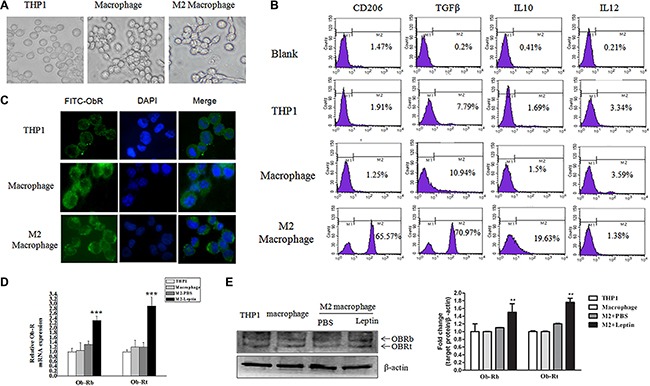
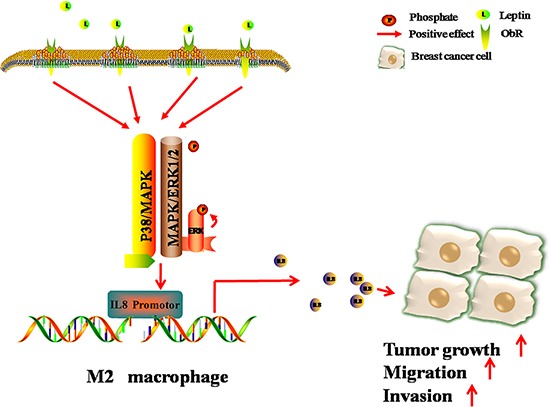
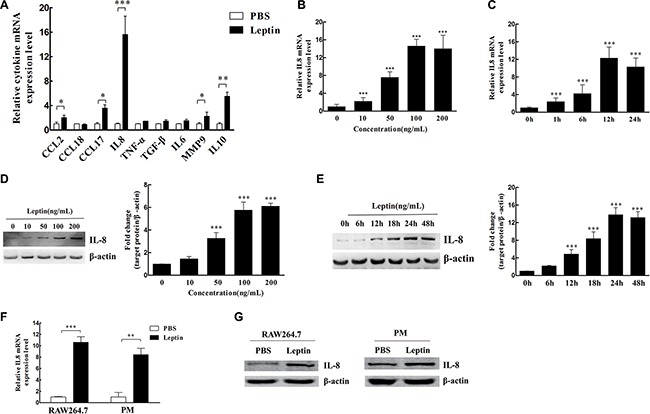
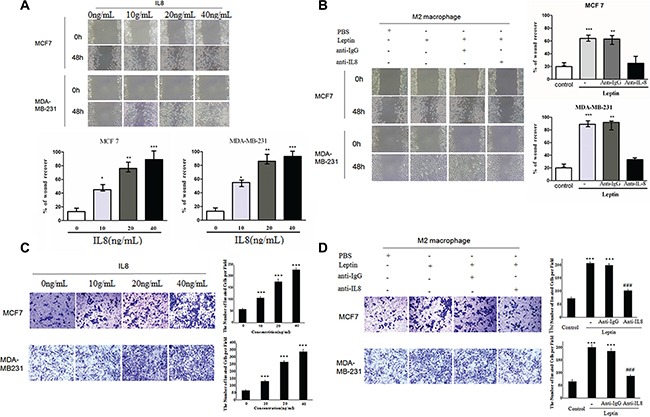
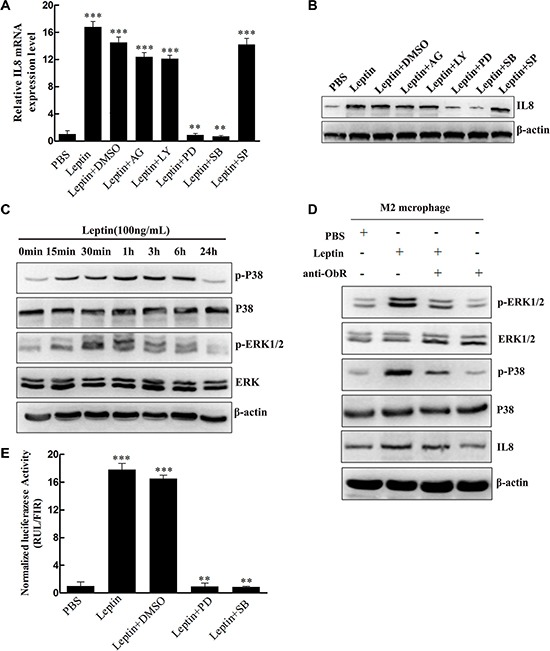
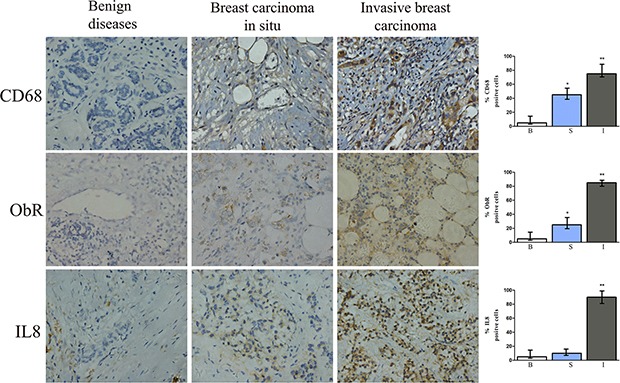
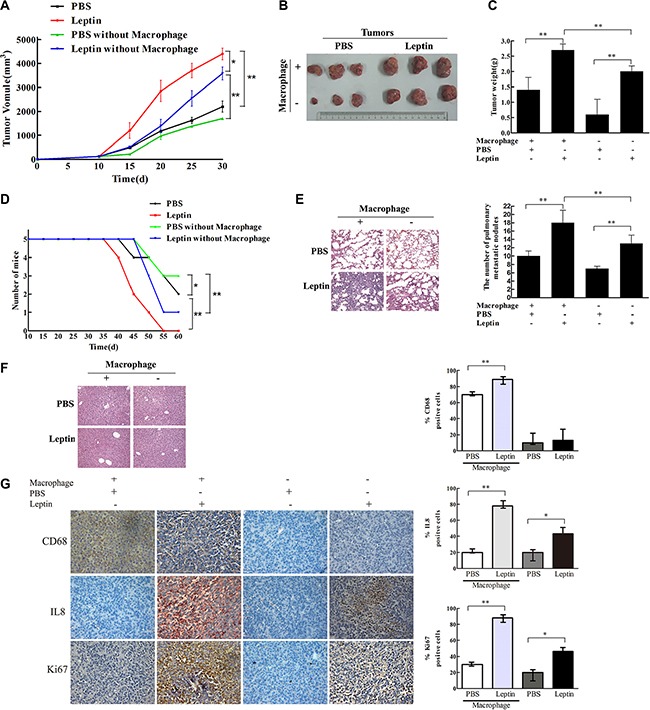
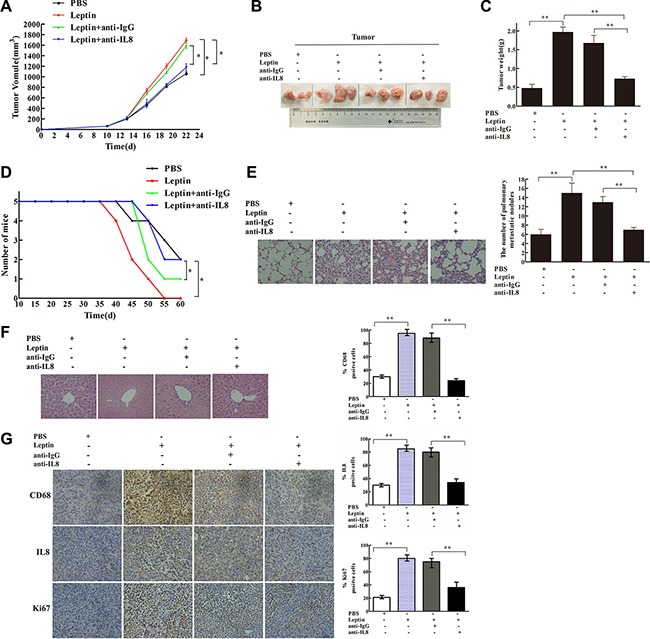
This study aims to investigate the mechanisms underlying leptin-mediated crosstalk between tumor-associated macrophages (M2 macrophages) and breast cancer cells. THP1 human leukemic monocytes were induced to differentiate into M2 macrophages by PMA (100 nM) and IL-4 (20 ng/mL). Quantitative RT-PCR and Western blot revealed that leptin (100 nM) significantly increased the expression of leptin receptor (ObR) in the M2 macrophages (P < 0.01) and stimulated interleukin (IL)-8 expression in the M2 macrophages, mouse macrophage cells RAW264.7, and primary mouse peritoneal macrophages in a dose- and time-dependent manner. Leptin-induced IL-8 production was sensitive to the ERK inhibitor PD980590 (10 μmol/L), p38 MAPK inhibitor SB203580 (20 μmol/L), and anti-ObR neutralizing antibody (4 μg/mL). Leptin (100 ng/mL) substantially increased the phosphorylation of p38 and ERK1/2. Thus, leptin may induce IL-8 production in M2 macrophages by interacting with ObR to activate the p38 and ERK signaling pathways. Scratch and transwell chamber assay showed that both recombinant IL-8 and leptin-induced M2 macrophage-derived IL-8 promoted the migration and invasion of human breast cancer cells MCF7 and MDA-MB-231 (All P < 0.01). In a nude mice xenograft model of breast cancer (n = 5 per group), injection of leptin (0.1 μg/g) dramatically increased tumor volume and mass, reduced survival, exacerbated pulmonary metastasis, and elevated IL-8 and Ki67 expression in the tumor tissue (All P < 0.05) compared with PBS injection. Depletion of mouse macrophage by Clophosome®-clodronate liposome and injection of anti-mouse IL-8 neutralizing antibodies in the xenograft tumor significantly attenuated those leptin-mediated stimulations (All P < 0.05). These findings indicate that leptin may promote tumor growth and metastasis by stimulating IL-8 production in tumor-associated macrophage.
本研究旨在探究瘦素介导的肿瘤相关巨噬细胞(M2巨噬细胞)与乳腺癌细胞之间相互作用的潜在机制。通过佛波酯(PMA,100 nM)和白细胞介素-4(IL-4,20 ng/mL)诱导THP1人白血病单核细胞分化为M2巨噬细胞。定量逆转录聚合酶链反应(qRT-PCR)和蛋白质免疫印迹法(Western blot)结果显示,瘦素(100 nM)显著增加了M2巨噬细胞中瘦素受体(ObR)的表达(P < 0.01),并以剂量和时间依赖的方式刺激了M2巨噬细胞、小鼠巨噬细胞RAW264.7以及原代小鼠腹腔巨噬细胞中白细胞介素-8(IL-8)的表达。瘦素诱导的IL-8生成对细胞外信号调节激酶(ERK)抑制剂PD980590(10 μmol/L)、p38丝裂原活化蛋白激酶(MAPK)抑制剂SB203580(20 μmol/L)以及抗ObR中和抗体(4 μg/mL)敏感。瘦素(100 ng/mL)显著增加了p38和ERK1/2的磷酸化水平。因此,瘦素可能通过与ObR相互作用激活p38和ERK信号通路,从而诱导M2巨噬细胞产生IL-8。划痕实验和Transwell小室实验表明,重组IL-8以及瘦素诱导M2巨噬细胞产生的IL-8均促进了人乳腺癌细胞MCF7和MDA-MB-231的迁移和侵袭(所有P < 0.01)。在乳腺癌裸鼠异种移植模型(每组n = 5)中,与注射磷酸盐缓冲液(PBS)相比,注射瘦素(0.1 μg/g)显著增加了肿瘤体积和质量,降低了生存率,加剧了肺转移,并提高了肿瘤组织中IL-8和Ki67的表达(所有P < 0.05)。通过氯膦酸二钠脂质体(Clophosome®-clodronate liposome)清除小鼠巨噬细胞,并在异种移植肿瘤中注射抗小鼠IL-8中和抗体,可显著减弱瘦素介导的这些刺激作用(所有P < 0.05)。这些研究结果表明,瘦素可能通过刺激肿瘤相关巨噬细胞产生IL-8来促进肿瘤生长和转移。