Ngufor Corine, Critchley Jessica, Fagbohoun Josias, N'Guessan Raphael, Todjinou Damien, Rowland Mark
London School of Hygiene and Tropical Medicine (LSHTM), London, United Kingdom.
Centre de Recherches Entomologiques de Cotonou (CREC), Cotonou, Benin.
PLoS One. 2016 Sep 2;11(9):e0162210. doi: 10.1371/journal.pone.0162210. eCollection 2016.
Indoor spraying of walls and ceilings with residual insecticide remains a primary method of malaria control. Insecticide resistance in malaria vectors is a growing problem. Novel insecticides for indoor residual spraying (IRS) which can improve the control of pyrethroid resistant malaria vectors are urgently needed. Insecticide mixtures have the potential to improve efficacy or even to manage resistance in some situations but this possibility remains underexplored experimentally. Chlorfenapyr is a novel pyrrole insecticide which has shown potential to improve the control of mosquitoes which are resistant to current WHO-approved insecticides.
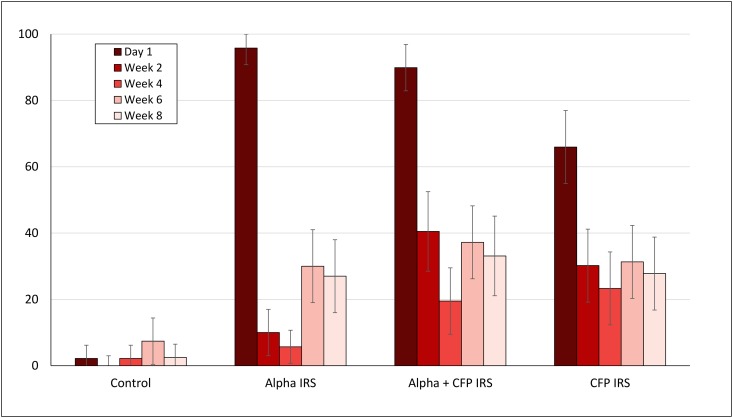
The efficacy of IRS with chlorfenapyr applied alone or as a mixture with alpha-cypermeththrin (a pyrethroid) was evaluated in experimental huts in Cove, Southern Benin against wild free flying pyrethroid resistant Anopheles gambiae sl. Comparison was made with IRS with alpha-cypermethrin alone. Fortnightly 30-minute in situ cone bioassays were performed to assess the residual efficacy of the insecticides on the treated hut walls.
Survival rates of wild An gambiae from the Cove hut site in WHO resistance bioassays performed during the trial were >90% with permethrin and deltamethrin treated papers. Mortality of free-flying mosquitoes entering the experimental huts was 4% in the control hut. Mortality with alpha-cypermethrin IRS did not differ from the control (5%, P>0.656). The highest mortality was achieved with chlorfenapyr alone (63%). The alpha-cypermethrin + chlorfenapyr mixture killed fewer mosquitoes than chlorfenapyr alone (43% vs. 63%, P<0.001). While the cone bioassays showed a more rapid decline in residual mortality with chlorfenapyr IRS to <30% after only 2 weeks, fortnightly mortality rates of wild free-flying An gambiae entering the chlorfenapyr IRS huts were consistently high (50-70%) and prolonged, lasting over 4 months.
IRS with chlorfenapyr shows potential to significantly improve the control of malaria transmission in pyrethroid resistant areas compared to pyrethroid IRS or the mixture. Thirty minute in situ cone bioassays are not predictive of the performance of chlorfenapyr IRS under field conditions.
在墙壁和天花板上喷洒残留杀虫剂仍然是疟疾控制的主要方法。疟疾病媒的杀虫剂抗性问题日益严重。迫切需要新型室内残留喷洒(IRS)杀虫剂,以改善对拟除虫菊酯抗性疟疾病媒的控制。杀虫剂混合物有可能提高药效,甚至在某些情况下控制抗性,但这种可能性在实验中仍未得到充分探索。氯虫苯甲酰胺是一种新型吡咯类杀虫剂,已显示出改善对目前世界卫生组织批准的杀虫剂具有抗性的蚊子控制效果的潜力。
在贝宁南部科夫的实验小屋中,评估单独使用氯虫苯甲酰胺或与高效氯氰菊酯(一种拟除虫菊酯)混合进行室内残留喷洒对野生自由飞行的拟除虫菊酯抗性冈比亚按蚊复合组的效果。与仅使用高效氯氰菊酯进行室内残留喷洒作比较。每两周进行一次30分钟的原位锥形生物测定,以评估杀虫剂在处理过的小屋墙壁上的残留效果。
在试验期间进行的世卫组织抗性生物测定中,来自科夫小屋地点的野生冈比亚按蚊在用氯菊酯和溴氰菊酯处理过的纸片上的存活率>90%。进入对照小屋的自由飞行蚊子的死亡率为4%。使用高效氯氰菊酯进行室内残留喷洒的死亡率与对照无差异(5%,P>0.656)。单独使用氯虫苯甲酰胺时死亡率最高(63%)。高效氯氰菊酯+氯虫苯甲酰胺混合物杀死的蚊子比单独使用氯虫苯甲酰胺少(43%对63%,P<0.001)。虽然锥形生物测定显示,仅2周后,氯虫苯甲酰胺室内残留喷洒的残留死亡率迅速下降至<30%,但进入氯虫苯甲酰胺室内残留喷洒小屋野生自由飞行的冈比亚按蚊的每两周死亡率持续较高(50 - 70%),且持续时间延长,超过4个月。
与拟除虫菊酯室内残留喷洒或混合物相比,氯虫苯甲酰胺室内残留喷洒显示出显著改善拟除虫菊酯抗性地区疟疾传播控制的潜力。30分钟的原位锥形生物测定不能预测氯虫苯甲酰胺室内残留喷洒在田间条件下的效果。