Krasny Lukas, Paul Angela, Wai Patty, Howard Beatrice A, Natrajan Rachael C, Huang Paul H
Division of Cancer Biology, The Institute of Cancer Research, 237 Fulham Road, London SW3 6JB, U.K.
Proteomics Core Facility, The Institute of Cancer Research, London SW3 6JB, U.K.
Biochem J. 2016 Nov 1;473(21):3979-3995. doi: 10.1042/BCJ20160686. Epub 2016 Sep 2.
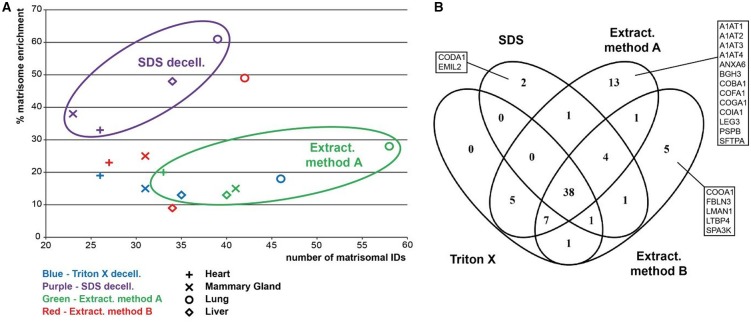
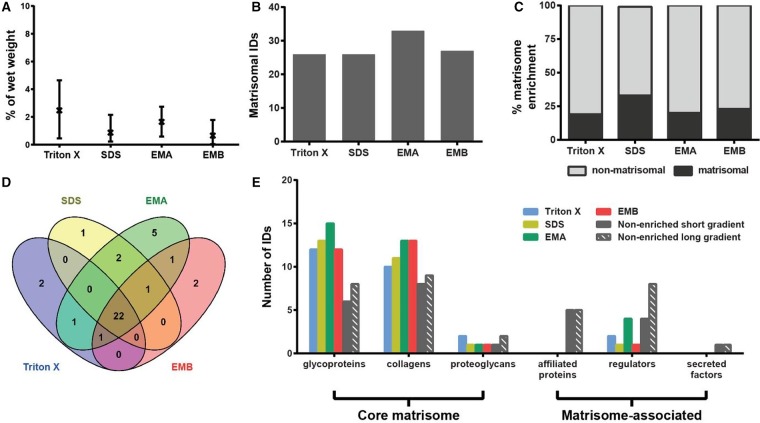
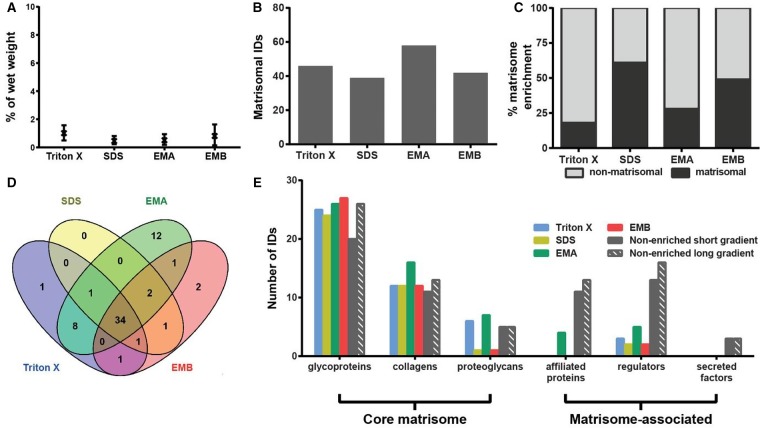
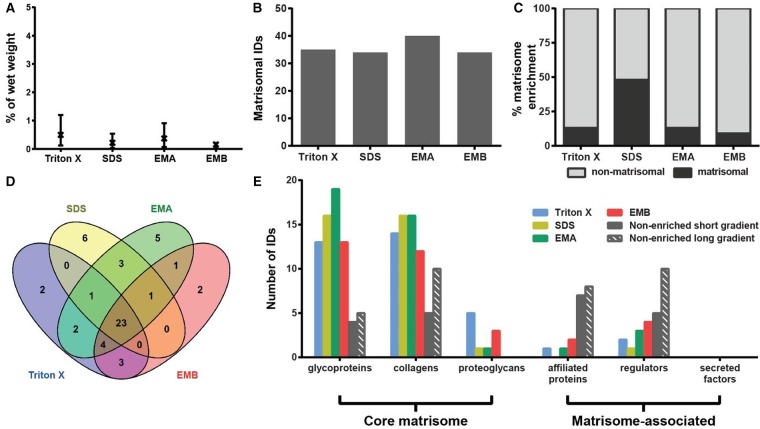
The matrisome is a complex and heterogeneous collection of extracellular matrix (ECM) and ECM-associated proteins that play important roles in tissue development and homeostasis. While several strategies for matrisome enrichment have been developed, it is currently unknown how the performance of these different methodologies compares in the proteomic identification of matrisome components across multiple tissue types. In the present study, we perform a comparative proteomic assessment of two widely used decellularisation protocols and two extraction methods to characterise the matrisome in four murine organs (heart, mammary gland, lung and liver). We undertook a systematic evaluation of the performance of the individual methods on protein yield, matrisome enrichment capability and the ability to isolate core matrisome and matrisome-associated components. Our data find that sodium dodecyl sulphate (SDS) decellularisation leads to the highest matrisome enrichment efficiency, while the extraction protocol that comprises chemical and trypsin digestion of the ECM fraction consistently identifies the highest number of matrisomal proteins across all types of tissue examined. Matrisome enrichment had a clear benefit over non-enriched tissue for the comprehensive identification of matrisomal components in murine liver and heart. Strikingly, we find that all four matrisome enrichment methods led to significant losses in the soluble matrisome-associated proteins across all organs. Our findings highlight the multiple factors (including tissue type, matrisome class of interest and desired enrichment purity) that influence the choice of enrichment methodology, and we anticipate that these data will serve as a useful guide for the design of future proteomic studies of the matrisome.
基质组是细胞外基质(ECM)和与ECM相关的蛋白质的复杂且异质的集合,它们在组织发育和内环境稳态中发挥重要作用。虽然已经开发了几种富集基质组的策略,但目前尚不清楚这些不同方法在跨多种组织类型进行基质组成分的蛋白质组学鉴定中的表现如何比较。在本研究中,我们对两种广泛使用的脱细胞方案和两种提取方法进行了比较蛋白质组学评估,以表征四种小鼠器官(心脏、乳腺、肺和肝脏)中的基质组。我们对各个方法在蛋白质产量、基质组富集能力以及分离核心基质组和基质组相关成分的能力方面的性能进行了系统评估。我们的数据发现,十二烷基硫酸钠(SDS)脱细胞导致最高的基质组富集效率,而包括对ECM部分进行化学和胰蛋白酶消化的提取方案在所有检查的组织类型中始终鉴定出最多数量的基质组蛋白。在全面鉴定小鼠肝脏和心脏中的基质组成分方面,基质组富集相对于未富集的组织具有明显优势。引人注目的是,我们发现所有四种基质组富集方法都导致所有器官中可溶性基质组相关蛋白的显著损失。我们的研究结果突出了影响富集方法选择的多个因素(包括组织类型、感兴趣的基质组类别和所需的富集纯度),并且我们预计这些数据将为未来基质组蛋白质组学研究的设计提供有用的指导。